
Professional services that organize unsecured debts and review consumer credit records typically help individuals manage repayment and identify report inaccuracies. These services may work by consolidating multiple account balances into one payment plan, negotiating altered terms with creditors, assisting with formal dispute submissions to credit reporting agencies, or advising on the mechanics of credit reports and score factors. In the United States these activities are subject to federal statutes and agency oversight that shape how providers operate and how consumers may exercise rights.
Providers offering consolidation or credit-report assistance commonly include banks, credit unions, licensed debt settlement firms, and nonprofit credit counseling agencies. The specific methods used vary: some facilitate a single loan to cover multiple accounts, others administer a managed repayment plan that distributes funds to creditors, while credit reporting assistance often involves reviewing reports from Experian, Equifax, and TransUnion and preparing dispute documentation under the Fair Credit Reporting Act (FCRA). Outcomes and timelines may differ depending on account types and the approach chosen.

Comparing these examples reveals differences in structure and likely consumer experiences. A consolidation loan typically replaces several accounts with one lender relationship and may alter monthly payment amounts and interest accrued over the loan term. A DMP administered by a nonprofit counselor often focuses on unsecured consumer accounts and may require an enrollment period with monthly deposits to a plan administrator. Debt settlement typically involves negotiation that may lead to partial debt forgiveness but can extend timelines and affect reporting. Assistance with credit report disputes focuses on accuracy of information rather than changing contractual debt terms.
Credit reporting and dispute processes in the United States are governed by FCRA and related rules that define consumer rights and furnishers’ responsibilities. Consumers may obtain free credit reports via AnnualCreditReport.gov and may file disputes directly with each bureau; professional services typically assemble documentation and submit disputes as a facilitator. Providers that operate in this space may also be subject to the Credit Repair Organizations Act (CROA), which imposes specific requirements on companies that claim to improve credit records, including disclosure and payment timing rules enforced by the FTC.
When evaluating operational details, timelines often vary: consolidation loans may have a usual repayment term between two and seven years depending on lender and loan type; DMPs commonly last several years until enrolled balances are paid according to the plan; credit-report dispute cycles often take 30 to 45 days for bureaus to investigate, though complex disputes can take longer. These timeframes may affect credit score trajectories in different ways—some actions may temporarily lower a score before potential improvement if balances decline or errors are corrected.
Fee structures and transparency can differ across providers. Nonprofit credit counseling agencies frequently offer low-cost initial consultations and may charge modest monthly maintenance fees for DMPs, while private debt settlement firms may charge based on the percentage of debt enrolled or the amount settled. Credit report review services may charge for repeated dispute work or continuous monitoring. Consumers and advisers typically examine written fee disclosures, regulatory registrations, and complaint histories when assessing a provider’s approach, recognizing that choices may have varied long-term effects.
In summary, professional services that consolidate debt or assist with credit reports encompass distinct methods—loans, managed plans, negotiated settlements, and report dispute support—each with differing mechanics, timelines, and potential impacts on credit records. Regulatory frameworks in the United States provide specific consumer protections and procedural steps that may shape service operations. The next sections examine practical components and considerations in more detail.
Consolidation via a loan typically involves a consumer taking a secured or unsecured installment loan from a bank or credit union to pay off multiple unsecured balances, creating a single monthly obligation. Credit unions in the United States often offer member-focused loan terms that may differ from commercial banks. Debt management plans administered by nonprofit counseling agencies involve the agency negotiating with creditors for reduced interest or waived fees and collecting a single monthly payment from the consumer to distribute to enrolled creditors. These plans may require enrollment agreements and periodic account reviews.

Debt settlement firms concentrate on negotiating reduced payoffs for unsecured accounts; interactions usually involve an agreement to accumulate funds for settlements and third-party negotiations with creditors. Such services can change the timing and characterization of accounts on credit reports and may generate taxable income if a creditor issues a Form 1099-C for forgiven debt. Credit report review services focus narrowly on identifying potential inaccuracies, verifying documentation, and submitting disputes to Experian, Equifax, and TransUnion under procedures outlined by FCRA and enforced by federal agencies.
Some providers combine elements of these approaches, for example offering counseling plus a referral to a consolidation loan product or coordinating dispute submissions alongside a managed payment plan. In the United States, nonprofit agencies often display accreditation or partnerships with national counseling bodies; consumers may review an agency’s affiliations such as with the National Foundation for Credit Counseling to understand service models. Each service type may target different account classes—credit cards and personal loans are common candidates, while federal student loans have separate administrative pathways.
When assessing how each type functions, it is useful to consider likely operational steps: enrollment or application, documentation review, negotiations or loan underwriting, ongoing payments, and reporting outcomes. Typical administrative timelines vary, and changes to account status or credit reports may appear at different stages. Understanding these functional distinctions helps clarify why one approach may be chosen over another for particular household financial situations, while recognizing that regulatory and tax implications can also influence outcomes.
Costs associated with consolidation and credit-report services vary by provider type and method. A debt consolidation loan generally involves interest costs established at origination and may include origination or late fees; annual percentage rates (APRs) differ by lender and borrower credit profile. Debt management plans through nonprofit counselors may charge enrollment and monthly maintenance fees that are often disclosed up front, while debt settlement firms frequently charge fees tied to the total enrolled debt or amount saved through settlements. Credit report review services may bill a flat fee or monthly subscription for monitoring and dispute assistance.
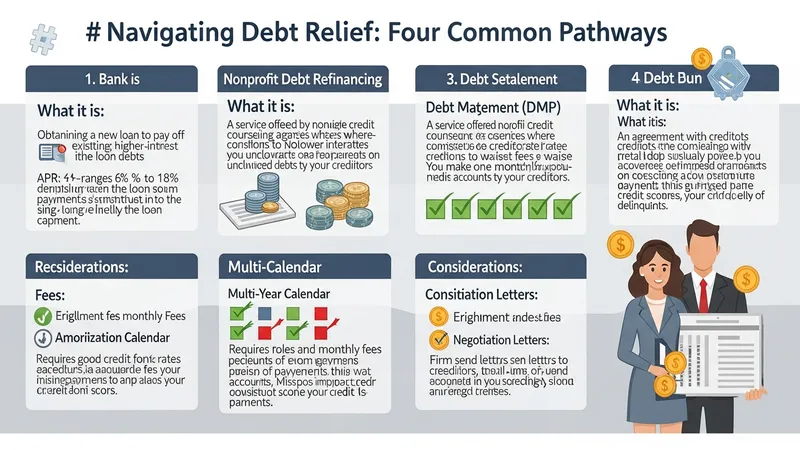
Typical timelines also differ. Consolidation loans follow the loan’s amortization schedule, which may be two to seven years in common consumer scenarios depending on lender terms. DMPs often run multiple years until enrolled balances are satisfied through negotiated payments. Debt settlement processes may take several months to multiple years, depending on creditor responsiveness and the pace of accumulating settlement funds. Credit report dispute cycles initiated with bureaus commonly conclude in roughly 30 to 45 days for straightforward inquiries, though back-and-forth documentation can extend that period.
Potential indirect costs and considerations include the possible impact on credit scores and tax implications. Accounts included in a debt settlement may be reported as settled for less than the full balance and can lower a credit score in the short term; forgiven debt may trigger a Form 1099-C and potential taxable income reporting to the Internal Revenue Service in some circumstances. Consumers often weigh these downstream effects alongside immediate monthly payment relief and overall budget implications, recognizing that fiscal outcomes can vary by individual situation.
Insider considerations used by analysts and practitioners include scrutinizing fee disclosure documents, estimated timelines in written agreements, and whether a provider holds relevant registrations or memberships in nonprofit or industry organizations. Reviewing public complaint records—such as entries in the Consumer Financial Protection Bureau database—or verifying provider adherence to federal disclosure requirements may inform expectations about costs and timing. These considerations typically guide a measured evaluation rather than a prescriptive recommendation.
Several federal laws and regulatory agencies shape how consolidation and credit report services operate in the United States. The Fair Credit Reporting Act (FCRA) governs accuracy and dispute procedures for consumer reports and sets obligations for credit reporting agencies and furnishers. The Fair Debt Collection Practices Act (FDCPA) limits certain collection practices by third-party collectors. The Credit Repair Organizations Act (CROA) restricts deceptive practices by companies that advertise credit improvement services, including advance fee prohibitions and mandatory written disclosures, and the Federal Trade Commission (FTC) enforces related provisions.

The Consumer Financial Protection Bureau (CFPB) also provides oversight and consumer education on debt collection, debt relief products, and credit reporting. Consumers in the United States have specific rights to obtain free annual credit reports via AnnualCreditReport.gov and to dispute errors with each bureau; CFPB and FTC materials outline complaint and enforcement pathways. State-level laws and licensing requirements may additionally apply to debt settlement and collection businesses, so service availability and regulatory obligations can differ among states.
Enforcement and complaint mechanisms are notable features of this framework. Consumers may file complaints with the CFPB or FTC if they encounter potential violations of federal disclosure rules, deceptive marketing, or unfair practices. Providers are often required to provide written contracts and transparent fee statements; CROA specifically mandates that credit repair organizations provide a written contract detailing services, timelines, and cancellation rights. These protections aim to balance the commercial aspects of service offerings with consumer information and recourse options.
When interpreting regulatory guidance, practitioners typically advise attention to documentation and timing: ensuring that any agreement is in writing, reviewing disclosure statements about fees and expected outcomes, and understanding statutory dispute timelines. Public resources from CFPB, FTC, and the IRS provide procedural information relevant to consolidation and credit-report activities. These frameworks are intended to help consumers and professionals navigate service options with a clearer view of rights and obligations.
Practical considerations often focus on transparency, contract terms, and alignment with account types. Written agreements should describe the service scope, fee schedule, and estimated timelines; federal rules require certain disclosures for credit repair organizations and debt relief services. Different debt types may be treated differently: federally held student loans have separate administrative or consolidation pathways through the Department of Education and are not typically eligible for private debt settlement, while unsecured consumer debts such as credit cards and some personal loans are more commonly included in DMPs or settlement arrangements.

Verifying provider credentials and complaint histories may inform expectations. Many nonprofit credit counselors list accreditation or membership with national organizations such as the National Foundation for Credit Counseling. Consumers may review entries in the CFPB complaint database or consult FTC guidance for signs of compliance issues. It is often useful to compare written fee schedules, payment allocation procedures, and whether the provider secures written creditor agreements for negotiated terms rather than relying solely on verbal assurances.
Budgetary and reporting consequences should be anticipated. Enrolling in a managed plan or committing to settlement savings may change monthly cash flow and could affect timely payments to creditors if not executed precisely. Changes to account status—such as settled, paid in full, or enrolled in a plan—may appear on credit reports and influence scoring models; the direction and magnitude of score changes can vary. Tax implications for forgiven debt may arise under IRS rules; professional tax guidance may be relevant when discharge amounts exceed statutory thresholds.
Ongoing monitoring and recordkeeping are practical steps that often accompany professional services. Retaining copies of contracts, settlement letters, dispute confirmations, and correspondence with credit bureaus supports documentation of actions taken. Consumers commonly access free annual reports from AnnualCreditReport.gov to track changes and verify that corrections or negotiated terms are reflected as expected. These practices serve as informational safeguards and help align expectations with the administrative realities of consolidation and credit-report remediation.