
Manufacturing components for aircraft and spacecraft requires processes that control geometry, surface finish, and material properties to within narrow ranges. In Italy, firms and technology providers often focus on machining strategies, assembly protocols, and inspection systems that together reduce dimensional variation and ensure repeatable part performance. The activity typically spans initial material qualification, multi-axis cutting or forming, heat treatments, and a range of non-destructive and dimensional inspections that record conformance to technical drawings and applicable standards.
Precision in this context involves both machine capability and documented process control. Equipment selection, toolpaths, fixturing, coolant and cutting parameters, and environmental controls can all influence achievable tolerances. Italian industrial suppliers, metrology laboratories, and standards bodies commonly collaborate with manufacturers to validate processes and provide traceable measurement results. Production planning often integrates statistical process control and documented calibration regimes so measured parts can be traced to recognised Italian or European standards.
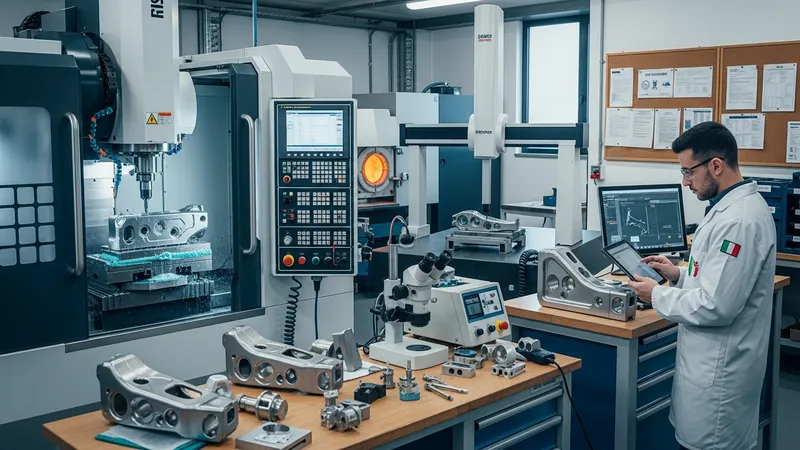
Material selection is central to high-tolerance production. Aerospace alloys such as aluminium-lithium, titanium grades, and nickel-based superalloys have distinct machining responses and thermal sensitivities that may affect dimensional stability. In Italy, material certificates and supplier traceability commonly follow EN and UNI-adopted standards, and testing laboratories or accredited heat-treatment facilities provide associated documentation. Manufacturers typically plan machining sequences and stress-relief steps to reduce distortion and achieve target tolerances while maintaining certification records for each batch of material.
Machine-tool capability and process design often determine achievable tolerances. Multi-axis CNC centres, precision lathes, and controlled-environment grinding machines can reduce geometric error sources when combined with rigid fixturing and tool-path strategies. Italian machine tool suppliers and systems integrators may offer cells with temperature control, vibration isolation, or in-process probing to improve repeatability. Process planners can factor cycle time, tool wear rates, and in-process measurement to balance productivity with the repeatable accuracy required for aerospace parts.
Inspection and metrology are integrated throughout high-tolerance workflows rather than applied only at final inspection. Coordinate measuring machines (CMMs), optical scanners, and form testers are used for first-article inspection, in-process checks, and final verification. Calibration and traceability to national standards are often provided by accredited Italian bodies so measurement results carry recognised validity. Data from inspections may be fed back to machining parameters to support corrective actions and maintain statistical control over batches of components.
Non-destructive testing and materials testing complement dimensional verification in aerospace production. Techniques such as ultrasonic testing, eddy current, and dye-penetrant examination can detect subsurface or surface defects that dimensional checks will not reveal. Accredited Italian laboratories and in-house NDT teams often follow procedures aligned with EN standards and industry guidance; documentation from these tests typically accompanies part certification to provide a fuller conformity record for airworthiness or contractual review.
Process documentation and supplier control are crucial administrative elements that link physical processes to compliance. Work instructions, control plans, calibration records, and material certificates create a traceable chain from raw material to delivered component. Within the Italian context, many manufacturers reference UNI/EN standards and may engage with organisations such as Accredia for calibration accreditation. This administrative layer may often be as influential as machine capability in demonstrating that a produced part meets specified tolerances and quality requirements. The next sections examine practical components and considerations in more detail.
Machining strategies typically form the backbone of producing narrow-tolerance aerospace parts. Processes commonly used in Italy include 5-axis CNC milling for complex geometries, high-precision turning for shafts and bores, and fine grinding for critical surfaces. Suppliers of machine tools in Italy may offer thermal compensation, direct-drive spindles, and integrated probing that can reduce systematic errors. Process planners often characterise machine capability in terms of repeatability and process variation, and they may specify expected tolerance bands such as low-micrometre ranges depending on the feature and material.
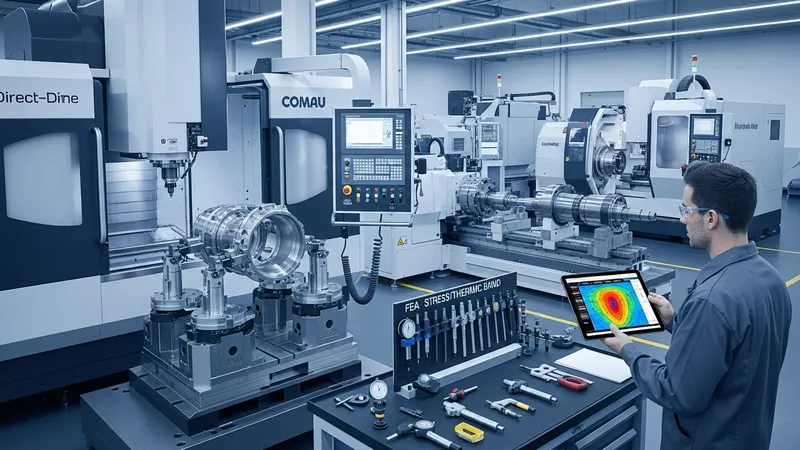
Fixturing and workholding design can strongly influence achievable accuracy. Proper fixture stiffness, minimised overhangs, and thermal isolation are typical considerations to avoid clamp-induced distortion. Italian automation integrators like Comau can provide bespoke cells that standardise part loading and reduce variation introduced by manual handling. Engineers in production planning may use finite-element analysis or empirical testing to assess how clamping forces and machining sequences will interact with material residual stresses.
Tooling and cutting strategy choices often account for material-specific behaviour. For titanium and nickel alloys, lower cutting speeds and careful toolpath planning may reduce workpiece heating and resultant dimensional drift. Carbide or cubic boron nitride tooling is frequently selected for wear resistance in abrasive alloys. Italian tooling distributors and machine-tool manufacturers typically provide data on recommended feeds, speeds, and tool life expectations that production teams may use to set conservative process windows for high-tolerance components.
Environmental and thermal controls can be necessary when tolerances approach the micrometre scale. Temperature stability in the workshop, closed-loop coolant temperature control, or climate-controlled enclosures around critical machines may be employed to limit thermal growth of parts and machines. In Italy, some precision workshops adopt such measures for specific product lines; these controls may be paired with regular machine warm-up procedures and documented measurement checkpoints to preserve consistency across production batches.
Measurement systems used in Italian aerospace manufacturing commonly include bridge or gantry CMMs, optical scanners, and form-measurement machines. Calibration against national standards is typically performed by accredited bodies such as Accredia or by laboratories that trace results to the Istituto Nazionale di Ricerca Metrologica (INRIM). Metrology teams often define inspection plans that specify which features are measured, acceptable variation, and frequency of checks—ranging from 100% inspection of critical geometry to sampling plans informed by statistical process control.
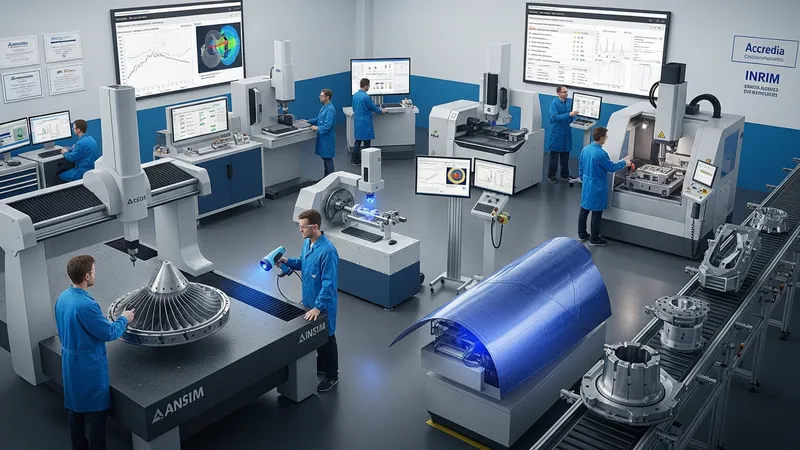
In-process measurement is commonly used to detect drift before large batches are completed. Probing cycles on CNC machines, optical comparators at process stations, and automated dimensional checks in assembly lines can reduce scrap and rework. Italian suppliers of metrology equipment, such as ZEISS Italia, may provide on-site support and software solutions that integrate measurement data into production control systems, enabling traceability from measured values back to specific machine settings or tool assemblies.
Documentation accompanying measurements is an important compliance element. Typical records include calibration certificates, measurement reports, and control charts that show feature stability over time. These records may be requested by prime contractors, certification authorities, or customers and are often organised to align with EN and UNI standards. In Italy, companies may also participate in inter-laboratory comparisons or proficiency schemes to maintain confidence in measurement capability and demonstrate adherence to accepted practices.
Selection of inspection methods is influenced by both feature geometry and production volume. For low-volume, highly critical components, exhaustive dimensional mapping and destructive validation tests may be appropriate. For higher-volume parts, a mix of automated checks and periodic full inspections can maintain throughput while controlling quality. Metrology teams in Italy typically balance inspection coverage with manufacturing flow, documenting rationales for chosen sampling frequencies in quality plans.
Aerospace materials selection in Italian production often centres on alloys that balance strength, fatigue resistance, and machinability. Common material families include aluminium alloys used in structural parts, titanium alloys for high-strength low-weight components, and nickel-based superalloys for hot-section engine parts. Suppliers and manufacturers usually require material certificates (for example, EN 10204 types) that document chemical composition and mechanical test results; these certificates are typically archived as part of the traceability package for each delivered component.
Mechanical testing, heat-treatment validation, and metallurgical examination commonly complement dimensional checks. Tensile tests, hardness testing, and metallography may be performed by accredited laboratories in Italy to verify that heat-treatment cycles produced the intended microstructure and properties. Non-destructive testing (NDT) such as ultrasonic or eddy current inspection is often applied according to recognised procedures; documentation from NDT personnel is typically included with batch records to support component release for assembly or delivery.
Certification pathways for aerospace components frequently reference international standards adopted within Italy. Quality systems such as EN 9100 (the European format of AS9100) are commonly used across the sector, and conformity to these standards may be audited by certification bodies operating in Italy. Companies may also align with EN and UNI standards that specify testing methods and inspection criteria; adherence to these standards helps demonstrate that produced parts meet the expectations of airworthiness authorities and industrial customers.
Supplier control and subcontractor qualification are often part of the certification landscape. Manufacturers may require their material and process suppliers to provide evidence of capability and relevant accreditations. In Italy, this can include supplier audits, review of calibration certificates issued by Accredia-accredited laboratories, and verification of personnel qualifications for specialized tasks such as NDT or heat treatment. These administrative elements may be as important as the physical tests in establishing compliance for high-tolerance parts.
Italy’s aerospace supply chain often clusters in northern regions such as Lombardy, Veneto, and Piedmont where a concentration of machine tool builders, specialised suppliers, and research institutions exists. Universities and technical institutes, including Politecnico di Milano and Politecnico di Torino, may collaborate with industry on process development and workforce training. These collaborations can provide local manufacturers with access to research on high-precision machining, surface integrity, and measurement science that support improved production capability.
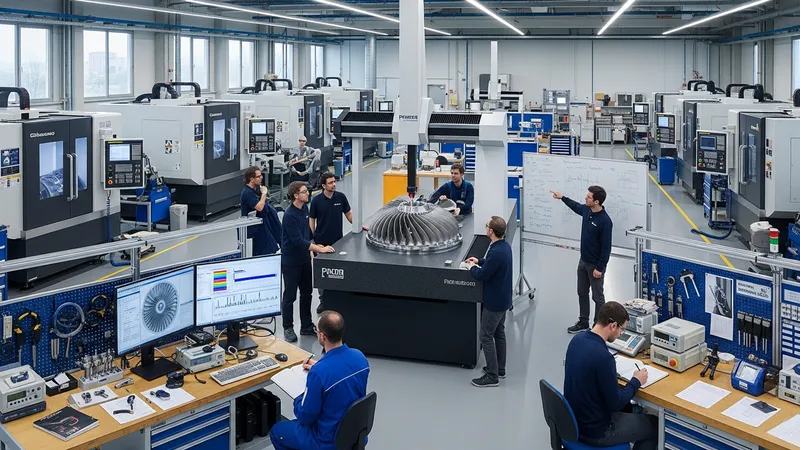
Skilled personnel and vocational training are typical considerations for maintaining tight-tolerance production. Italian technical schools and university programmes may supply graduates with knowledge of CAD/CAM, metrology, and materials science; however, many firms also invest in on-the-job training and cross-training between machining, inspection, and quality departments. Workforce planning may emphasise measurement literacy and understanding of process control so operators and engineers can interpret inspection data and adjust processes within documented control plans.
Supply chain resilience and supplier qualification are commonly emphasised in Italy’s aerospace manufacturing sector. Manufacturers may work with regional suppliers for raw materials, heat treatment, and specialised finishing to shorten lead times and maintain traceability. Procurement and quality teams often document supplier capabilities, accreditations, and historical performance; these records can inform decisions about which suppliers will participate in programs producing narrow-tolerance components.
Research and standards institutions in Italy provide resources relevant to high-tolerance production. National metrology institutes like INRIM, standards bodies, and accreditation organisations contribute to a framework that supports traceable measurements and recognised certification. Companies operating in the sector may reference these institutions when establishing calibration plans, selecting inspection methods, or demonstrating conformity to technical and regulatory requirements for aerospace components.