
Artificial intelligence (AI) in cancer treatment refers to computational systems that analyze clinical, imaging, and molecular data to support aspects of oncology care. These systems include machine learning models, deep learning networks, and statistical algorithms that process large datasets to identify patterns, assist with image interpretation, and generate quantitative predictions. The goal of such systems is to provide additional information to clinicians and researchers rather than to replace clinical judgment. AI applications are typically developed around specific tasks such as image segmentation, risk stratification, or biomarker discovery and are evaluated for performance against established clinical or laboratory standards.
AI in oncology often combines multiple data types—radiology images, pathology slides, genomics, and electronic health record entries—to form multimodal models that may reveal associations not evident from single-source analysis. Development commonly involves supervised learning from labeled datasets, unsupervised analysis to detect subgroups, and reinforcement or generative approaches for simulation or hypothesis generation. Implementation typically requires attention to dataset representativeness, model explainability, and integration into clinical workflows so that outputs are interpretable and usable by care teams.

Imaging-focused AI systems often concentrate on tasks such as lesion detection, segmentation, or radiomic feature extraction. These models may be trained on annotated images and validated against radiologist reads or histopathology. Imaging AI can serve in triage workflows or as quantitative second reads, and its performance typically depends on image quality, annotation consistency, and variation in scanner settings. When considering imaging AI, researchers and clinicians often evaluate sensitivity, specificity, and calibration across diverse patient populations to understand where models may generalize or require further refinement.
Predictive models that use clinical and molecular data often combine demographic, laboratory, and genomic variables to estimate outcomes such as treatment response or progression. Such models may use conventional regression techniques, tree-based ensembles, or neural networks. Their clinical value often depends on both statistical performance and interpretability: clinicians may prefer models that provide feature-level contributions or risk stratification thresholds that align with existing decision processes. Models may require external validation across independent cohorts before being considered for clinical use.
Drug discovery applications employ AI to prioritize chemical structures and biological targets that could be relevant to oncology. These methods can accelerate in-silico screening phases by predicting properties such as target affinity, toxicity liabilities, or synthetic accessibility. While AI can reduce the number of candidate compounds for laboratory testing, laboratory and preclinical assays remain essential to confirm biological activity and safety. Collaboration between computational chemists and experimental teams often shapes which AI-generated leads proceed to further evaluation.
Integration of AI into clinical workflows raises technical and organizational considerations. Data interoperability, electronic health record integration, and user interface design often determine whether an AI output is effectively used in practice. Prospective studies and pilot implementations may reveal workflow bottlenecks or user experience issues that retrospective evaluations did not capture. Stakeholders commonly assess whether model outputs are actionable, interpretable, and align with existing clinical pathways before broader adoption.
In summary, AI in cancer treatment encompasses imaging analysis, predictive modeling, and computational drug discovery, all of which may augment research and clinical processes when developed and validated with care. These systems typically perform task-specific analyses and require attention to data quality, external validation, and interpretability. The next sections examine practical components and considerations in more detail.

AI approaches in oncology broadly fall into supervised, unsupervised, and generative categories. Supervised learning commonly addresses classification and regression tasks such as tumor detection or outcome prediction using labeled examples. Unsupervised methods may identify previously unrecognized patient subgroups or molecular signatures by clustering high-dimensional data. Generative approaches, including variational autoencoders or generative adversarial networks, can simulate realistic biological or imaging data for augmentation or hypothesis exploration. Each approach may serve distinct research or clinical aims and is selected based on task requirements, available labeled data, and evaluation objectives.
Deep learning architectures, including convolutional neural networks and transformer models, are frequently used for image analysis and multimodal integration. These models can extract hierarchical features that may correlate with pathology or molecular states. Simpler models such as logistic regression or tree-based ensembles often remain relevant where data volume is limited or interpretability is a priority. Practitioners typically weigh trade-offs between model complexity, data needs, and the clarity of explanations provided to clinical users.
Multimodal AI systems combine imaging, genomics, and clinical data to build more comprehensive representations of a patient’s disease. Integration techniques range from early fusion—concatenating features before modeling—to late fusion—combining predictions from separate models. Multimodal models may capture interactions across data types that single-modality models miss, but they also often demand larger, well-annotated datasets and more complex validation strategies to ensure robustness across different data sources.
When choosing an AI approach, teams often consider data availability, regulatory expectations, and end-user needs. A useful consideration is whether a model must run in real time (e.g., intra-procedural imaging) or may operate offline for research purposes. Developers commonly pilot multiple architectures and emphasize transparent reporting of performance metrics, dataset composition, and limitations so that clinicians and researchers can judge applicability for specific tasks or populations.
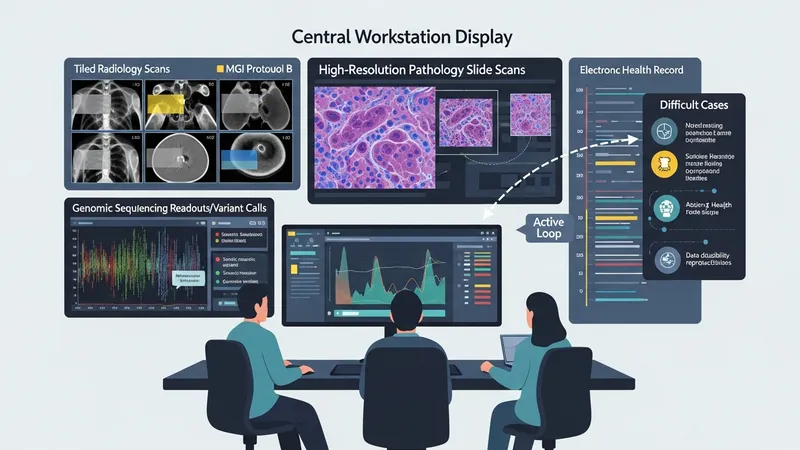
Key data sources for oncology AI include imaging archives, pathology slide scans, genomic sequencing output, and electronic health record data. Each data type brings specific quality challenges: imaging may vary by scanner and protocol, pathology annotations require domain expertise, and genomic data needs standardized pipelines for variant calling. Data curation steps such as harmonizing formats, removing personally identifiable information, and ensuring consistent labeling are often necessary before model training. Teams typically document preprocessing steps to support reproducibility and later auditability.
Annotation quality strongly influences supervised model performance. Expert annotations for lesions or histologic features may be time-consuming and variable across raters. Approaches to improve annotation utility include consensus labeling, multi-reader aggregation, and the use of annotation tools that capture uncertainty. Where annotations are scarce, weak supervision or active learning methods may be explored to make efficient use of available expert time, though these strategies usually require careful validation to quantify introduced biases.
Interoperability and workflow integration determine practical utility. Models that output results in formats compatible with picture archiving and communication systems (PACS), pathology viewers, or clinical decision support modules are more likely to be reviewed by clinical teams. Considerations such as latency, user interface clarity, and alignment with clinician information needs often surface during pilot implementations. Teams commonly plan iterative refinements based on clinician feedback to improve adoption potential while ensuring data governance and security requirements are met.
Data governance and bias mitigation are central concerns. Datasets that lack demographic or clinical diversity may produce models that perform unevenly across subgroups. Strategies to address this concern include stratified validation, external testing on independent cohorts, and transparent reporting of dataset composition. Privacy-preserving techniques such as federated learning or secure multi-party computation may be considered when pooling data across institutions is constrained by legal or ethical considerations, although these approaches bring their own technical and validation challenges.
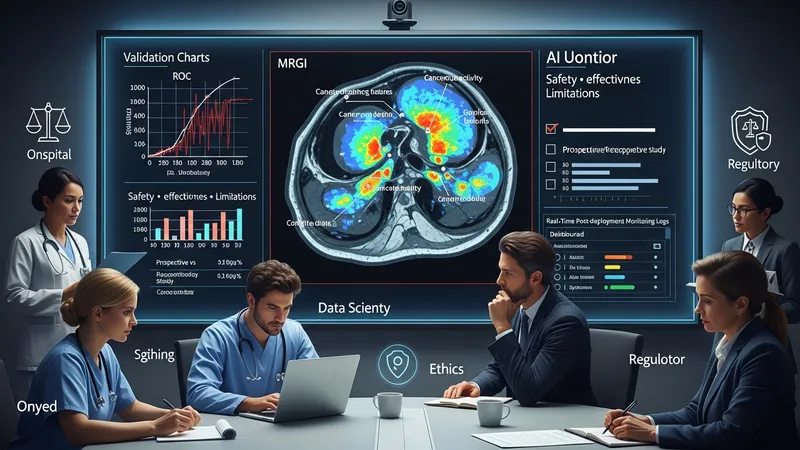
Regulatory frameworks for AI in healthcare typically emphasize evidence of safety, effectiveness, and risk mitigation. Validation pathways often mirror those for diagnostic or decision-support tools and may include retrospective performance evaluation, prospective clinical validation, and post-deployment monitoring. Regulatory expectations can vary by jurisdiction, and developers commonly engage with regulatory guidance early to align study designs and evidence generation plans with applicable requirements. Clear documentation of intended use, limitations, and performance characteristics forms part of regulatory submissions.
Ethical concerns include algorithmic fairness, transparency, and informed consent for data use. Explainable AI techniques that surface key contributing features or highlight uncertainty may assist clinicians in interpreting model outputs, though such explanations do not eliminate the need for clinician oversight. Ethical review boards and institutional governance bodies often assess projects for patient privacy, data minimization, and the potential for disparate impacts across demographic groups. Responsible deployment typically involves monitoring for unintended consequences after models are introduced into practice.
Clinical validation strategies often progress from internal test sets to external validation cohorts and, when appropriate, prospective studies embedded in care pathways. Performance metrics beyond accuracy—such as calibration, decision-curve analysis, and clinical utility assessments—are commonly reported to illustrate how model outputs might influence clinical decisions. Developers and clinical teams often design pilot implementations to measure workflow effects and to identify situations where model guidance aligns or conflicts with standard clinical reasoning.
Post-deployment surveillance is an important aspect of responsible AI use. Models may degrade over time due to changes in practice patterns, equipment, or patient populations, so ongoing monitoring of performance and periodic re-training or recalibration may be necessary. Establishing governance processes that define responsibilities for maintenance, updates, and incident response can help ensure models remain appropriate for their intended context of use. Such processes typically include technical, clinical, and legal stakeholders to manage lifecycle risks.

Research areas that may shape future AI applications in oncology include more robust multimodal models that integrate imaging, molecular, and longitudinal clinical data. Advances in federated learning and privacy-preserving methods may enable collaborative model development across institutions while reducing data transfer barriers. Another area of active investigation is causal inference and counterfactual modeling to better support individualized treatment effect estimation, though these methods require careful assumptions and validation to be clinically useful.
Personalized therapy planning using AI may involve combining predictive models with mechanistic or systems-biology models to suggest individualized regimens or dose adjustments. Integrating AI into adaptive clinical trial designs is an active research pathway, where models could help identify subgroups more likely to benefit from experimental therapies. These possibilities typically require close collaboration between data scientists, clinicians, and trial methodologists to ensure scientific rigor and patient safety.
Technical challenges that often surface in research include interpretability for complex models, robustness to dataset shift, and the need for sufficiently large and representative datasets. Emerging methods such as uncertainty quantification, model ensembling, and continuous learning pipelines are being explored to address these concerns. Researchers commonly emphasize that experimental findings should be replicated across independent cohorts before consideration for clinical translation.
Overall, AI may continue to contribute to research and clinical workflows in oncology by enabling more quantitative analyses and hypothesis generation. Progress typically depends on transparent reporting, external validation, and multidisciplinary collaboration to address ethical, regulatory, and technical challenges. Continued evaluation of how AI tools interact with clinical decision-making will be important as technologies evolve.