
Pumps intended for very thick or slow-flowing liquids are designed to move fluids whose resistance to flow is substantially greater than water. Such designs focus on creating predictable displacement per cycle, controlling clearances to manage leakage, and avoiding excessive shear or trapped gas. Typical engineering responses include selecting positive-displacement mechanisms, specifying low rotational speeds, adding temperature control to reduce apparent viscosity, and detailing seal and bearing arrangements that tolerate heavier lubricating fluids or abrasive solids. The overall concept centers on matching pump geometry and drive conditions to the fluid’s rheology so that flow and pressure remain stable under expected process temperatures.
Key operational factors involve how viscosity interacts with pressure and flow. As viscosity increases, required input torque and volumetric slip often increase, so designers may enlarge gear sizes, lengthen rotor profiles, or select multi-lobe geometries to preserve steady throughput. Some viscous fluids are shear-sensitive or non-Newtonian; these characteristics influence whether a rotary, piston, or progressive-cavity approach is preferable. Auxiliary systems such as heating jackets, slow-speed gearboxes, and pressure relief devices are commonly integrated to keep performance within safe, maintainable ranges without implying a single universal solution.
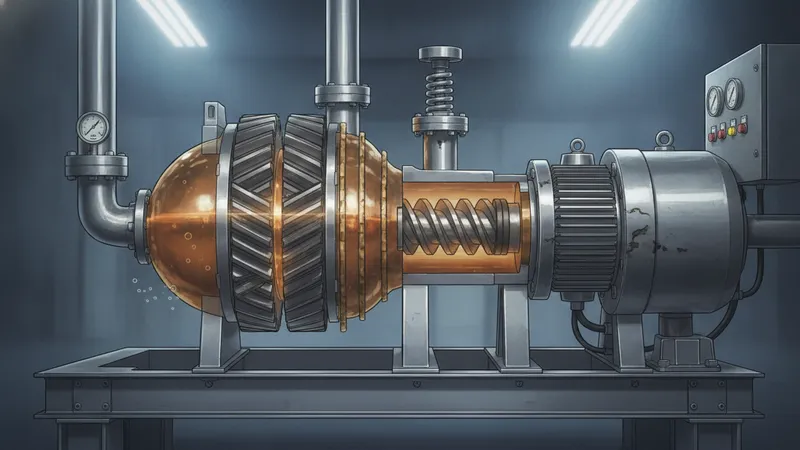
Viscosity influences volumetric efficiency and required drive power in measurable ways. For a given pump geometry, volumetric slip (internal leakage past clearances) can increase with higher viscosity, reducing delivered flow relative to theoretical displacement; however, in some positive-displacement designs slip may decrease because thicker fluid seals gaps more effectively. Drive power typically scales with both flow rate and viscosity, so torque requirements may be several times larger than for low-viscosity liquids at similar flow rates. Designers often specify safety margins for torque and bearing loads to account for steady-state and start-up conditions.
Clearances, tolerances, and surface finishes are central to reliable handling of thick fluids. Smaller clearances can reduce internal leakage but may increase the risk of seizure if thermal expansion or entrained solids are present. Surface roughness affects shear and abrasion; polished wetted surfaces can reduce adhesion and assist self-priming in some rotary types. Elastomer stators or seals are chosen based on chemical compatibility and hardness; softer elastomers may improve sealing in progressive-cavity pumps but can wear faster with abrasive particles. These trade-offs are addressed in material selection and planned maintenance intervals.
Temperature control is a common method for managing viscosity in-service. Heating jackets, fluid-filled heat-transfer circuits, and trace heating on suction lines can lower apparent viscosity sufficiently to reduce torque and improve volumetric output. For shear-thinning fluids, pumping at slightly higher shear rates can reduce apparent viscosity locally, but excessive shear may damage product properties. Where heating is used, expansion, seal compatibility at elevated temperatures, and uniformity of temperature across the pump and piping must be considered to avoid uneven flow or degraded components.
Maintenance planning and monitoring are important for long-term performance. Wear of rotors, stators, and seals can gradually change clearances and thus flow and efficiency; scheduled inspections can identify progressive changes before abrupt failure. Vibration analysis, torque monitoring, and routine checks for seal leakage are commonly used diagnostics. Spare-part strategies typically include replacement rotors or stators and seal kits sized for expected service intervals. The next sections examine practical components and considerations in more detail.
Rotary and reciprocating positive-displacement mechanisms are widely used when liquids have high apparent viscosity because they deliver a defined volume per cycle. External gear pumps generate flow by entraining liquid between gear teeth and the casing; they can be compact but may require more precise clearances. Progressive cavity pumps create a moving cavity that advances fluid with minimal backflow; this is often useful for shear-sensitive or particulate-containing fluids. Rotary lobe pumps provide large cavities and gentle handling, and may be chosen where low shear and ease of cleaning are priorities. Selection often depends on a balance of volumetric accuracy, allowable shear, and solids handling.
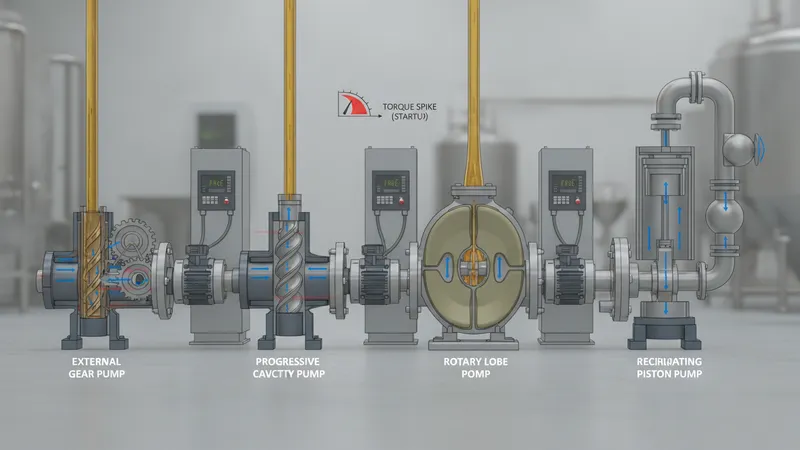
Operational speed and drive selection are practical considerations tied to the selected pump type. Lower rotational speeds typically reduce shear and heat generation but may require larger displacement per revolution to meet flow targets. Gearboxes or variable-frequency drives may be used to tune speed within process constraints. Reciprocal piston pumps can achieve high pressures but produce pulsation that often needs dampening. The combination of pump geometry, drive power rating, and coupling design is specified to maintain acceptable torque margins during start-up, when viscous suction conditions can increase transient loads.
Seal and shaft-bearing arrangements differ by pump family and influence maintenance needs. Seal types range from packing and single mechanical seals to cartridge double seals for pressure-critical applications. For very viscous fluids, seals may need to be warmed or provided with barrier fluids to prevent congealing. Bearings must accommodate higher radial loads from viscous torques and potential imbalance; some designs use larger, heavier bearings or external oil lubrication systems. These mechanical details are integral to overall pump reliability and are considered alongside material compatibility.
Flow control and pulsation management are often incorporated at the system level. Positive-displacement pumps can generate pulsation that affects downstream metering or mixing; surge dampeners, pulsation dampers, or downstream accumulators may be applied. In applications where metering accuracy is important, pump selection and speed control are coordinated with feedback instrumentation. Engineers commonly model expected slip and pulsation behavior during the specification phase to size control elements that preserve process stability without implying a single universal configuration.
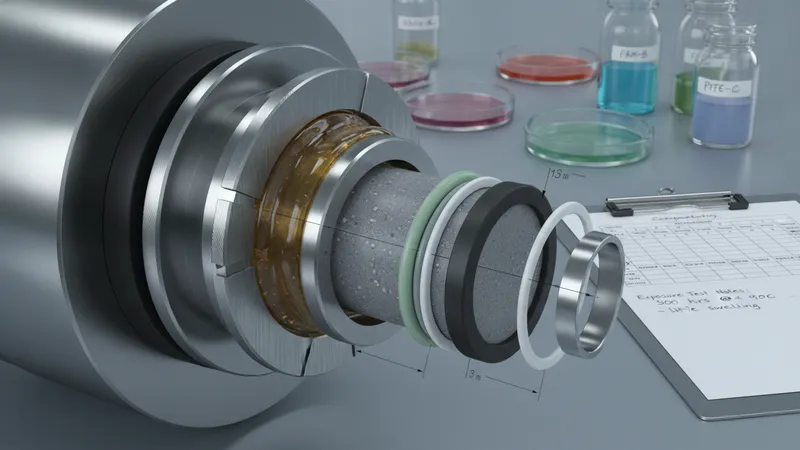
Material selection for wetted components must align with fluid chemistry, solids content, and operating temperature. Stainless steels (e.g., austenitic grades) are commonly used for corrosion resistance, while hardened alloys or surface treatments may be specified where abrasive solids are present. Elastomeric stators and seals are chosen for chemical compatibility and hardness; nitrile, fluorocarbon, and PTFE-based compounds are frequently considered depending on fluid composition. Compatibility charts and laboratory exposure tests often inform these choices to reduce unplanned degradation in service.
Surface finish and dimensional tolerances influence pumping behavior of thick liquids. Smoother surfaces reduce adhesion and fouling for sticky fluids, while precise machining tolerances help control internal leakage that affects volumetric accuracy. Designers may specify electropolishing or protective coatings for certain food-grade or adhesive applications to reduce build-up. When solids are expected, designers balance clearance tightness with the risk of entrapment and abrasion; replaceable wear sleeves or hardened inserts can extend component life without implying a universally optimal solution.
Elastomer selection for stators and seals is a trade-off between sealing efficiency and wear resistance. Softer elastomers can form better seals in progressive cavity geometries, improving low-flow performance, but tend to abrade faster when solids are present. Elastomer resilience at elevated temperatures is also critical if heating is used to lower viscosity. For applications where chemical swelling is a concern, PTFE linings or metal-seated designs are sometimes specified. These choices are framed as situational considerations rather than blanket recommendations.
Corrosion and compatibility assessments may include practical tests and vendor-provided data sheets. Engineers frequently review material chemical resistance lists and consider periodic sampling after in-service exposure. Where foaming, oxidation, or polymerization risks exist, inerting or controlled atmosphere measures at the suction side may be discussed as protective options. These preventive approaches are part of a holistic specification process that aligns material choices with expected operational stresses.
Temperature has a strong, often exponential influence on viscosity for many fluids; modest heating can markedly reduce apparent viscosity and required drive torque. Common industrial measures include steam or hot-oil jackets, electric cartridge heaters, and insulated piping. Designers assess whether uniform temperature distribution through the pump and immediate piping is achievable, as temperature gradients can create local viscosity differentials that affect sealing and volumetric consistency. Safety controls and appropriate pressure-relief measures are typically specified when elevated temperatures are used.
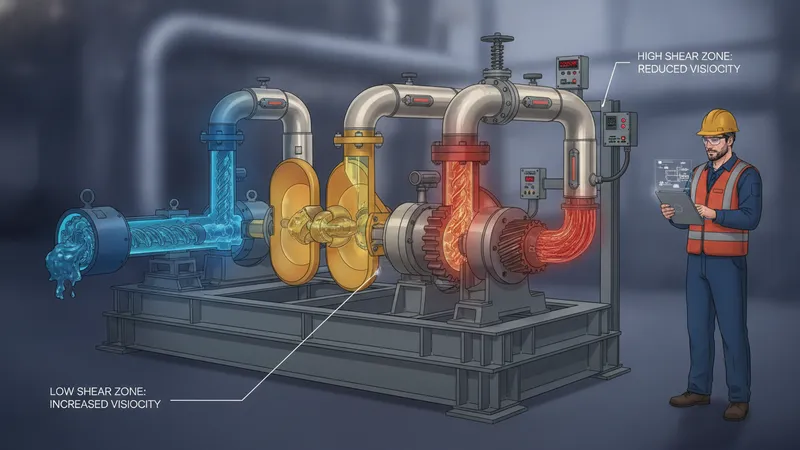
Shear-thinning and thixotropic fluids require distinct handling philosophies. For shear-thinning media, increased shear in the pump’s swept volume can lower apparent viscosity locally and improve flow, but excessive shear may alter product properties. Progressive cavity and lobe pumps often provide lower shear rates than gear pumps, which can be advantageous for maintaining product integrity. Engineers may test representative samples across shear ranges to determine acceptable operating envelopes rather than assuming uniform behavior.
Suction-side design is critical when temperature control is applied. Insulation and trace heating on suction lines can prevent cooling and re-thickening of the fluid before the pump inlet, which may otherwise increase start-up torque or cause air entrapment. When suction lift is required, designers may minimize lift distance and use priming strategies compatible with the fluid’s rheology. These details are framed as considerations that can reduce operational risk when properly engineered and validated.
System-level integration frequently includes monitoring to ensure viscosity management remains effective. Temperature sensors, torque meters, and flow meters provide feedback that can be used to adjust heating or speed. Control logic may allow gradual ramp-up of temperature or speed during start-up to limit transient loads. Such monitoring is an informational tool for operators and engineers to maintain stable performance rather than a prescriptive mandate for any single solution.
Volumetric efficiency, mechanical efficiency, and overall energy use are interrelated performance metrics for viscous-fluid pumps. Volumetric efficiency can be affected by internal slip and by the presence of compressible phases; mechanical efficiency depends on frictional losses and bearing design. Energy consumption per unit volume pumped typically increases with viscosity, so system designers factor this into motor sizing and thermal management plans. Performance testing with representative fluids under anticipated temperature and pressure ranges is commonly recommended to set realistic expectations.
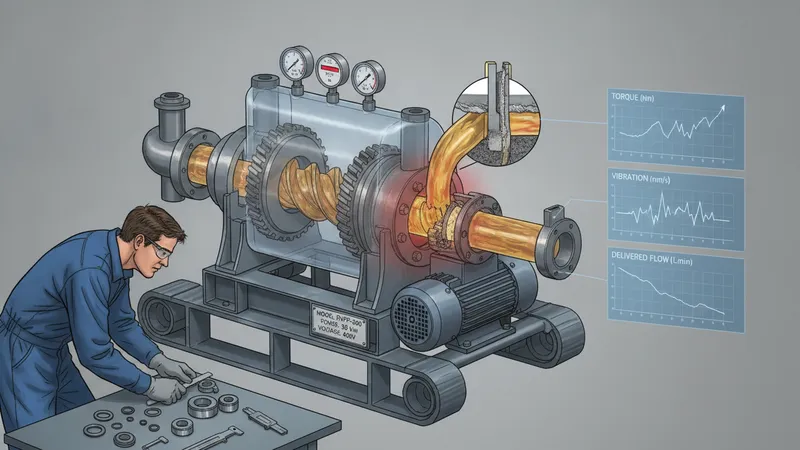
Maintenance considerations often focus on wear parts and seal longevity. In rotary designs, rotor and stator wear or gear tooth wear can slowly change clearances and affect flow; scheduled inspections and dimension checks provide early warning. Seal leakage may indicate hardening or swelling of elastomers or particulate intrusion; planned replacement intervals and availability of spare kits are typical elements of robust maintenance planning. Monitoring trends in torque, vibration, and delivered flow can signal when service is advisable.
Applications that frequently use these pump approaches include polymer processing, adhesives and sealants, food pastes and syrups, asphalt and bitumen handling, and slurry transfer with moderate solids. Each sector emphasizes different priorities: sanitary finish and cleanability in food, low shear in adhesive metering, and abrasion resistance for slurries. Recognizing these contextual differences helps in specifying pump families, materials, and auxiliary systems without implying a single optimum for all use cases.
Final operational considerations include instrumentation and safety integration. Pressure relief, over-torque protection, and temperature interlocks are commonly incorporated to avoid equipment damage and maintain process control. Where product properties are critical, sampling ports and inline monitoring may be used to verify that pumping has not altered the fluid adversely. These measures support reliable service life and predictable performance when aligned with the pump type and material choices described earlier.