
Many organisations engage an external team to simulate attacker behaviour and assess the resilience of systems, networks, and applications. Independent assessors conduct controlled testing that is separate from internal security functions, with the intent of identifying vulnerabilities, misconfigurations, and gaps in controls. This external perspective can help reveal issues that internal teams may overlook due to familiarity with the environment, and it typically follows agreed rules of engagement and legal boundaries to reduce operational risk during testing.
Independent assessments may cover a range of targets and levels of access, from unauthenticated internet-facing scans to credentialed internal evaluations. Assessors commonly use structured methodologies that align with public frameworks and industry guidance. Independence is often intended to reduce or remove conflicts of interest, making findings more objective for governance, risk management, or compliance purposes. Reports from such assessments can feed into remediation planning and measurement of security posture over time.

When comparing these approaches, organisations often consider scope, risk tolerance and operational impact. External perimeter testing can be scheduled more frequently without broad disruption, while internal or authenticated testing may require maintenance windows or careful safeguards to avoid service interference. Some organisations combine multiple assessment types in sequence to map an attack path from internet-facing entry points to sensitive assets. Selection of methods may also reflect regulatory or contractual expectations and the maturity of internal security processes.
Assessment frameworks commonly used by practitioners include structured checklists, threat modelling and mapping to known adversary behaviours. Test activities may range from automated scanning to manual verification and controlled exploitation to validate real-world risk. Controlled exploitation is typically limited and documented so that it confirms the presence and potential impact of a vulnerability without causing undue system damage. Evidence collection and reproducible steps are usually recorded to support remediation and verification.
Independent assessors often follow established standards and best-practice references to maintain consistency and defensibility. Using public references such as the OWASP guidance and mappings to common vulnerability scoring helps organisations interpret findings and compare results across assessments. Independence does not eliminate the need for collaboration; agreed scope, legal authority, and technical contacts are important so that testing can proceed safely and with clear escalation paths if serious issues are discovered.
Reports from third-party assessments typically include descriptions of findings, exploitation details where applicable, risk ratings and suggested remediation categories. Organisations may prioritise fixes based on a combination of potential impact, exploitability and business criticality rather than risk scores alone. Independent testing can also serve governance needs by providing an external validation point for internal risk reporting or compliance evidence.
Independent testing may be scheduled periodically or triggered by significant changes, such as major deployments or architecture shifts. The timing, depth and frequency of assessments commonly reflect the organisation’s risk profile and resource constraints. When planned as part of an overall assurance programme, third-party testing can complement continuous monitoring, code review and automated scanning by providing deeper, attacker-focused perspectives. The next sections examine practical components and considerations in more detail.
Assessment scope commonly distinguishes between external-facing targets and internal systems. External testing typically examines internet-accessible services, mail servers and exposed application endpoints, while internal assessments focus on network segmentation, privileged access controls and lateral movement potential. Another common distinction is between authenticated testing, where assessors use supplied credentials to evaluate privileged functions, and unauthenticated testing, which simulates an outside attacker. Scope definition may also specify excluded systems, planned maintenance windows and acceptable testing techniques to reduce the likelihood of unintended impact.
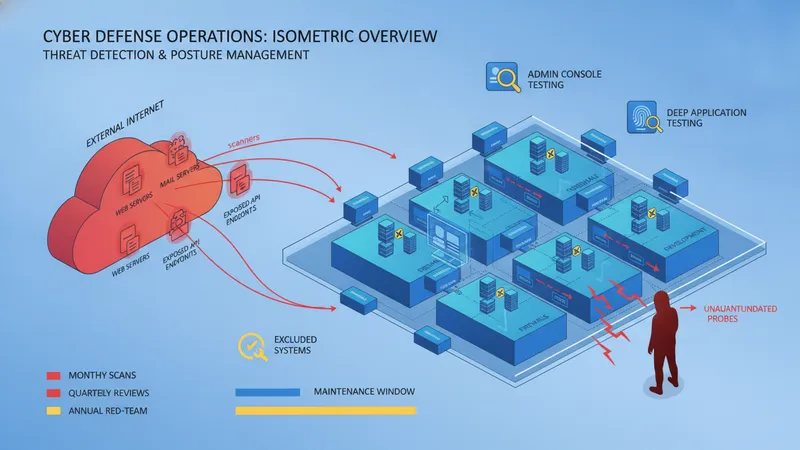
Organisations often balance breadth and depth when defining scope. Broad, periodic scans may reveal surface-level misconfigurations across many assets, whereas targeted, deeper engagements can validate protocol handling, business logic flaws or environment-specific issues. Some programmes apply tiered scopes: lightweight scanning monthly, deeper application reviews quarterly and comprehensive red-team exercises annually. The chosen pattern typically reflects risk tolerance, regulatory commitments and available resources rather than a universal standard.
Legal and contractual elements are commonly part of scoping decisions. Written rules of engagement, explicit authorisation, point-of-contact details and escalation procedures help protect both the assessor and the assessed entity. Where cloud or third-party hosted components are involved, permissions from service providers or tenancy owners may be necessary. Organisations frequently document these administrative controls before technical testing begins so that responsibility and liability are clearer for all parties.
Insider considerations often include how to treat sensitive data and production systems during tests. Many organisations opt to use test or staging environments for high-risk exploit techniques, or apply controls such as rate limits and monitoring to reduce service disruption. Independently conducted testing may also be aligned with compliance checklists when required by regulators or contractual frameworks, and the scope can be adjusted to capture specific controls that matter for audit evidence.
Structured methodologies often begin with reconnaissance to map assets and services, followed by vulnerability identification using both automated tools and manual inspection. After initial findings, assessors commonly perform risk validation through controlled exploitation or proof-of-concept actions to gauge potential impact. Validated findings typically include reproducible steps and supporting evidence. Methodologies may reference public standards or community frameworks to ensure consistency and facilitate stakeholder understanding of results.

Controlled exploitation is often treated cautiously to avoid destabilising production services. Assessors may document which exploit actions are permitted and where a non-destructive verification is preferred. For example, proof-of-concept interactions may confirm that a vulnerability exists without performing destructive payloads. This approach allows organisations to prioritise remediation efforts with a clearer view of practical exploitability while managing operational risk during testing.
Credentialed testing is commonly used to reveal issues that are not visible externally, such as weak privilege separation or flawed access control logic. When credentials are provided, assessors typically validate the scope of access and note any escalations or privilege abuses observed. Testing teams may combine network-level techniques with application-focused checks to construct plausible attack paths from initial access to sensitive assets, documenting lateral movement techniques and required conditions.
Quality of findings often depends on the assessment’s depth and the assessor’s familiarity with the environment. Neutral criteria such as reproducibility, availability of exploit details, and mapping to known weaknesses help stakeholders interpret results. Independent assessors commonly include mitigation suggestions and references to public guidance so that remediation teams can align fixes with accepted practices rather than ad hoc remedies.
Application testing frequently emphasises input validation, authentication, session management and business logic flows. Tests may map to community-driven lists of common weaknesses and include API security checks for endpoints handling structured requests. Manual inspection often supplements automated scanning to catch complex logic issues that tools may not flag. Findings commonly point to both coding defects and architectural choices that affect application resilience under adversarial conditions.

Network testing may include service enumeration, banner analysis, exposure checks for legacy protocols and verification of segmentation controls. Internal network assessments often focus on how easily an attacker could move between segments or access privileged infrastructure. Assessors typically describe the sequence of steps used to move laterally and the conditions that enabled access, providing context for prioritising segmentation or access-control improvements.
Cloud and API assessments commonly evaluate identity and access management, storage permissions, misconfigured network ACLs and exposed management interfaces. Cloud-native features such as role-based access, ephemeral credentials and managed services can change the attack surface, so assessors often examine service-specific configurations and privilege boundaries. Where possible, tests are designed to avoid disrupting production cloud services while verifying excessive permissions or publicly readable resources.
Practically, many organisations find that combining focused application reviews with periodic infrastructure and cloud checks yields a clearer picture of systemic weaknesses. Test teams may recommend defensive controls such as improved monitoring, hardened baselines and tighter privilege models, framed as considerations to reduce exploitability rather than as prescriptive directives. Continual refinement of scope and methods keeps assessments aligned with changing environments.
Reports from independent assessments usually present findings with contextual detail: description, evidence, risk rating and suggested mitigation paths. Common risk frameworks such as CVSS or similar qualitative scales are often used to communicate exploitability and impact. Organisations can use these risk indicators alongside business context — for example, the criticality of affected systems — to determine remediation priority. Neutral presentation of facts and reproduction steps helps technical teams address issues with clearer understanding of cause and effect.
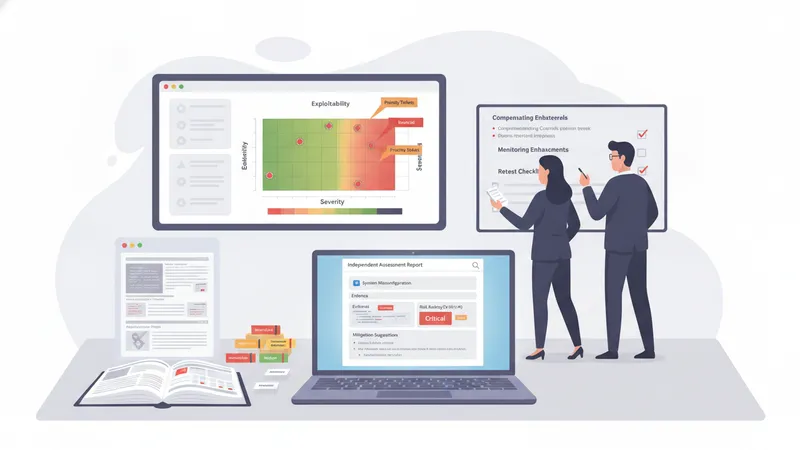
Remediation prioritisation commonly balances severity, exploitability and business impact. High-severity items with easy exploit paths and direct access to sensitive data often receive earlier attention, while lower-severity configuration issues may be scheduled with routine maintenance. Independent reports may also include recommendations for compensating controls or monitoring enhancements to reduce exposure where immediate remediation is not feasible. These recommendations are typically framed as options to consider rather than mandatory prescriptions.
Retesting or verification activities usually follow remediation to confirm that fixes have addressed the originally reported issues. Retests may be scoped to specific findings and may involve the same level of depth as the initial validation, often with reduced effort if changes are isolated. Organisations commonly plan retesting windows and acceptance criteria in advance so that closure of issues is transparent and measurable, supporting governance and audit needs.
Practical considerations include documenting the remediation lifecycle, preserving evidence for audits and tracking residual risk where some findings cannot be fully mitigated immediately. Independent testing can serve as a recurring quality check within a broader assurance programme, and repeated assessments over time may demonstrate trends in control effectiveness. Readers may review these structured processes to understand how external validation fits into ongoing security maintenance and governance.