
When someone looks for a local plumbing professional, a clear evaluative approach can help distinguish qualified practitioners from those who simply advertise widely. The concept involves checking formal credentials, confirming relevant experience, clarifying the scope of services offered, and verifying protections such as insurance and written agreements. This approach aims to reduce uncertainty and provide a factual basis for comparing local providers without relying on marketing claims or single data points.
Evaluation typically includes several independent checks: verification of any required licensing or registration with the appropriate authority, review of customer feedback and references, assessment of whether the plumber performs the specific work needed (for example, pipe replacement versus fixture installation), and scrutiny of written estimates or contract terms. Each of these areas can be examined through documentation, direct questions, and publicly available records where applicable.

Verifying licensing and credentials often begins with the regulator or licensing board relevant to the location. Many jurisdictions require plumbers to hold a specific class of license for work that involves gas or sealed systems, while other routine repairs may be performed by registered technicians. License records may provide scope limitations (for instance, residential versus commercial work) and disciplinary history. When a license is not required locally, other certificates from recognized trade organizations or manufacturer training records may provide useful evidence of relevant competence.
Insurance and liability coverage are practical protections to examine. Liability insurance typically covers accidental damage to property during work, while workers’ compensation addresses injuries to employees. Requesting a certificate of insurance that names the provider and policy period can clarify coverage. Warranties or guarantees for parts and labor are separate elements; these may be offered in writing with specified durations and conditions. Understanding what a warranty covers and any exclusions often helps in assessing potential future costs.
Written estimates and transparent pricing reduce the chance of later disagreement. Estimates commonly identify labor hours or hourly rates, parts prices, permit fees if applicable, and any diagnostic or call-out fees. Some providers may offer flat-rate pricing for defined tasks, while others charge hourly plus parts. Comparing two or more detailed written estimates can reveal differences in scope or exclusions rather than only comparing total numbers. It can also be helpful to ask which components of an estimate are variable and which are fixed.
Customer feedback and references serve as complementary evidence to formal credentials. Public reviews may highlight punctuality, communication, or recurring problems, while direct references from recent clients can provide context about the specific type of work performed. When evaluating feedback, consider patterns across multiple sources and whether issues cited relate to workmanship, scheduling, or billing. Isolated negative comments are sometimes less informative than consistent themes that appear across several reports.
Summing up, a structured evaluation combines documentary verification (licenses, insurance), comparative analysis (multiple written estimates), and qualitative input (references and reviews). This blended approach may reduce uncertainty and surface relevant differences among local providers. The next sections examine practical components and considerations in more detail.
Licensing requirements for plumbing vary by jurisdiction, and understanding the local standard is a starting point. In many areas a journey-level plumber holds a license that allows for a wide range of work, while apprentices and helpers may be limited in scope. Licensing records often list the type of work a credential covers and any disciplinary actions. Contacting the local licensing authority or using an online lookup (where available) can confirm whether a stated credential is current and whether it includes relevant endorsements, such as backflow testing or gas appliance installation.

Certification from trade organizations or manufacturer-specific training may supplement formal licenses. These credentials can indicate additional coursework in areas like tankless water heaters, sump pumps, or pressure systems. While such certificates do not replace an official license where one is required, they can demonstrate focused training for specific equipment. When reviewing certificates, note issuing organizations and dates to assess recentness of training, since product standards and installation methods can evolve.
Examining practical qualifications can also involve asking about supervision and team composition. For larger projects, determine whether a licensed journeyperson will perform or supervise work and what roles apprentices or subcontractors will have. Documentation such as a written list of personnel assigned to a project or subcontractor agreements may clarify responsibility and accountability. This information is relevant for liability, permit compliance, and post-installation follow-up.
Regulatory context often dictates what documentation is most useful. Where permits are required for plumbing alterations, permit records can show who applied and whether inspections passed. A history of compliant permits and passing inspections may be a neutral indicator that work was performed to local code. Keep in mind that permit processes and licensing names differ by place; asking the local authority which records to check can be an informative early step.
Experience can be evaluated by the types and volumes of projects a provider has completed. Providers often specialize in residential repairs, commercial systems, hydronic heating, sewer line replacement, or gas appliance work. Different specializations typically require different skill sets, tools, and safety practices. For example, sewer rehabilitation may involve trenchless equipment and camera inspections, while water heater installation requires knowledge of venting and temperature-pressure safety devices. Consider whether the provider’s documented experience matches the technical needs of the job.
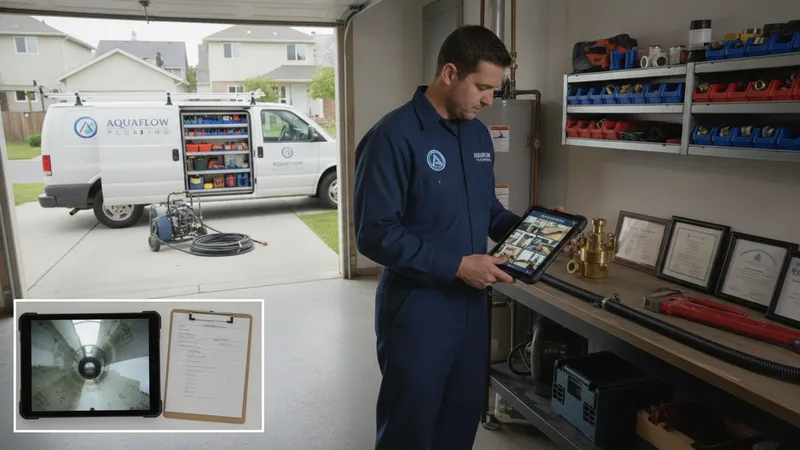
Specialized tasks frequently require distinct certifications or manufacturer-authorized training. Examples include certification for backflow prevention testing, gas-fitting endorsements, or installation training for certain water heater brands. Such qualifications may be described on resumes, company profiles, or training certificates. When assessing a provider’s suitability for a specialized task, ask which specific training or projects demonstrate competence in that area, and whether the provider can show documented examples of similar completed work.
For multi-stage or larger projects, consider how a provider manages project planning and communication. Experience in coordinating permits, inspections, subcontractors, and material deliveries can affect timelines and outcomes. Ask how the provider typically sequences work and what documentation they use for change orders and progress reporting. Providers with longer histories may have established processes for project management; newer providers may still develop such systems even if technically competent.
Availability of tools and diagnostic equipment can signal readiness for specific assignments. Items such as drain cameras, video inspection equipment, pipe locators, and pressure-testing rigs are commonly used for accurate diagnosis and repair planning. The presence of such tools may reduce diagnostic uncertainty and help in producing detailed written estimates. However, tool ownership alone does not assure quality; it should be considered alongside demonstrated experience and documentation of results.
Pricing structures typically fall into several categories: hourly labor rates plus parts, flat-rate pricing for defined tasks, and fixed-price contracts for larger projects. Each model has trade-offs. Hourly billing may provide flexibility for unexpected findings but can be less predictable; flat-rate pricing can clarify cost expectations for well-defined tasks. For larger installations or renovations, fixed-price contracts often include detailed scopes, payment schedules, and milestone descriptions. Requesting written estimates that specify what is included and what is excluded helps compare proposals more objectively.
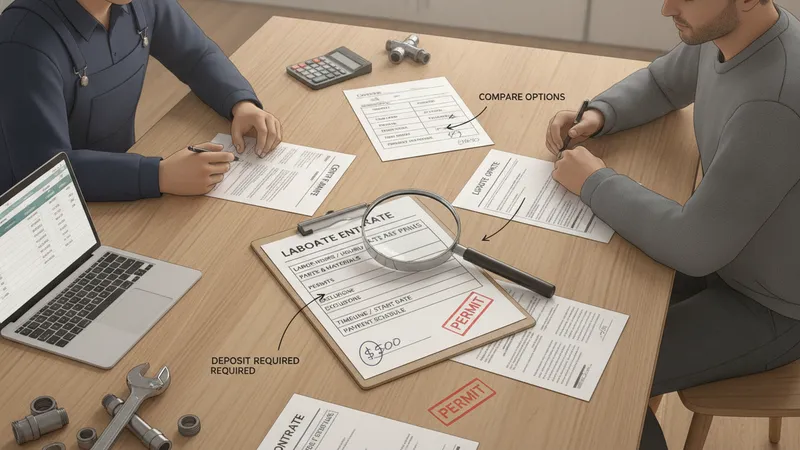
A thorough written estimate commonly lists labor hours or rates, part and material allowances, permit costs if applicable, and a timeline or estimated start date. It may also detail exclusions such as unforeseen structural issues or samples of materials that are not included. When comparing estimates, look for consistency in scope rather than only comparing totals; lower bids may omit necessary work or warranties. Estimates may also state payment terms, whether deposits are required, and acceptable payment methods, which are important contractual elements.
Change orders and contingency procedures are relevant components of contract clarity. A clear process for approving additional work and documenting agreed-upon changes can reduce disputes. Contracts may specify how unforeseen conditions will be priced and how approvals are obtained. Some providers include a contingency allowance for unknowns, while others require separate written approval before proceeding. Understanding these procedures in advance helps set expectations for budget and schedule adjustments.
Guarantees and workmanship warranties are distinct from manufacturer warranties on parts. Workmanship warranties typically cover installation-related defects for a stated period and may be conditional on routine maintenance. Manufacturer warranties apply to specific components and require registration or proof of installation method in some cases. Written warranty terms should state durations, what is covered, and any conditions for voiding coverage. Clarifying these elements in the estimate or contract reduces ambiguity about post-completion responsibilities.
Insurance considerations include general liability, professional liability where applicable, and workers’ compensation. A current certificate of insurance can confirm coverage amounts and policy periods. If work involves property damage or potential environmental contaminants, coverage limits and exclusions become especially relevant. Asking whether a provider maintains policies that cover subcontractors or whether subcontractors carry separate insurance may clarify risk allocation. These inquiries are informational and help determine the existing risk protections tied to the service.
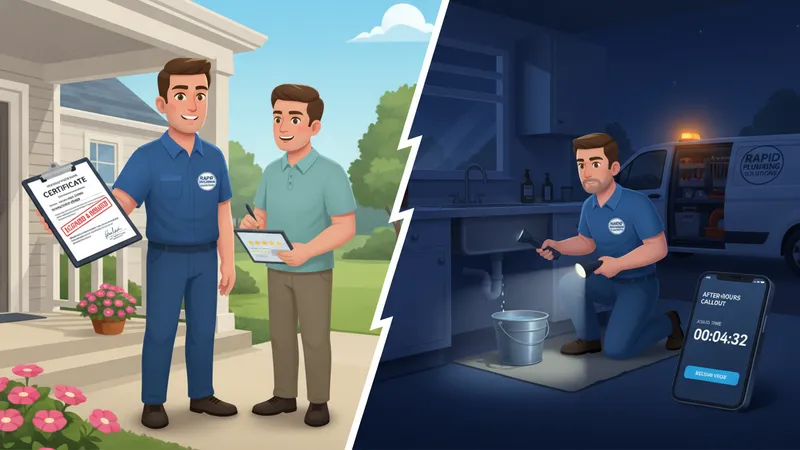
Availability and emergency response practices are practical service attributes to review. Providers may offer standard business hours, extended service windows, or emergency call-out procedures. Understanding response time ranges, how after-hours work is priced, and whether diagnostic or trip charges apply can be useful for planning. For urgent situations such as active leaks, knowing the typical timeframe for a response and any interim mitigation steps the provider suggests may inform decision making in the short term.
Customer feedback and direct references can illuminate recurring strengths or weaknesses in communication, timeliness, and billing practices. When examining reviews, note whether comments reference resolution of similar technical problems and whether follow-up work was needed. Asking for recent references for comparable projects can provide targeted insights. Consider also third-party dispute records or consumer-protection agency reports, when available, as supplementary data points rather than definitive measures.
After-service support and maintenance commitments are part of long-term service considerations. Some providers offer scheduled maintenance plans, inspection reminders, or documentation of completed work for future reference. Keeping records of invoices, warranties, and permits supports any later claims or resale documentation. Evaluating these after-service elements alongside credentials, pricing, and references provides a comprehensive picture of a provider’s suitability for specific needs and helps set realistic expectations for ongoing care.