
Many non-bank lenders provide short- and medium-term financing by using private capital rather than deposits or public funding. These entities may be structured as private companies, investment funds, or groups of individual investors that supply capital for specific projects, property purchases, or business needs. They typically set terms around collateral, repayment schedules, and interest that reflect higher perceived risk or faster transaction timelines compared with traditional commercial lenders.
Operationally, such lenders often focus on flexibility and speed. Underwriting can be more tailored, using asset value, exit strategies, or borrower track record rather than standardized credit score rules. Funding sources may include institutional investors, private equity, or individual accredited investors. Servicing, monitoring, and enforcement practices vary by firm and regulatory environment, and many lenders maintain secondary review processes for collateral valuation and exit feasibility.

Hard‑asset bridge lending commonly uses property appraisal, project plans, and expected resale or refinance as underwriting anchors. Lenders that provide these loans may emphasize loan-to-value (LTV) limits and holdback schedules tied to construction milestones. Fees and interest rates on such facilities may reflect expedited processing and elevated collateral monitoring. Typical documentation can include construction draws, independent inspections, and reserve requirements intended to align borrower activity with lender risk controls.
In private business financing, structures often separate senior secured debt from subordinate or mezzanine layers. Senior creditors normally have first claim on specified assets, while mezzanine providers may take higher yields paired with equity kickers or warrants. Covenants, reporting frequency, and events of default are negotiated to reflect operational risk and projected cash flow. Lenders may require ongoing financial reporting and may impose restrictions on distributions, asset sales, or additional indebtedness to protect capital recovery prospects.
For private mortgage lending, underwriting may weigh collateral condition, local market liquidity, and borrower capacity to execute an exit such as resale or refinance. Credit score-based models can be supplemented or replaced by property-centric valuation and comparable sales analysis. Repayment terms are frequently shorter than conventional mortgages, and amortization may be interest-only with a balloon principal due at maturity. Servicing arrangements may include investor oversight and specific loss-mitigation procedures if occupancy or market conditions change.
Interest rates, origination fees, and prepayment terms in private lending can vary widely depending on collateral type, borrower profile, and deal complexity. Lenders may charge arrangement fees, servicing fees, and default-related penalties in addition to stated interest. Pricing frameworks often consider perceived recovery prospects and transaction speed. Borrowers and capital providers generally evaluate scenarios across multiple repayment outcomes to assess expected returns and stress points rather than relying on a single projection.
In summary, privately funded lenders operate through a mix of asset-focused underwriting, varied loan structures, and bespoke documentation tailored to each transaction. They may offer alternatives where conventional financing is not aligned with project timelines or borrower circumstances, though that flexibility often comes with distinct pricing and covenant frameworks. The next sections examine practical components and considerations in more detail.
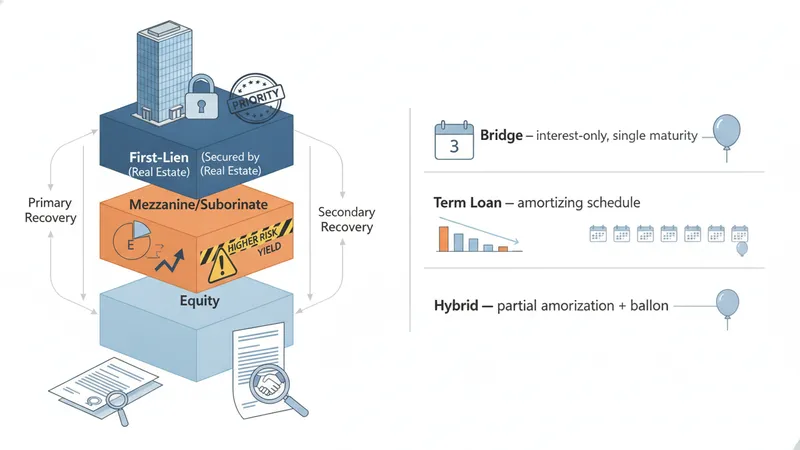
Private lending arrangements often fall into distinct structural categories that reflect collateral, seniority, and intended use of funds. For example, first‑lien loans secured by real estate typically provide priority over later claims and may limit lender exposure to the collateral value. Subordinate or mezzanine debt occupies a different risk position and can pair with equity participation to offset higher yield expectations. Understanding the structure clarifies recovery prospects and contractual obligations when assessing a proposal or reviewing a loan agreement.
Loan term length and amortization conventions can differ substantially across structures. Short-term bridge loans may be interest-only with single maturity payments, while term loans for businesses may amortize principal over a defined schedule. Some private lenders use hybrid models such as partial amortization with a final balloon payment. These choices affect borrower cash flow needs and may influence the types of collateral or guarantees that a lender requests as additional protection.
Covenant design often corresponds to structure and risk exposure. Asset-based facilities may include periodic valuation checks and controlled disbursement schedules tied to project milestones. Business financing frequently uses financial covenants such as minimum liquidity thresholds or leverage caps. Lenders in private markets may also negotiate cure periods, grace windows, and default remedies specific to the asset class to reduce ambiguity in enforcement and recovery planning.
Secondary features like prepayment provisions, default interest, and exit fees are commonly part of structural negotiations. Prepayment language can affect borrower flexibility to refinance if market conditions change, while default rates and enforcement protocols shape recovery timelines. Parties may also define events of default and remedies that trigger collateral acceleration, foreclosure procedures, or negotiated workout paths, which are important practical considerations for both lenders and borrowers contemplating private financing.

Underwriting in private lending typically emphasizes collateral quality, transaction economics, and realistic exit options. Rather than relying solely on standardized credit scoring, underwriters may perform detailed asset appraisals, market comparables, and scenario stress tests. For business loans, cash flow modeling and management assessments can occupy a central role. Borrower experience with similar projects or industries is often factored into lending decisions as an indicator of execution capacity and risk management.
Documentation requested during underwriting may include financial statements, project budgets, appraisal reports, permits, and proof of title or ownership. Lenders frequently require evidence of insurance, contractor agreements, or cost contingencies for construction‑related financing. Legal due diligence on collateral encumbrances and lien positions is also common to ensure that the lender’s security interest can be enforced if recovery becomes necessary.
Borrower requirements can extend beyond financial metrics to governance and reporting obligations. Private lenders often stipulate periodic reporting such as monthly operating statements, draw request substantiation, or occupancy certifications. Such covenants are intended to give the lender timely insight into performance and to provide triggers for corrective action if conditions deteriorate. These requirements may vary according to deal size, asset class, and perceived counterparty risk.
Considerations for underwriting also include regulatory and tax factors that may influence deal feasibility. For cross-jurisdictional or complex business structures, advisors may evaluate compliance with local laws, licensing, or tax treatment of interest and fees. These assessments affect expected net returns and may lead to structural adjustments such as escrow accounts or withholding arrangements to manage regulatory exposure while preserving the intended economic outcome.

Pricing in private lending generally reflects asset risk, term length, and liquidity considerations. Interest rates may be stated as fixed spreads, variable rates tied to reference indices, or blended yields that incorporate fees and arrangement charges. Origination fees, commitment fees, and servicing fees are additional cost elements that can materially affect the effective interest burden. Parties often negotiate fee timing and capitalization to match the borrower’s cash flow and project lifecycle.
Repayment profiles often align with expected exit strategies. Short-term investments may rely on project completion, resale, or refinance as the repayment source, leading to interest-only periods followed by a balloon payment. Longer-term business financings may use amortizing schedules to reduce principal risk over time. Lenders and borrowers frequently model sensitivity to slower-than-expected exits to evaluate potential extension fees, maturity amendments, or structured workout options before default occurs.
Prepayment and penalty provisions influence refinancing flexibility. Some agreements permit prepayment without penalty after defined intervals, while others include prepayment premiums or breakage charges tied to lost yield. Late payment remedies and default interest rates are commonly specified to preserve recovery incentives and to compensate for increased enforcement costs. Transparency in how these terms are calculated is important for both parties to anticipate financial outcomes during stress scenarios.
Fee disclosure and documentation practices vary; however, clear schedules that itemize all recurring and one‑time charges are standard in prudent transactions. Lenders may present illustrative amortization and fee schedules during due diligence so borrowers can project total financing costs. Careful review of these schedules and assumptions can help participants assess affordability and align expectations around refinancing, sale, or operational cash flow needed to meet repayment obligations.

Collateral evaluation is central to risk assessment in privately funded loans. For real estate, appraisals, environmental reviews, and title searches inform value and enforceability. For business loans, collateral may include accounts receivable, inventory, or intellectual property, each requiring specialized valuation approaches. Lenders typically consider liquidity of the collateral and the probable recovery timeframe under distressed scenarios when deciding on advance rates and required reserves.
Documentation standards commonly include loan agreements, security instruments, perfection filings, and intercreditor arrangements when multiple lenders are involved. Clear priority rules and enforcement procedures are especially important in layered capital structures. Legal opinions and closing certificates may be required to confirm corporate authority, enforceability, and absence of undisclosed liens, reducing post-closing litigation risk and clarifying recovery pathways.
Risk considerations extend to market cycles, interest rate movements, and borrower operational risk. Scenario analysis such as sensitivity testing or downside valuation often guides covenant design and capital reserves. Lenders may require insurance, escrowed reserves, or third-party monitoring to mitigate specific risks. Where recovery depends on property resale, local market liquidity and comparable sales history typically influence acceptable loan-to-value thresholds.
Ongoing monitoring and workout planning are practical components of risk management. Regular reporting, independent inspections, or trustee arrangements can provide early signals of performance deterioration. When remediation is necessary, negotiated forbearance, restructuring, or orderly asset disposition are common alternatives to immediate enforcement. Documenting these potential pathways in advance may reduce time and cost during stressed conditions while clarifying expectations for all parties involved.