
Unified communications over modern mobile networks refers to the integration of voice, video, messaging, and collaboration services over a single network fabric that is designed for high capacity and low latency. This concept emphasizes delivering synchronised communication tools—call signalling, real-time media, presence, and shared applications—over packet-based mobile infrastructure rather than treating each channel as a separate service. Underlying elements may include cloud-native application servers, session control frameworks, and programmable transport layers that enable applications to operate together with fewer protocol boundaries.
Technical enablers typically include radio access enhancements, a software-defined core, and in-network programmability that together support concurrent media streams and data services. The architecture often pairs session management functions (for example, SIP-based control or IMS-like alternatives) with application-layer platforms that handle collaboration features. Convergence here means that voice, video, and messaging can share the same service logic and quality controls instead of being routed and managed as isolated silos.

Network slicing and service-level segmentation are commonly referenced approaches to ensure differentiated handling of unified communications traffic. By partitioning network resources logically, an operator or service provider may assign predictable bandwidth, latency, and isolation characteristics to communication services. Selection criteria for slices often include latency targets, throughput ranges, and concurrent session limits. These partitions can be dynamic, adapting to time-of-day or load, and are typically coordinated with application-layer controls so that the communication stack can request or release resources as sessions evolve.
Edge computing frequently complements slicing by hosting media servers, transcoding, and application logic nearer to endpoints. In practical deployments, edge nodes may perform media mixing, AI-based audio/video enhancement, or temporary caching of shared content to improve perceived responsiveness. This pattern often reduces core transport usage and may allow services to meet stringent latency objectives that are important for real-time collaboration. Operators and application developers may plan service placement based on user distribution and the specific media-processing requirements of each application.
Quality of service (QoS) models and congestion management remain central to predictable unified communications behavior over wireless links. Radio-aware scheduling and differentiated packet treatment across transport domains can help maintain audio continuity during variable signal conditions. However, wireless environments are inherently variable, so designs typically include adaptive codecs, jitter buffering, and retransmission strategies that can tolerate transient degradations. Integrations between the application layer and network control plane often enable coordinated adjustments in codec bitrate or media fidelity when network conditions change.
Interoperability and session continuity are important operational considerations when users move between access types (for example, Wi‑Fi and cellular). Handover schemes and session anchoring methods may be used so that ongoing calls or conferences persist when a device switches networks. Architectures that separate session control from media pathing can enable flexible media rerouting and reduce the likelihood of dropped sessions. Planning for diverse client implementations and testing across device types is commonly advised, since endpoint behavior can influence perceived continuity.
In summary, unified communications delivered over advanced mobile networks combines session control, media handling, and application services on a shared, programmable transport that may include slicing and edge hosting. Implementations typically balance network-level guarantees with application-level adaptation to achieve usable voice, video, and messaging performance. The next sections examine practical components and considerations in more detail.

Network slicing may provide distinct virtual networks tailored to communication service needs, and these slices can carry differing QoS profiles for voice, video, and collaborative data. A slice intended for voice might prioritise low jitter and bounded latency, while a slice for file synchronization may emphasise throughput. In many operational models, slice configuration ties into orchestration systems that map service-level objectives to transport policies. When assessing slicing as part of unified communications, stakeholders often consider manageability, slice isolation, and the ability to adjust slice parameters as session loads shift.
QoS provisioning across radio, transport, and core domains typically involves marking and mapping traffic classes so that packet treatment is consistent end-to-end. Radio schedulers may allocate uplink and downlink resources differently depending on device conditions, which in turn can affect end-user media quality. Practical designs often combine network-side QoS with adaptive application behavior—such as scalable video codecs or variable bitrate audio—so services can maintain continuity when a slice cannot fully meet transient demand.
Operational considerations often include monitoring and analytics that correlate slice performance with user experience metrics like MOS-like scores, packet loss, and rebuffer events. These correlations may help teams adjust slice templates or orchestration parameters. Another practical point is inter-domain coordination: slices that traverse multiple administrative boundaries require agreed-upon interfaces, shared telemetry, and compatible orchestration policies to remain effective for unified communications use cases.
As an informational transition, readers may note that slice design choices typically interact tightly with edge placement and media handling strategies. Understanding how slice characteristics translate to actual packet treatment and media performance can help architects choose where to host conferencing or presence services to meet target behaviors without overprovisioning. Continued sections address edge and media handling in more detail.
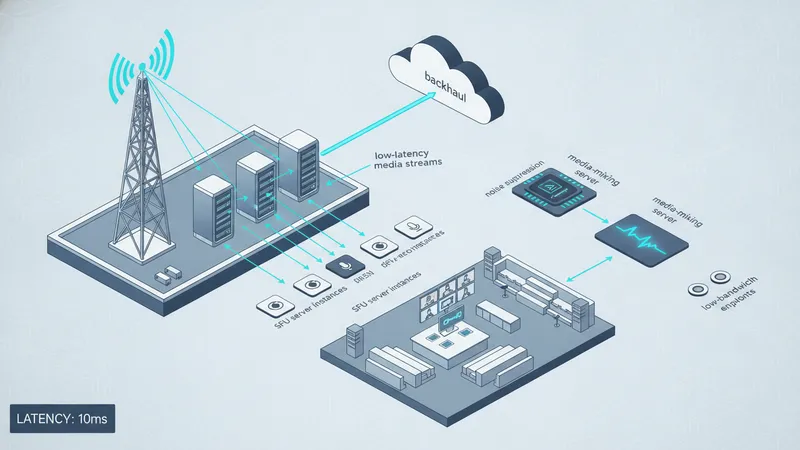
Edge compute nodes are often positioned to reduce the distance that real-time media must travel, which can lower round-trip latency for interactive voice and video. Typical edge functions for unified communications include media mixing, transcoding, recording, and AI-based enhancement such as noise suppression. Deploying these functions near radio aggregation points may help conserve backhaul capacity and improve responsiveness for geographically concentrated user groups. Architects may plan edge capacity by profiling expected concurrent sessions and media-processing load.
Media-handling strategies commonly include selective forwarding units (SFUs) for multiparty video, where media streams are forwarded with minimal server-side mixing, and media servers that perform mixing when necessary for low-bandwidth endpoints. In edge deployments, SFUs may scale horizontally across instances to handle bursts in conference participants. Decision factors for SFU versus mixing approaches often include endpoint capabilities, expected group sizes, and the latency sensitivity of the application.
Real-world deployments often balance edge placement against operational complexity: more edge nodes can reduce latency but increase orchestration and state synchronisation requirements. Considerations include how stateful session information is replicated, how failover is handled, and how analytics are aggregated for monitoring. These are typically design trade-offs rather than absolute rules, and choices often reflect an operator’s topology and expected traffic patterns.
Looking ahead, integration between edge-hosted media services and network orchestration may enable more dynamic placement of processing tasks based on live load and user location. Such coordination may be beneficial for unified communications because it can match processing location to current session needs. The next page expands on mobility and client-side considerations for converged services.

Maintaining uninterrupted sessions as users move across coverage areas and between access networks is a core requirement for converged communications. Session continuity approaches often separate control-plane state from media-plane paths so that media can be reanchored or rerouted without losing call or conference context. Techniques may include media relay anchors, session border controllers, or application-layer reconnection mechanisms. Endpoint implementations also influence continuity: client libraries that support quick re-registration and state resynchronisation tend to reduce perceptible disruption during handover.
Endpoint diversity is a practical factor; unified communications clients run on phones, tablets, desktops, and specialized devices with varying CPU, battery, and network characteristics. Applications commonly include adaptive features like variable framerate, resolution scaling, and energy-aware networking to preserve user experience across devices. Developers often test across representative device classes and network conditions to understand how client-side decisions interact with network-provided QoS and slicing.
Handover scenarios may introduce transient packet loss or reordering, so codecs and jitter buffers often include mechanisms to smooth playback during short interruptions. For multi-party sessions, architectures that avoid single points of failure and that enable local recovery can reduce the impact of mobility events. Operational testing under realistic mobility patterns is typically used to validate whether the chosen session continuity mechanisms meet expected user experience targets.
As a transition, consider that security and interoperability are closely linked to mobility and client support: session handoffs, roaming, and multi-homed clients all affect how credentials, encryption keys, and session policies are managed. The following page addresses those security and interoperability aspects in depth.

Security for converged communications over advanced mobile networks usually layers transport security, authentication, and access control to protect both signaling and media. End-to-end encryption for media and messaging can be applied at the application layer, while transport-layer protection such as IPsec or TLS secures control-plane interactions. Practical deployments often balance cryptographic protection with in-network functions like lawful intercept or media processing, using architectures that clearly delineate which functions may access unencrypted media and under which controls.
Privacy considerations commonly involve data residency, metadata handling, and user consent for media processing—especially when media is processed at edge nodes or in third-party clouds. Designers often adopt data minimisation and clear logging practices to limit exposure of personal information. Interoperability also matters: adherence to common protocols and profiles (for signaling, media codecs, and presence semantics) helps services interconnect across vendors and domains while reducing translation overhead that can add latency or degrade quality.
Operationally, interoperability testing and conformance checks are frequently used to validate multi-vendor environments. Session border elements and protocol gateways may be required where differing implementations meet, and these components introduce their own latency and security considerations. Teams typically profile these elements in lab and field trials to understand trade-offs and to tune codec negotiation and keepalive strategies for stable operation across heterogeneous networks.
In closing, unified communications over high-capacity mobile networks is a systems-level endeavor involving network partitioning, edge placement, adaptive media handling, and layered security. Implementers and operators often approach these issues as trade-offs that can be tuned for particular user populations and service expectations. This final section complements earlier material by tying security and interoperability back to slice design, edge strategy, and client behaviour, rounding out a practical view of converged communications over next-generation mobile networks.