
Automated systems that combine machine learning, natural language processing, and predefined rules can analyze prospect activity and generate email actions with minimal human intervention. In practical terms, these systems ingest inputs such as form submissions, click behavior, website visits, and CRM records, then apply models or templates to assign lead intent scores, select message variants, and schedule sends. The overall aim is to create repeatable sequences that move contacts through stages commonly associated with lead development, while reducing manual steps in list management and message assembly.
Core functions typically include classifying incoming contacts, segmenting audiences by inferred interest or value, and composing messages that match a recipient’s context. Automation may route higher-scoring contacts into faster or more tailored sequences and may suppress outreach for contacts who recently converted or unsubscribed. Implementations vary: some use simple rule engines with conditional branching; others layer predictive models that update scores as new signals arrive. The following concise examples illustrate representative methods and tool types used in these workflows.
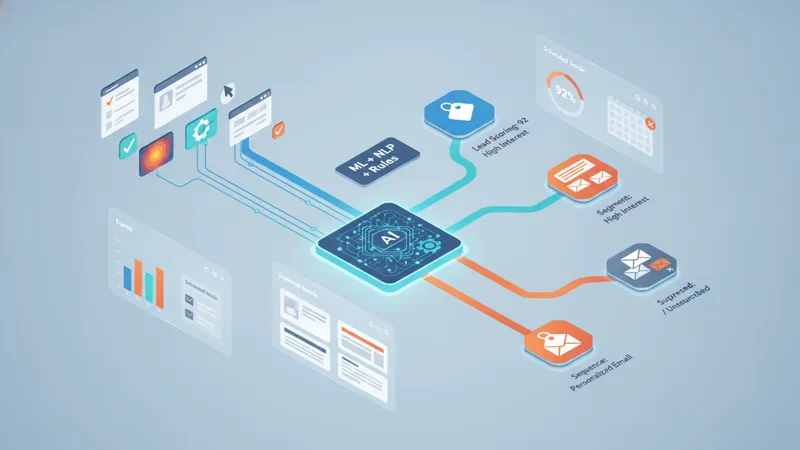
Comparatively, rule-based and model-driven methods often coexist within the same system. Rule-based logic may handle compliance and simple routing (for example, suppressing sends to unsubscribed contacts), while predictive scores may prioritize outreach within those rules. Organizations that adopt mixed approaches typically gain practical control: deterministic rules maintain governance, and probabilistic models guide prioritization. This combination can also ease auditability, because rules are explicit and model outputs can be logged for later review rather than acting as sole decision-makers.
Segmentation strategies informed by automated tools often rely on both explicit data (form fields, purchase history) and implicit signals (time on site, email opens). AI components can cluster recipients into microsegments that may not be obvious from manual inspection, but these clusters should be interpreted with care. Analysts often validate automated segments against conversion patterns before widely deploying new sequences. Measurement frameworks that incorporate holdout groups or A/B tests may help determine whether automated segmentation produces material differences in lead progression without assuming uniform effects across audiences.
Personalization through content generation may increase message relevance, yet it can also introduce risks if templates or models produce inaccurate assertions about a contact’s status. Typical mitigations include using verified CRM fields for factual statements, limiting generative text to descriptive or neutral phrases, and maintaining content preview steps. In many setups, dynamic fields are combined with template logic so that personalization adapts to available data without overstating unknown attributes, thereby reducing the chance of misleading recipients.
Operationally, automated follow-up sequences and scheduling logic often balance engagement patterns and sending cadence. Systems may delay follow-ups after certain events (for example, a recent purchase) or escalate contact frequency based on scoring thresholds. Scheduling algorithms can account for time zones and customary business hours, and they may back off if engagement signals indicate disinterest. These behaviors typically require ongoing tuning: what works for one audience segment may not transfer directly to another without adjustments informed by observed metrics.
In summary, these automated approaches to email-driven lead workflows combine scoring, segmentation, templating, and event-driven logic to reduce manual orchestration while preserving governance through explicit rules. Implementations vary by technical maturity, data availability, and organizational priorities; therefore, understanding the interplay between deterministic rules and probabilistic models is often critical. The next sections examine practical components and considerations in more detail.
Predictive scoring systems in email workflows commonly use supervised learning models trained on historical engagement and conversion data to estimate a contact’s likelihood to take a next-step action. Typical features include email opens, click patterns, page views, form completions, and demographic or firmographic fields when available. Scores may be refreshed in near real time as new signals arrive, and threshold bands can route contacts into differentiated sequences. Practitioners often treat these scores as one input among several, and they may calibrate thresholds periodically to reflect changes in campaign behavior or market conditions.
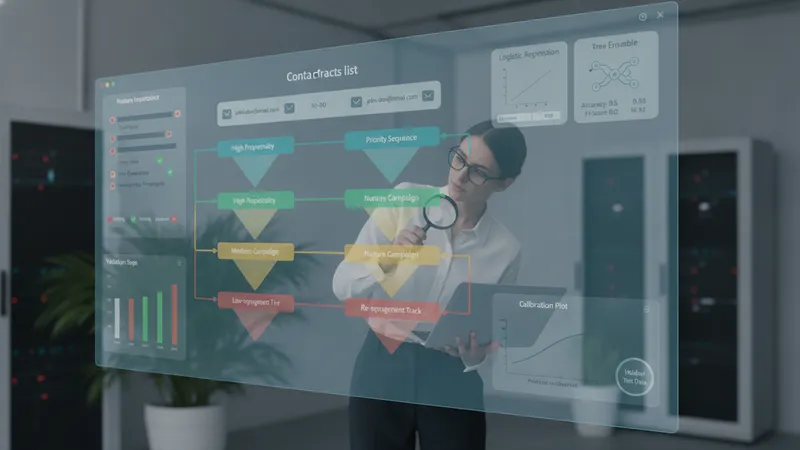
Model interpretability and feature selection are relevant operational considerations. Simpler models such as logistic regression may be preferred where explainability is needed for compliance or cross-team alignment, while tree-based ensembles can capture nonlinear interactions when predictive performance is a priority. Data quality matters: noisy or sparse fields can skew scores, so teams often implement feature engineering and data validation steps. Where available, holdout evaluation and calibration plots may help assess whether a score aligns with observed conversion rates before it is used to automate routing.
Integration patterns matter: predictive scores can be computed inside a marketing platform, generated by a dedicated analytics service, or provided via an external API. Each pattern has trade-offs in latency, governance, and maintenance. In-platform scoring may be convenient but limited in model complexity; external scoring services can host advanced models but require secure data flows and mapping of identifiers. Teams often document data flows and retention policies to ensure that automated scoring aligns with privacy norms and internal data governance frameworks.
Common considerations for adopting predictive scoring include monitoring drift, setting conservative thresholds, and using scores as prioritization rather than absolute decision rules. Monitoring pipelines that track feature distributions and score histograms may indicate when retraining or feature revisions are necessary. These practices help maintain the reliability of automation over time and encourage measured use of model outputs within broader lead generation workflows.
Lead capture methods feed the early stages of email workflows and often combine form data, UTM parameters, and behavior signals to create initial contact profiles. AI-enhanced capture can enrich records via public data or lookups, and basic qualification logic may tag contacts according to inferred intent. Segmentation then groups contacts by shared characteristics or engagement patterns; algorithms such as clustering or propensity modeling can reveal microsegments that manual rules might miss. These automated segments typically require validation against downstream outcomes before being used at scale in lead nurture sequences.

Qualification rules may be hybrid: explicit criteria (e.g., industry or company size) combined with behavioral thresholds (e.g., page depth or repeated visits). Automated systems can flag high-priority contacts for faster follow-up or route them into specialized sequences. It is common to maintain audit trails for qualification decisions, so teams can review why a contact entered a particular pathway. This traceability supports iterative refinement of both capture fields and the models or rules that interpret them.
Segmentation strategies informed by AI often include temporal dimensions, such as recency of interaction or decay functions for older signals. Time-aware segmentation may reduce outreach to contacts whose signals have aged, and it may elevate contacts with fresh interactions. Teams usually implement conservative decay parameters initially and then adjust based on observed engagement patterns. This approach helps balance relevance with the risk of over-communicating to segments that have not recently demonstrated interest.
When configuring automated segmentation, privacy and consent considerations are relevant. Systems should respect opt-out flags and consent records, and segmentation logic may need to exclude contacts or alter processing based on legal and policy constraints. Documenting how segments are constructed and what data sources feed them aids compliance reviews and ensures that automated classification aligns with stated privacy commitments to contacts.
Personalized workflows combine segmentation outputs with template logic to assemble email variations tailored to recipient context. Templates often include dynamic fields for known attributes and conditional blocks that adjust content based on segment membership. Automated follow-up logic may escalate frequency or change messaging when certain triggers occur, such as a download or a demo request. Scheduling algorithms typically consider recipient local time and historical engagement windows to choose send times that may increase visibility without presuming universal optimal times.
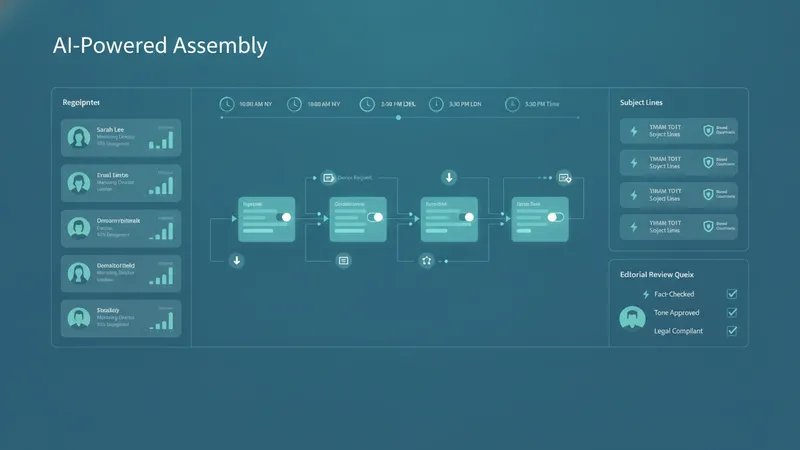
Generative text models are sometimes used to produce subject lines or short body variants; however, many teams implement guardrails so generated content remains factual and consistent with brand guidelines. Common guardrails include content templates with limited generative slots, editorial review queues for new templates, and checklist-based validation for claims that reference a contact’s status. These measures aim to reduce the chance of erroneous or misleading statements while still leveraging automation to scale personalization.
Automated follow-ups often use staged timing and conditional logic: a sequence may pause if a contact replies or convert, or it may advance to a different branch if a link is clicked. Back-off rules may suspend outreach for a period after a negative signal, such as a spam complaint or unsubscribe. Teams frequently instrument sequencing with monitoring metrics—reply rate, conversion rate, unsubscribe rate—to detect when a workflow requires tuning, and they may run controlled experiments to compare cadence variants.
From an operational perspective, maintaining clear ownership of templates, segment definitions, and scheduling rules is useful. Cross-functional handoffs between marketing operations, analytics, and legal or privacy teams may be needed to manage content approval and consent requirements. Documented workflows and change logs support accountable automation and help teams iterate while limiting unintended impacts on recipient experience.
Integration with CRM systems, analytics platforms, and data warehouses is central to effective automated email workflows. Data synchronization patterns—near real time versus batch—impact how quickly new signals update scores and trigger sequences. When planning integrations, teams often assess identifier mapping, field-level consistency, and latency to determine whether a given tool can support intended automation use cases. Maintaining consistent contact identifiers across systems helps preserve state and avoids duplicate or conflicting outreach.
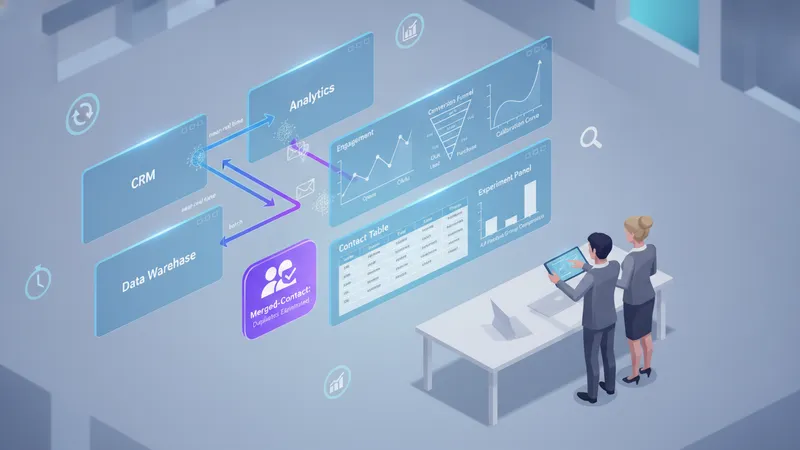
Reporting and analytics typically include engagement metrics (opens, clicks), downstream measures (lead conversions), and model performance indicators (score distributions, calibration). Dashboards that combine these signals can help teams monitor campaign health and detect performance drift. Many organizations use experimentation frameworks or holdout groups to evaluate whether automation changes materially influence lead progression, treating analytic outcomes as iterative evidence rather than definitive proof of causation.
Privacy and compliance considerations often shape what data can be used and how long it can be retained. Consent records, suppression lists, and data minimization practices may limit personalization. Teams frequently document data flows, retention policies, and access controls to align automation practices with regulatory and internal requirements. Conservative approaches—such as restricting sensitive attribute usage or anonymizing where possible—may reduce compliance risk while allowing for practical personalization.
Tool selection considerations typically weigh factors such as extensibility, model transparency, integration options, and operational support. Organizations often pilot multiple approaches to compare how well predictive scoring, content generation, and workflow orchestration interoperate within their tech stack. Selection decisions may prioritize maintainability and observability—how easy it is to inspect model outputs, update templates, and audit sequences—rather than relying solely on vendor feature lists. These considerations support sustainable automation that can be adjusted as data and business priorities evolve.