
Biomass gasification systems are engineered processes that convert solid organic materials into a combustible gas mixture through controlled thermochemical reactions. In these systems, biomass undergoes drying, pyrolysis, partial oxidation, and reduction under elevated temperatures to produce synthesis gas (syngas), which typically contains hydrogen (H2), carbon monoxide (CO), carbon dioxide (CO2), methane (CH4), and light hydrocarbons. The conversion path depends on reactor design, heating rate, and the presence of oxidants such as air, oxygen, or steam. Gasifiers are sized and configured to balance thermal inputs, reaction residence times, and desired syngas composition for downstream use.
Key operational variables include temperature profiles, equivalence ratio (the fraction of oxidant relative to complete combustion), and feedstock characteristics such as moisture and particle size. Different reactor types—fixed-bed, fluidized-bed, and entrained-flow—promote distinct reaction regimes and syngas properties. Gas cleaning and conditioning stages follow conversion to remove tars, particulates, and alkali species when syngas is intended for engines, turbines, or synthesis processes. System integration often considers heat recovery and gas utilization pathways to improve overall energy efficiency.
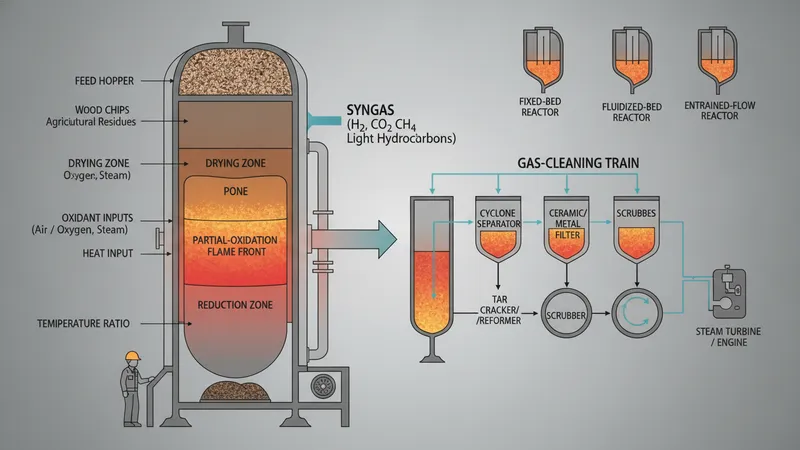
Comparative reactor performance often hinges on trade-offs between feed flexibility and syngas cleanliness. Fixed-bed designs can tolerate larger particle sizes and simpler feeding systems but may produce higher tar yields that complicate downstream use. Fluidized beds generally provide more uniform temperature distribution and can support staged gasification for improved conversion, though they can be sensitive to ash characteristics and bed agglomeration. Entrained-flow reactors operate at higher temperature and pressure ranges that may suppress tar formation but typically demand more intensive feed preprocessing and auxiliary energy input.
Feedstock preparation is a central determinant of process stability and syngas quality. Moisture content, particle size, and inherent ash composition influence drying energy, heat transfer, and slagging or fouling tendencies. Typical target moisture levels for many gasifiers may range from about 10–20% on a wet basis, though specific systems can accept higher or lower values depending on thermal design. Pretreatment options such as drying, torrefaction, or pelletizing can improve fuel homogeneity but introduce additional processing steps and energy considerations that affect overall system efficiency.
Energy efficiency in gasification systems can be evaluated through cold gas efficiency and overall system energy balance, taking into account heat recovery and power generation choices. Cold gas efficiency—ratio of chemical energy in produced syngas to energy in the dry feedstock—may vary widely with reactor type and operating conditions and often falls below unity when parasitic loads and gas cleaning are included. Integration strategies such as combined heat and power (CHP) or catalytic upgrading can influence how much primary energy is practically recovered from the biomass source.
Environmental considerations encompass emissions, lifecycle greenhouse gas implications, and residues management. Gasification can reduce direct particulate and volatile emissions compared with open burning of biomass when properly controlled, but attention to tar decomposition and trace contaminants is important. Ash and char byproducts may contain concentrated minerals and heavy metals depending on feedstock, which affects disposal or recycling options. Lifecycle assessments often emphasize feedstock sourcing and land-use impacts as key variables when estimating net carbon flows associated with gasification-based energy.
In summary, these systems convert solid biomass into a versatile synthesis gas through staged thermochemical reactions that are sensitive to feedstock, reactor design, and operating conditions. Practical implementation typically balances feed preparation, reactor selection, syngas cleaning, and energy integration to meet targeted end uses such as heat, power, or chemical synthesis. The next sections examine practical components and considerations in more detail.
Feedstock preparation frequently determines the stability and efficiency of a gasification system. Typical preparation tasks include size reduction, drying, and homogenization to achieve a consistent particle size and moisture content suitable for the chosen reactor type. Mechanical shredding or milling may be required for entrained-flow systems, while fixed-bed and fluidized-bed reactors often tolerate coarser material. Moisture management commonly involves passive drying or waste-heat integration; achieving moisture levels near 10–20% may reduce energy required for drying in many designs. Operators often monitor ash fusibility and mineral content since these factors can affect slagging and bed behavior.
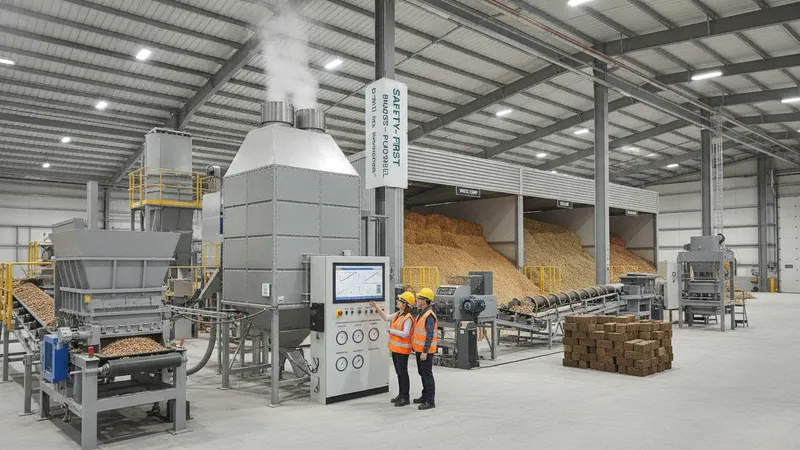
Logistics and storage are practical considerations that can affect feedstock quality over time. Biomass stored in piles may self-heat or degrade, altering moisture and calorific value; covered or ventilated storage reduces variability. Transport costs and seasonal availability often influence the scale of local supply chains and may favor densification methods such as pelletizing or briquetting to improve bulk handling. When feedstock originates from agricultural residues or mixed wood streams, preprocessing strategies can standardize properties to minimize operational interruptions caused by heterogeneity.
Water and oxygen content in feedstock influence gas composition and conversion efficiency. Higher moisture increases the latent heat demand for drying and can lower reactor temperatures unless supplemental heat is provided, which in turn may alter tar formation and gas yields. Conversely, steam co-feeding can be used intentionally to promote hydrogen production through water–gas shift and reforming reactions, though it requires management of steam-to-carbon ratios and catalytic behavior in downstream units. These trade-offs are often evaluated at design stage to match syngas targets.
Insider considerations include matching preprocessing to reactor tolerance and planning maintenance around expected ash behavior. For instance, alkaline residues in certain crop wastes can lead to bed agglomeration in fluidized systems, so blending or ash mitigation strategies may be considered rather than simply increasing temperature. Early-stage feedstock characterization—proximate and ultimate analysis—can inform which preparation steps most effectively reduce operational risk. These considerations may help designers and operators optimize throughput and syngas quality while minimizing unscheduled downtime.
Gasification progresses through identifiable stages: drying, pyrolysis, oxidation (partial combustion), and reduction. During drying, free moisture is removed; pyrolysis thermally decomposes organic macromolecules into char, volatiles, tar, and gases. Oxidative reactions supply heat by partially combusting a fraction of the feedstock, establishing temperatures needed for endothermic reduction reactions that convert char and volatiles into syngas components. Key reduction pathways include the Boudouard reaction (C + CO2 ⇌ 2CO), water–gas reaction (C + H2O ⇌ CO + H2), and various reforming reactions that influence the relative amounts of H2 and CO in the product stream.
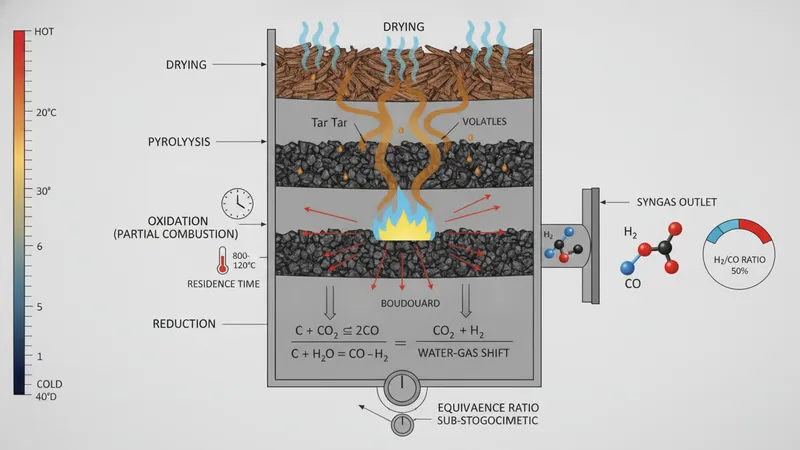
Temperature and residence time strongly affect the relative importance of these reactions. Lower-temperature regimes may yield higher tar and char, while higher temperatures can favor gas-phase reforming and tar cracking. Equivalence ratio, defined as the ratio of actual to stoichiometric oxidant, is often controlled in the range that allows partial oxidation without complete combustion; typical values vary by reactor and feedstock but are usually below the stoichiometric point for full combustion. These process levers may be adjusted to steer syngas composition toward greater hydrogen or carbon monoxide content depending on downstream needs.
Tar formation and cracking are significant operational concerns because tars can condense and foul downstream equipment. Tar yield is influenced by feedstock lignin content, heating rate, and temperature profile. Thermal cracking at elevated temperatures and catalytic reforming using catalysts such as dolomite or nickel-based materials may reduce tar levels but introduce cost and catalyst management considerations. Understanding the balance between thermal conditions and catalyst use is important for designing downstream gas cleaning and conditioning strategies appropriate for the intended application.
Operational tips include monitoring gas temperature profiles and using staged air or steam injection to manage hotspots and promote complete conversion of volatiles. Instrumentation for syngas composition, tar sampling, and particulate load can provide feedback for adaptive control strategies. Designers may also consider modular approaches that allow retrofit of additional cleanup or reforming units as syngas end-uses evolve. These practical measures often help align thermochemical behavior with reliability and maintainability expectations over a system’s operational lifetime.
Syngas composition typically includes hydrogen, carbon monoxide, carbon dioxide, methane, and trace light hydrocarbons; exact proportions depend on feedstock and operating parameters. Quality factors relevant to applications include calorific value, tar concentration, particulate load, and the presence of contaminants such as sulfur compounds, chlorine, and alkali metals. These species can influence engine performance, catalyst lifetime, and emissions. For power generation, lower tar and particulate levels are usually required, while synthesis routes for chemicals may demand tighter contaminant specifications, particularly with respect to sulfur and chlorine.
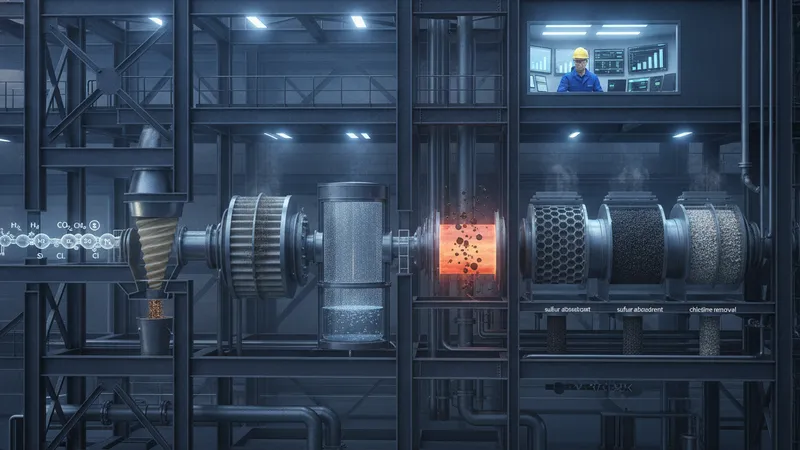
Gas cleaning methods span mechanical to chemical approaches. Cyclones and filters remove particulates, while scrubbers and wet cleaning may reduce soluble contaminants. Thermal cracking and catalytic reforming can lower tar concentrations, and adsorption or absorption systems target sulfur and chlorine species. Selection of cleaning methods often reflects an economic and technical balance: more stringent cleanup improves syngas usability but increases capital and operational costs. Many system designs include staged cleaning, with bulk removal upstream and finer polishing units downstream, to manage costs while meeting required gas quality.
Measurement and monitoring are integral to maintaining syngas quality. Periodic gas sampling for tar profiling, continuous monitoring of key gas species (H2, CO, CO2, CH4), and particulate counting may be implemented depending on risk tolerance. Trace contaminants may require laboratory analysis on a less frequent schedule. These data support decisions about when to regenerate filters, replace catalysts, or adjust operating conditions to prevent degradation of downstream equipment. Quality control protocols often form part of routine operations, especially where syngas supports sensitive processes.
Practical considerations for operators include designing cleanup systems that match the intended syngas end use and planning for maintenance of sorbents and catalysts. For small-scale systems, simpler filtration combined with thermal tar management may suffice for heating applications, whereas medium-to-large systems intended for gas engines or chemical synthesis generally require multi-stage cleaning trains. Establishing clear gas quality targets during design reduces retrofit risk and supports predictable operational costs associated with consumables and maintenance.
Syngas from biomass gasification can be used across a range of energy applications, including direct combustion for heat, combined heat and power (CHP) systems, engine or turbine-driven electricity generation, and chemical synthesis through catalytic pathways. The choice of application affects required syngas quality and system configuration: power generation often tolerates lower syngas purity than processes that feed catalytic reactors. Integration strategies, such as heat recovery to support feedstock drying or steam generation for hydrogen-enhancing reactions, may improve overall energy efficiency and reduce external energy inputs.
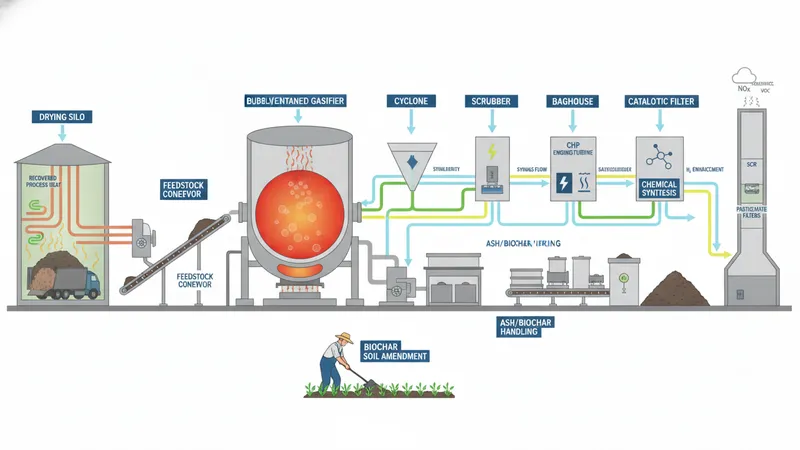
System integration also considers lifecycle environmental performance. When feedstock is sourced from residues or sustainably managed biomass, greenhouse gas balances may be favorable compared with fossil fuels, though outcomes depend on logistics, preprocessing energy, and land-use change effects. Emissions control for NOx, particulates, and volatile organics remains important to meet local air quality requirements. Management of solid residues like ash or biochar is another environmental factor; residues may be used as soil amendments or require disposal depending on contaminant levels.
Operational optimization often explores trade-offs between electrical efficiency and useful heat recovery. Smaller gasification units may prioritize heat for local industrial processes, while larger systems may favor electricity production with appropriate power conditioning and grid interconnection. Economic and environmental assessments typically incorporate the value of heat utilization and the costs of gas cleaning and maintenance. Sensitivity analysis on feedstock availability and seasonal supply variability is commonly used to assess long-term viability without implying financial outcomes.
Insider considerations include planning for variable syngas demand and modular upgrades. For instance, a facility that initially supplies heat might plan space and connections for later addition of gas polishing or catalytic units if the operator later pursues electricity generation or synthesis routes. Regular environmental monitoring and adaptive management of feedstock sourcing can help maintain compliance with emission standards and support transparent reporting on greenhouse gas performance. These measured approaches can inform phased deployment and reduce operational uncertainty over time.