
An enterprise IT service management platform organizes IT operations by grouping capabilities into modules for incident tracking, problem analysis, change coordination, asset tracking, and service request fulfilment. Such a platform typically centralizes data in a configuration management database (CMDB), supports defined workflows to route tasks and approvals, and provides a single interface for service agents and end users. The conceptual goal is to provide a cohesive set of functions that can be configured to reflect organizational processes, roles, and operating procedures while enabling visibility across incidents, changes, assets, and requests.
Key capabilities often include workflow engines to automate routine steps, a service desk interface for handling tickets, reporting and dashboards for operational metrics, and knowledge base tools to capture institutional information. The platform may integrate with monitoring systems, identity sources, and external tools using APIs or connectors. Implementation typically involves mapping existing processes to platform modules, defining SLAs and escalation rules, and configuring forms and notifications to match organizational needs rather than replacing governance or process design.
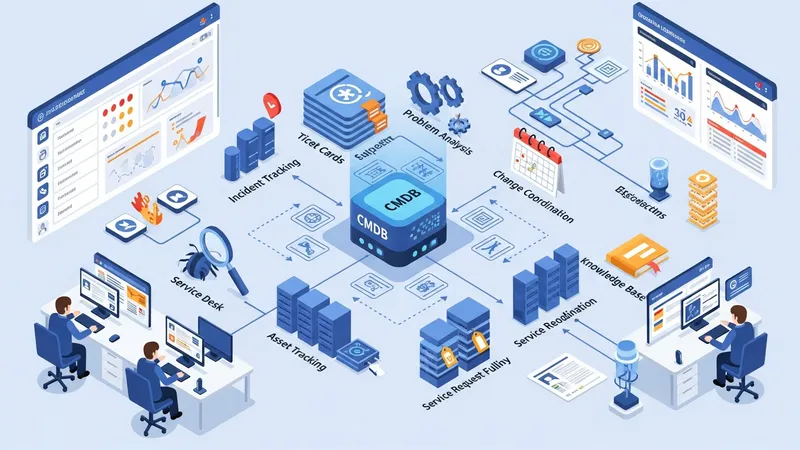
Integration and workflow automation are commonly used to reduce manual handoffs and improve consistency. Automated workflows may create tasks, send notifications, enforce approval gates, and update related records across modules; they can often be extended through scripting or integration adapters. When automation is applied, organizations typically plan for exception handling and regular review of automated rules to prevent drift between documented processes and actual operations. Metrics such as mean time to resolution (MTTR) and change success rates are often used to evaluate the effect of workflow automation.
Service desk and self-service features can alter how users interact with IT. A unified service interface may combine incident intake, request submission, and knowledge search. Self-service portals often allow users to raise standard requests via guided forms and track progress, while agents use the service desk view to manage queues and escalations. It is common for organizations to pilot a subset of request types to refine forms and approvals before broad rollout, which may reduce rework and clarify ownership of recurring tasks.
Knowledge management and reporting functions support operational learning and transparency. Knowledge bases typically store solutions, troubleshooting steps, and configuration notes that agents or end users can search; maintenance of these entries is often governed by review cycles to keep content current. Reporting and dashboards can combine data from incidents, changes, and assets to provide cross-functional insights. Organizations often configure recurring reports for capacity planning, SLA compliance, and trend analysis to inform resource allocation and process adjustments.
Asset and configuration management interacts with change control to provide context for risk and impact analysis. A CMDB that captures relationships between services and underlying components may be used to identify downstream effects of proposed changes or incidents. Populating and reconciling asset data often requires discovery tools and periodic audits; many teams adopt phased approaches to populate critical service relations first. When change processes reference CMDB data, reviewers can better estimate affected users and systems, which may improve planning and reduce unintended disruptions.
In summary, an enterprise ITSM platform collects modular capabilities—incident, change, asset, request, knowledge, automation, and reporting—into a single operational environment that may support standardized workflows and consolidated data. Implementation strategies typically emphasize phased configuration, integration with existing monitoring and identity systems, and governance for knowledge and CMDB accuracy. The next sections examine practical components and considerations in more detail.
Incident handling typically focuses on restoring normal service operations quickly by recording incidents, assigning ownership, and tracking resolution steps. Problem management focuses on identifying root causes and reducing recurrence through investigations and known-error records. In practice, incident and problem records often link: a recurring incident may generate a problem investigation, and problem resolutions may produce changes. Teams often configure categorization schemes and priority matrices to ensure consistent triage and escalation; these schemes may be revised periodically as operational patterns change.
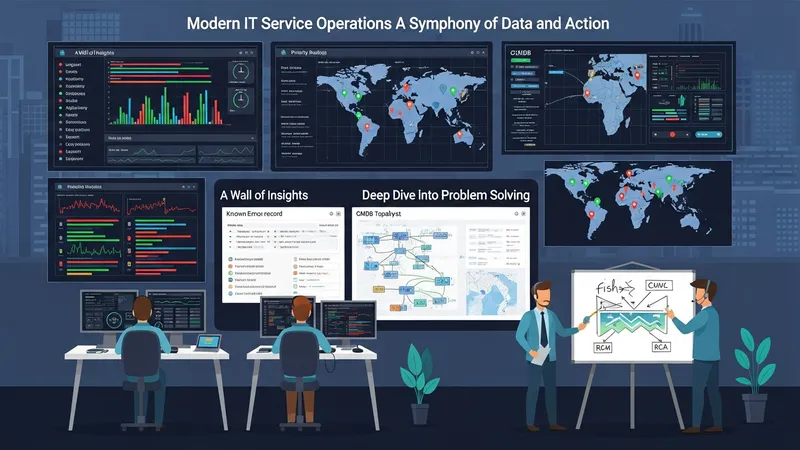
Common operational considerations include how incidents are routed—by skill group, service, or location—and how SLAs are applied based on priority. Automated routing rules and escalation paths can reduce manual reassignments but typically require clear definitions of roles and on-call rotations. Problem investigations may use structured templates for root-cause analysis and may integrate with the CMDB to identify affected configuration items. Organizations often treat problem management as a longer-cycle activity that complements the immediacy of incident response.
Data quality and reporting are central to assessing incident and problem outcomes. Typical metrics include ticket volumes by category, time to acknowledge, time to resolve, and repeat incident rates. Dashboards that combine incident trends with CMDB data can illustrate which services are most frequently affected. Teams commonly schedule periodic reviews of recurring incidents to decide whether problem investigations or proactive changes are warranted, and they may retain known-error records that link to knowledge articles used by agents and end users.
Insider considerations include starting with high-volume or high-impact service buckets to refine triage rules and knowledge content before scaling. It may be helpful to pilot automation for routine categorization or assignment and to monitor for edge cases that need manual handling. Over time, reviewing incident-to-problem transitions and the backlog of known errors can inform prioritization of corrective change activities. Readers may find it useful to track how configuration data supports impact analysis for recurring incidents.
Change management typically records proposed modifications, gathers approvals, assesses risk, and schedules implementation to reduce unplanned disruption. Release management coordinates bundled changes and deployment activities across environments. Configuration management (CMDB) stores components and their relationships to provide context for assessing change impact. Together, these capabilities form a control layer intended to balance agility with stability; organizations often tailor approval gates and CAB (change advisory board) processes to reflect risk tolerance and deployment cadence.

Risk assessment and scheduling are central to change workflows. Typical fields capture planned windows, rollback plans, and testing status. Integration with monitoring or continuous integration tools may allow automatic updates of change records or post-deployment validation. Some teams adopt differentiated paths—for example, low-risk standard changes may follow an expedited route, while high-risk changes require formal CAB review. These distinctions are usually based on clear criteria to avoid inconsistency in approvals and to reduce review overhead where appropriate.
A well-populated CMDB aids impact analysis but often requires ongoing effort to maintain accuracy. Discovery tools can automate inventory capture for servers, network devices, and software, while manual inputs may be needed for business service mappings. Periodic reconciliation—matching discovered items with authoritative records—may be scheduled to correct drift. Accurate relationships in the CMDB can improve the quality of change impact assessments and reduce surprises during deployments when dependencies are better understood.
Practical considerations include defining standard change templates for common, low-risk updates to streamline fulfilment, and establishing clear rollback criteria for releases. Teams may also track change success rates and post-implementation review findings to refine approval thresholds and testing requirements. As a neutral tip, documenting assumptions and test coverage in change records can help reviewers make more informed risk assessments and can provide useful artifacts for future audits or retrospectives.
Asset management tracks hardware, software licenses, and contracts to support lifecycle planning and compliance. Service request modules present catalog items and fulfilment workflows for standard services such as access provisioning or equipment requests. Self-service portals surface request forms and knowledge articles to end users, which can reduce direct service desk traffic for routine requests. These components often interoperate: a fulfilled request may create or update asset records, and asset status may influence available catalog options.
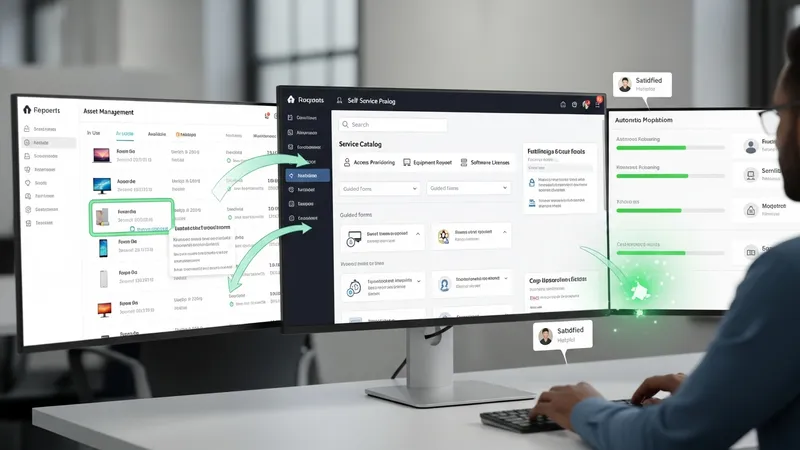
Service catalogs are commonly organized by user persona or service domain and include templated approvals and fulfilment steps. Request fulfilment may incorporate automated provisioning for standard items or human tasks for custom work. Portal design choices—search capability, categorization, and guided forms—can affect how effectively users find solutions and submit accurate information. Organizations often iterate on catalog structure based on request volume and feedback to simplify selection and reduce misrouted tickets.
Asset lifecycle processes—procurement, deployment, maintenance, and retirement—may leverage integrations with procurement systems and financial records where available. Tracking ownership, warranty, and end-of-life dates in asset records supports planning for refresh cycles and license renewals. Typical patterns include prioritizing critical assets that support business services and gradually expanding coverage; discovery tools can accelerate inventory capture, but validation and tagging processes often remain necessary to confirm relationships and locations.
Operational tips include beginning with a concise catalog of high-demand items and refining fulfilment steps before expanding the portal. Structured forms that require key fields can improve automation and reduce clarifying questions. For asset records, periodic audits and reconciliation between discovery output and authoritative lists can improve CMDB trustworthiness. These practices may help teams reduce fulfillment time and improve the accuracy of downstream reporting.
Knowledge management organizes repair steps, known errors, and procedural documentation to support consistent resolution and user self-help. Reporting combines data across incidents, changes, assets, and requests to provide operational visibility for service owners and technical teams. Governance defines ownership, review cadences, access controls, and retention policies for both knowledge content and configuration data. Together, these elements support continual improvement by making outcomes and practices observable and auditable.
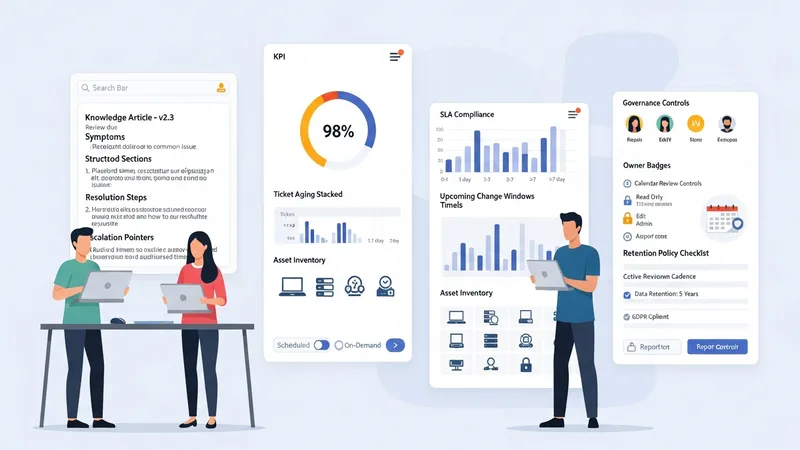
Knowledge articles are often versioned and assigned review dates to maintain relevance; searchability and article structure (symptoms, resolution steps, escalation pointers) can influence usefulness. Reporting typically surfaces SLA compliance, ticket aging, change windows, and asset inventories. Dashboards may be configured for different audiences—service managers, support leads, and executives—to present relevant KPIs without extraneous detail. Reports can be scheduled or generated on demand using the platform’s reporting tools or external analytics connectors.
Governance considerations include defining who may publish and approve knowledge, how articles are tested for accuracy, and how CMDB updates are authorized. Regular content audits and a feedback loop from agents can help keep knowledge current. Similarly, data governance for the CMDB may specify discovery frequency, reconciliation steps, and exception handling. These governance practices typically aim to sustain data quality and operational consistency rather than impose rigid controls that impede necessary changes.
Insider suggestions as considerations rather than directives include establishing a small core of knowledge stewards to curate high-value articles, scheduling quarterly CMDB reconciliation for critical services, and using a combination of automated and manual checks for reporting accuracy. Over time, measuring article reuse, ticket deflection, and report-driven decisions can indicate where governance or content processes may require adjustment. Continued observation of these signals can inform iterative improvements without prescriptive mandates.