
Business telephone systems in United States organizations are collections of hardware, software, and network services that enable voice and related communications across internal teams and with external contacts. These systems typically handle call setup and routing, provide voicemail and conferencing functions, and integrate with business applications for workflows or contact records. Deployments may run on dedicated on-premises equipment, be hosted in cloud environments, or combine both approaches depending on an organization’s existing infrastructure and operational needs.
Designing or selecting a system often involves evaluating feature coverage, compatibility with enterprise networks, and the expected growth in user count and concurrent calls. In the United States context, providers and configurations may also need to account for regulatory obligations such as enhanced 911 (E911) requirements and data handling expectations. Technical considerations commonly include codec selection, session initiation protocol (SIP) support, redundancy options, and integration pathways for customer relationship management (CRM) or helpdesk platforms.
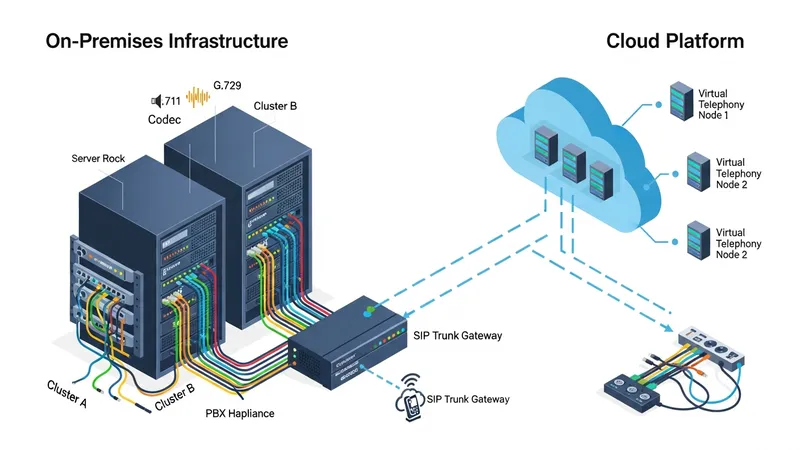
Feature sets across these deployment types may overlap but behave differently in practice. For example, call routing and auto-attendant functions often exist in both on-premises and cloud systems, yet latency, failover behavior, and administrative access can differ. Many U.S.-based organizations examine how voicemail, conferencing, and SMS interworking perform under peak loads and whether those capabilities integrate via APIs to CRM systems commonly used in the United States, such as Salesforce or Microsoft Dynamics. Integration choices can affect workflow automation and reporting capabilities.
Network and capacity planning typically shape deployment decisions. Voice over IP (VoIP) systems rely on sufficient downstream and upstream bandwidth, predictable latency, and quality of service (QoS) settings within local area networks. In U.S. enterprise environments, Internet service tiers and local carrier options can affect the selectable codecs and the number of concurrent calls supported without perceptible degradation. Organizations often estimate concurrent call paths and provision bandwidth margins to support peak periods and redundancy.
Operational management and compliance factors may influence vendor and configuration selection. In the United States, E911 functionality and regulatory guidance from the Federal Communications Commission (FCC) may require specific routing and location-handling behaviors for emergency calls; relevant FCC materials provide descriptive guidance on VoIP and E911 obligations. Security features such as TLS and SRTP for signaling and media encryption may be available across systems, and retention of call records or recordings can intersect with state-level data retention rules or corporate policies.
Scalability considerations usually combine technical, financial, and administrative dimensions. Scaling user counts often means adding user licenses, expanding SIP trunks or concurrent call channels, and ensuring sufficient compute and network resources. Cost structures differ: cloud subscriptions place costs in operational budgets, while on-premises solutions may require capital expenditure for expansion. Migration paths can be staged so that small increments in user load are accommodated without wholesale replacement of existing infrastructure.
In summary, organizational telephone systems consist of layered components that support voice and related communications, and U.S. entities commonly balance feature coverage, deployment model, and growth expectations when evaluating options. The following pages examine technical deployment types, key feature sets and integrations, scalability and capacity planning, and security and compliance considerations in more detail. The next sections examine practical components and considerations in more detail.
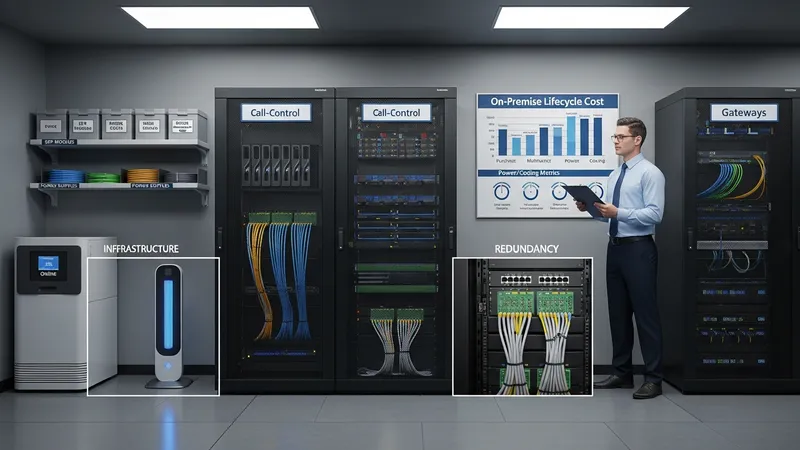
On-premises deployments typically place call-control servers, gateways, and analog/digital interface equipment within an organization’s facilities. These setups may be chosen where direct control over hardware, local PSTN interfaces, or certain regulatory configurations is required. In U.S. environments, on-premises systems can integrate with incumbent carrier circuits and private data networks; they may also require on-site maintenance contracts and spare parts planning. Organizations often assess life-cycle costs, power and cooling needs, and physical redundancy when considering an on-premises path.
Cloud-hosted VoIP services run call-control and ancillary services in provider data centers and are accessed over the public Internet or private WAN links. These services typically shift cost structures toward monthly operational charges and may reduce on-site equipment needs. In the United States, cloud services often include provider-managed features like software updates and geographic redundancy; however, enterprises frequently evaluate service-level agreements (SLAs), support response times, and how E911 information is handled by the vendor.
Hybrid approaches mix local infrastructure with hosted components to retain certain local controls while leveraging cloud resilience or rapid provisioning. For instance, a business may keep local call routing for internal traffic but use a cloud provider for long-distance routing or disaster recovery. Hybrid systems can ease phased migrations, allow retention of specialized on-premises integrations, and provide flexibility for compliance with state or sector-specific requirements in the United States.
SIP trunking is a common method for connecting internal systems to PSTN services via IP trunks rather than traditional T1/E1 lines. U.S. SIP providers offer per-channel and per-minute pricing models that may vary with geographic coverage and number portability considerations. Technical aspects to assess include session border controller (SBC) configurations, codec negotiation, NAT traversal, and redundancy across multiple SIP providers to maintain service continuity during carrier outages.
Call routing and automated attendant services form the core of many business phone deployments, enabling inbound calls to be directed by time-of-day, caller input, or directory lookup. Advanced routing may include skills-based routing for contact centers and overflow handling to external queues. In U.S. organizations, these features often integrate with directory services such as Active Directory for user provisioning and may provide logging for operational reporting and compliance audits.
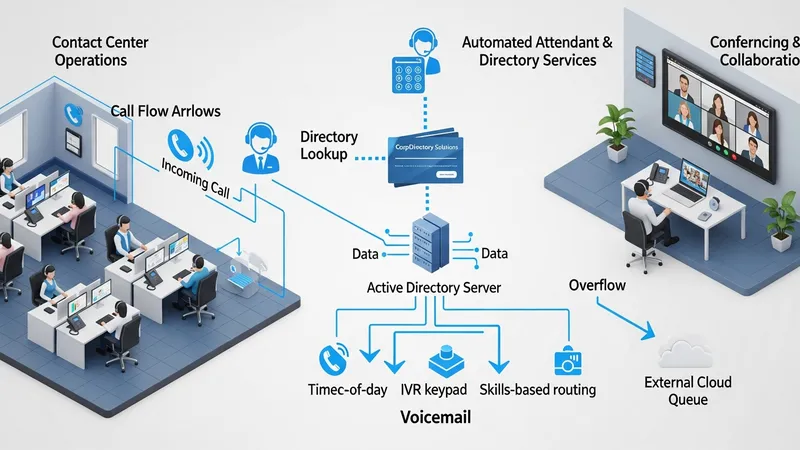
Conferencing and collaboration functions typically provide audio bridges, web conferencing, and screen-sharing capabilities. Conferencing capacity planning involves concurrent participant limits and bridge resources; many U.S. businesses compare hosted conferencing options versus on-premises bridges based on participant volume and data locality. Voicemail systems increasingly support voicemail-to-email transcriptions and searchable archives, which may affect retention policies and storage planning in line with corporate governance.
Integration with business software is a common requirement: telephone systems often provide APIs, webhooks, or native connectors for CRM, helpdesk, and workforce management tools. In the United States, popular integrations may target CRM platforms such as Salesforce, enabling click-to-dial, screen-pop customer records, and call logging. These integrations can streamline workflows and reporting but also introduce requirements for secure API credentials and audit trails.
Management and reporting features help administrators monitor usage trends, call quality metrics, and incident histories. Quality metrics such as jitter, packet loss, and Mean Opinion Score (MOS) are commonly tracked to diagnose voice quality issues. U.S. enterprises often standardize on centralized dashboards and alerting for threshold breaches, and may collect call detail records (CDRs) for billing or operational analytics while observing retention constraints under corporate policy.
Scaling a telephone system requires estimating both user growth and peak concurrent calls. Many U.S. organizations approximate concurrent call ratios based on historical usage patterns; for example, not all users will be on calls simultaneously, so concurrent call channels are planned with expected occupancy factors. Capacity planning may also include headroom for seasonal peaks or marketing campaigns that temporarily raise inbound call volumes. Forecasts typically inform purchase or subscription tiering decisions.

Bandwidth estimation for VoIP depends on codec choices and overhead. Common codecs such as G.711 may use around 80–100 kbps per concurrent call including overhead, while compressed codecs like G.729 can reduce that footprint substantially. U.S. network engineers often calculate total required bandwidth by multiplying concurrent call estimates by per-call bandwidth and adding a margin for other traffic, then configure QoS policies to prioritize voice packets across local networks and WAN links.
Redundancy and failover strategies help maintain service continuity. Typical patterns include multiple Internet service providers, alternate SIP trunks with different carriers, and geographically separate cloud regions for hosted control planes. In the United States, organizations sometimes leverage diverse carrier access to mitigate region-specific outages; planning also addresses automatic failover of call routing and restoration procedures to minimize operational disruption.
Administration scale considerations include centralized provisioning, license management, and role-based administration. As user counts grow, automated provisioning via directory synchronization or bulk import tools can reduce administrative overhead in U.S. environments. Monitoring tools that aggregate quality metrics across locations may be adopted to detect trends and inform capacity upgrades before service degradation occurs.
Security measures for telephone systems commonly include application-layer protections and transport encryption. Protocols such as TLS for SIP signaling and SRTP for media streams may be applied to reduce eavesdropping risk. U.S. entities often evaluate the extent to which vendors support these protocols and how encryption keys are managed. In addition, session border controllers and firewall rules are typically configured to limit exposure to the public Internet and to filter malformed or suspicious SIP traffic.
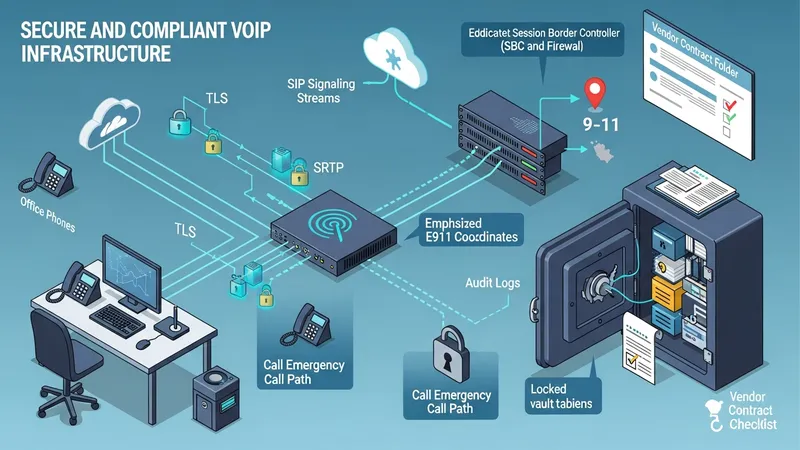
Regulatory and compliance considerations can influence system behavior and documentation. In the United States, E911 handling requires that emergency calls convey appropriate location information to public safety answering points; organizations often verify vendor E911 mechanisms and internal processes to maintain compliance. Recordings and call logs may be subject to retention policies, workplace privacy rules, or industry-specific regulations, so operational procedures for access control and audit logging are commonly implemented.
Operational management practices include patching, backup, and incident response procedures. Regular software updates and firmware management for endpoints and appliances reduce exposure to known vulnerabilities. U.S.-based organizations may maintain change-control records and test recovery procedures periodically. Backup strategies for configuration data and voicemail archives vary by deployment type and can influence recovery time objectives during outages or migrations.
Monitoring and capacity review cycles support ongoing reliability. Organizations often combine real-time alerts with periodic capacity reviews to adjust subscribed channels, bandwidth, or compute resources. In the United States, IT teams sometimes coordinate with finance and operations to align subscription tiers or hardware refresh cycles with business forecasts. Documentation of architecture, escalation paths, and service dependencies helps maintain continuity and informs future scaling or migration decisions.