
Car injury law firms provide legal services to people involved in vehicle accidents, focusing on the civil processes that follow collisions. These firms typically assess liability, organize evidence, prepare legal documents, and represent clients in communications with insurers or in court. Their role is to navigate procedural requirements, explain potential legal avenues, and coordinate information from medical providers, police reports, and third-party experts to frame a claim or defense within applicable rules and deadlines.
After an accident, a firm’s activities may include initial case screening, detailed fact-finding, and advising on possible outcomes without making guarantees. Legal teams often work with accident reconstruction specialists, medical providers, and vocational experts to clarify the nature and extent of loss or injury. They also prepare formal filings, draft demand letters, and may negotiate settlements on behalf of a claimant; if resolution is not reached, the firm can pursue litigation steps according to civil procedure in the relevant jurisdiction.

Case intake and initial evaluation often set the framework for subsequent actions. During intake, a firm typically documents the chronology of events, identifies involved parties and their insurance carriers, and records observable injuries and vehicle damage. This stage may include requests for medical records authorization and obtaining traffic collision reports. Early assessment may help identify potential statutory or procedural deadlines that apply in a given jurisdiction; those deadlines can vary and often influence whether a claim proceeds to negotiation or litigation.
Evidence preservation is a central activity and may involve multiple types of documentation. Photographs of the scene, vehicle damage, and visible injuries can be supplemented by surveillance footage, telematics or “black box” data, and witness statements. When appropriate, legal teams may coordinate with technical experts to perform accident reconstruction or obtain engineering opinions. Maintaining a clear chain of custody for physical or electronic evidence can be important if evidence must be admitted in court or relied upon during settlement talks.
Communication with insurance companies typically follows structured procedures and formal documentation. Law firms often prepare a demand package that outlines liability, itemizes economic and non-economic losses, and attaches supporting records such as medical bills and repair estimates. Insurance adjusters may respond with written offers that the firm reviews against its valuation. Negotiations can proceed through written exchanges, mediated meetings, or informal settlement discussions, and may involve uncovering policy limits or secondary sources of recovery.
If a case does not resolve in negotiation, litigation steps can include filing a complaint, engaging in discovery, deposing witnesses, and presenting expert testimony. Litigation timelines and procedures vary by court and jurisdiction; the process can be resource-intensive and typically requires detailed preparation. Legal representation may manage filings, courtroom advocacy, and coordination of experts to address technical issues like causation, impairment, or future care needs, while remaining attentive to cost and timing considerations.
In summary, car injury law firms perform multiple interrelated functions after a vehicle accident, including intake, evidence gathering, insurer communication, negotiation, and possible litigation. These activities typically proceed in stages and may vary depending on jurisdictional rules and the specifics of each incident. The next sections examine practical components and considerations in more detail.
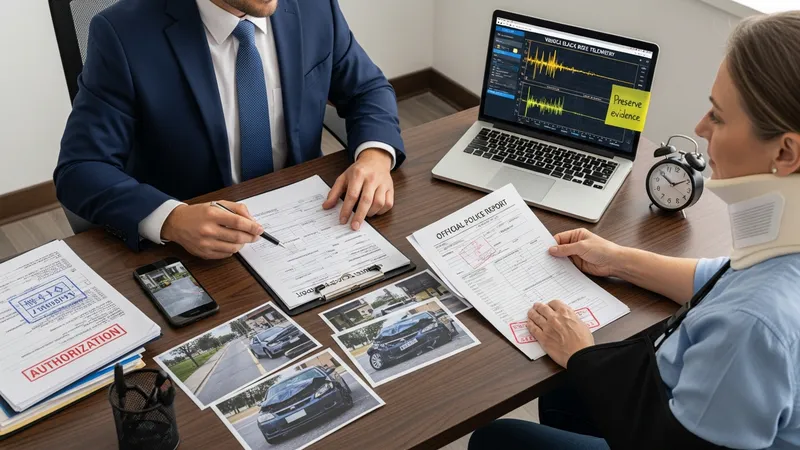
Initial case evaluation and client intake are foundational to how law firms handle vehicle-accident matters. Intake normally records contact details, a factual timeline, and initial documentation such as police reports and photos. The evaluation stage often considers liability elements, applicable legal standards (for example, negligence or comparative fault principles), and potential damages categories. Firms may use intake to flag urgent preservation steps, such as requesting rapid retention of surveillance footage or vehicle data, since some evidence sources may be transient.
During intake, firms commonly obtain authorizations to request medical records and billing statements. Medical chronology helps establish the nature of injuries and links treatment to the collision, which can affect claim valuation. Counsel may also identify future care needs by consulting treating clinicians or independent medical professionals. While the specific legal standards and deadlines differ by jurisdiction, early medical documentation often strengthens an evidentiary record for either settlement talks or litigation preparation.
Case screening may also assess potential defendants and coverage layers. A typical review identifies the drivers and vehicle owners, employer relationships if a commercial vehicle is involved, and relevant insurance policies. Multi-party accidents can introduce complex apportionment issues. Firms may advise clients about likely procedural steps and the type of documentation that will be required in negotiations or a complaint, but they generally avoid promising specific outcomes and instead explain possible paths and typical timelines.
Practical considerations during intake include preserving contact information for witnesses, noting the condition of the scene, and securing preliminary repair estimates or towing records. These items can contribute to a loss calculation and corroborate accounts of impact and fault. Clients may be informed about confidentiality and records release processes so that evidence can be gathered efficiently. Careful intake can therefore shape the trajectory of a claim and create options for either settlement or court-based resolution.
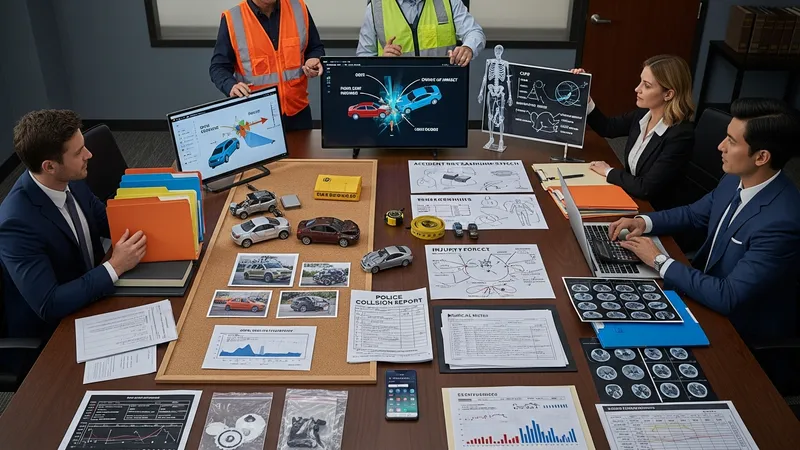
Evidence collection is a technical and methodical part of post-accident legal work. Law firms often assemble diverse sources of proof, including police collision reports, photographs of vehicles and scene conditions, maintenance records, and electronic data from vehicles or mobile devices. They may coordinate with expert witnesses—such as accident reconstructionists or biomechanics specialists—to interpret vehicle dynamics, impact forces, and injury mechanisms. The inclusion of expert analysis can clarify disputed points like point of impact or acceptable speeds under prevailing conditions.
Medical documentation commonly anchors damage assessments and can include emergency room notes, follow-up care records, diagnostic imaging, and bills. Firms typically seek to organize treatment timelines and note gaps in care that may require explanation. Where applicable, vocational or economic experts can assist in documenting lost earnings, reduced earning capacity, and projected future care costs. Clear, contemporaneous records generally serve as the basis for articulating economic losses during negotiation or trial.
Digital evidence increasingly plays a role in vehicle-accident cases. Dashcam footage, smartphone location data, and vehicle telematics can provide objective timelines or speed estimates. Legal teams may request such data early because it can be overwritten or deleted. When handling digital materials, firms often follow procedures to preserve metadata and maintain admissibility, documenting how files were obtained and ensuring continuity to withstand evidentiary scrutiny.
Chain of custody and admissibility are practical concerns for introducing evidence in court. Firms frequently document how each item was collected, who handled it, and where it was stored. For physical evidence like damaged parts or electronic modules, preservation protocols can be important if the item will be examined by opposing experts. Thoughtful documentation practices may not guarantee a particular result but can increase the likelihood that evidence will be considered in settlement discussions or by a factfinder.

Communication with insurers typically follows formalized steps: notification of claim, submission of supporting documentation, exchange of written positions, and offer/counteroffer cycles. Law firms often prepare a demand package that lays out liability theory and itemizes losses, with attached evidentiary exhibits. Insurers generally respond through adjusters who evaluate coverage, liability, and damages; responses can range from acceptance of liability to partial denials or reservation of rights. The process may be iterative and can take weeks to months depending on complexity.
Settlement negotiation commonly involves valuation analysis that balances economic damages, non-economic losses, comparative fault considerations, and litigation risk. Firms may run scenarios that estimate potential recovery versus the costs and time of litigation to inform settlement discussions. Mediation or neutral evaluation sessions are sometimes used to facilitate resolution; these forums may be mandated by a court rule or agreed to by the parties. Each option has trade-offs related to confidentiality, timing, and procedural formality.
Communication strategy often includes written correspondence to preserve a record of positions and offers. Demand letters and settlement proposals typically enumerate claimed losses and attach supporting documents. Firms may document all insurer communications to ensure clarity about deadlines and to preserve arguments should the matter proceed to litigation. Maintaining a clear evidentiary trail can assist in rebutting insurer defenses that rely on gaps in documentation or inconsistent accounts.
Practical negotiation considerations include identifying available insurance limits and potential secondary sources, such as underinsured motorist coverage or third-party liability. In multi-vehicle or commercial-vehicle incidents, allocating responsibility and identifying financially available defendants can affect settlement feasibility. Legal counsel may therefore evaluate coverage structures and advise on how those layers could influence negotiation dynamics, while avoiding any promise of a particular outcome.
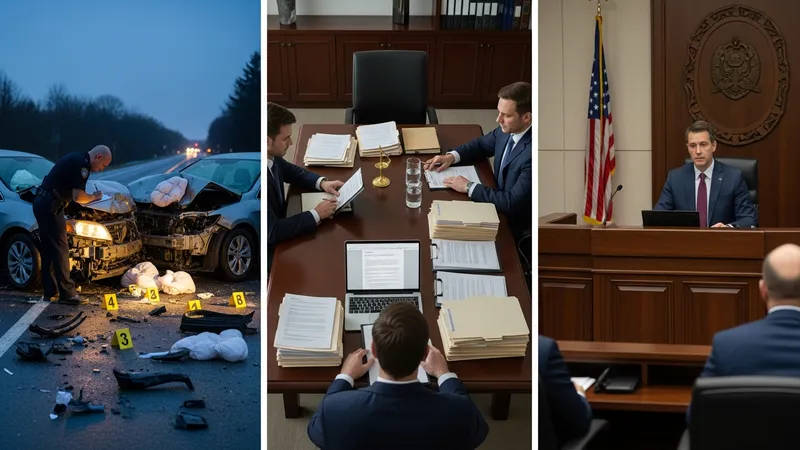
When negotiations do not produce a resolution, litigation becomes a procedural path that involves a sequence of filings and court events. Plaintiffs generally begin by filing a complaint that sets forth claims and alleged harms; defendants then answer and may assert counterclaims or affirmative defenses. Discovery follows, where parties exchange documents, interrogatories, and take depositions. The discovery phase can uncover additional facts, refine damages calculations, and shape trial strategy. Litigation timelines depend on court calendars and case complexity.
Expert testimony is commonly used in contested motor vehicle cases to address issues such as accident causation, biomechanical injury analysis, and future care cost estimation. Selection and preparation of experts typically require disclosure under applicable rules and may involve direct and cross-examination at trial. Legal teams often prepare expert reports that summarize methods and conclusions; the admissibility of expert opinion can hinge on the methodology applied and its relevance to the case’s disputed issues.
Court procedures also include pretrial motions that can resolve evidentiary disputes, limit claims, or seek dismissal in certain circumstances. Motions in limine, summary judgment motions, and evidentiary challenges may narrow the dispute or clarify legal questions before trial. Jury selection and trial presentation procedures vary by jurisdiction, and many civil cases settle before reaching a jury; however, trial preparation is often necessary to credibly negotiate or litigate a claim when required.
Cost considerations are an important practical factor in deciding whether to pursue litigation. Some clients and counsel use fee arrangements such as contingency agreements, which in many jurisdictions may commonly range from approximately 25% to 40% of any recovery, while other fee models exist depending on local rules and case specifics. Litigation also involves potential expenses for expert work, deposition costs, and filing fees. These practical aspects are typically discussed as part of informed decision-making rather than as prescriptive directives.