
Protecting data and applications in cloud environments involves a combination of technical controls, governance practices, and operational processes intended to preserve confidentiality, integrity, and availability. This concept covers how organizations manage identities, control access, encrypt information, monitor for threats, and align operational activities with legal and contractual privacy obligations. It also recognizes a shared responsibility model, where cloud providers and customers each hold specific duties for securing infrastructure, platform, and application layers.
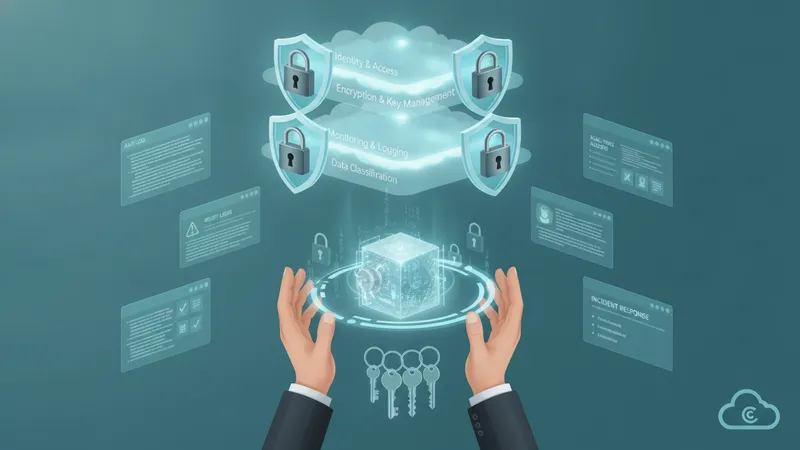
Effective protection in cloud settings typically involves layered defenses and documented processes. Layers may include identity and access mechanisms, encryption and key management, activity logging and monitoring, data classification and lifecycle controls, and periodic compliance assessments. These elements often interact: for example, access policies influence who can retrieve encrypted data, and monitoring systems feed incident response playbooks that address suspected exposures or regulatory inquiries.
When comparing IAM approaches, organizations often weigh centralized identity providers against federated or hybrid models. Centralized directories may simplify user lifecycle management and policy application, while federated models can support cross-organization collaboration and third-party access with reduced duplication. Each approach can affect auditability and the granularity of controls: for instance, role-based access control may be simpler to implement, whereas attribute-based access control can offer finer, context-aware permissions that respond to device posture, location, or time-bound conditions.
Encryption strategies typically combine symmetric encryption for data workloads with asymmetric techniques for key exchange and signature validation. Key management may be handled by cloud provider-managed services, by customer-managed keys, or by external hardware security modules; each option involves trade-offs in control, complexity, and cost. Data masking and tokenization are additional options for reducing exposure of sensitive fields while preserving application functionality for testing or analytics activities without revealing original values.
Monitoring and detection often rely on ingesting telemetry from multiple sources: infrastructure logs, application traces, network flow data, and endpoint signals. Correlating these feeds within a SIEM or cloud-native analytics service can help surface patterns such as unusual data transfers or privilege escalations. Alerting thresholds and prioritization rules may be tuned to reduce false positives; however, organizations should expect to refine detection logic over time and align investigative playbooks with compliance reporting requirements to preserve evidence and meet timelines for notification obligations.
Data governance practices include inventorying datasets, applying classification tags, and defining retention and deletion policies that align with regulatory retention windows. Privacy risk assessments and data mapping often inform technical controls and contractual terms with processors or sub-processors. Methods such as data anonymization and pseudonymization can reduce identifiability for certain processing activities, but their suitability depends on the intended use, re-identification risk, and legal standards that apply to specific datasets.
In summary, protecting cloud-hosted data and fulfilling privacy and compliance commitments typically requires an integrated set of controls spanning identity, encryption, monitoring, governance, and response capabilities. Organizations may sequence efforts based on risk assessments and compliance priorities while documenting responsibilities under the shared responsibility model. The next sections examine practical components and considerations in more detail.
Identity and access management (IAM) plays a central role in limiting who and what can access cloud resources. Typical components include centralized user directories, role definitions, conditional access policies, and multi-factor authentication. Organizations often adopt least-privilege principles to reduce exposure, granting rights narrowly and for limited durations where feasible. Integrations with third-party identity providers may facilitate single sign-on across multiple services, while service accounts and machine identities require distinct lifecycle controls to avoid orphaned credentials. Considerations also include the auditability of access events and the segregation of duties to support compliance.
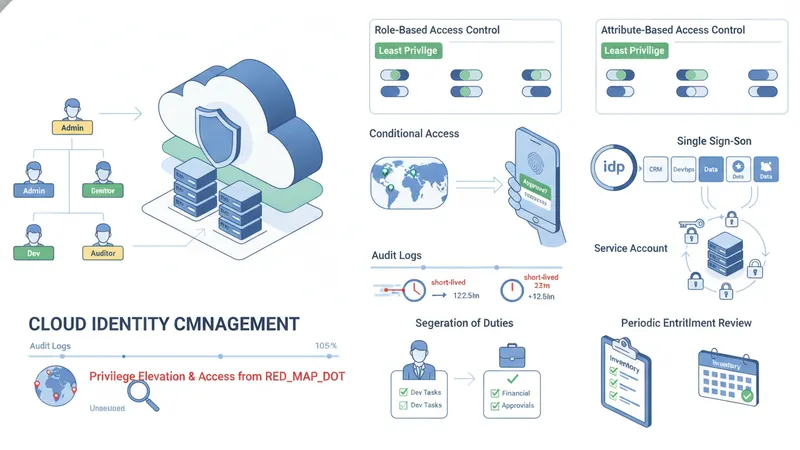
When designing IAM for cloud deployments, teams commonly map privileges to job functions and apply role-based or attribute-based controls to enforce boundaries. Temporary credential mechanisms, such as tokenized sessions or short-lived keys, can reduce the risk of long-term credential compromise. Monitoring of access patterns—such as unusual privilege elevation or access from uncommon geographies—may be incorporated into detection rules. It is also useful to maintain an inventory of privileged accounts and to periodically review entitlement lists to identify stale or excessive permissions as part of routine governance.
Service-to-service authentication and authorization are often managed differently than human identities. Approaches include managed identities, OAuth-based tokens, and mutual TLS for service authentication. These mechanisms may be combined with policy engines that evaluate contextual factors before granting access. Managing secrets for services—API keys, certificates, and credentials—typically involves secure storage solutions or secret management services that provide rotation and access auditing. Ensuring that automation scripts and CI/CD pipelines avoid hard-coded secrets can reduce accidental exposures.
From a compliance viewpoint, IAM controls can provide evidence for access governance and demonstrate adherence to segregation-of-duty requirements. Access reviews, role-approval workflows, and activity logs contribute to audit readiness. Teams may consider periodic simulated access reviews or leveraging automated entitlement governance tools to scale reviews. These practices are often correlated with incident response plans so that compromised credentials can be quickly revoked and associated sessions invalidated without creating service disruptions.
Encryption is a foundational technical control for protecting data in cloud storage and transit. Commonly, applications employ TLS for in-transit protection and symmetric encryption for at-rest data. Key management choices influence control and compliance: cloud-managed keys may reduce operational overhead, while customer-managed keys or hardware security modules can increase control over key lifecycle. Decisions typically consider regulatory requirements for key residency and the ability to produce key handling evidence for audits. Encryption alone does not eliminate access controls or monitoring needs but is an important component of layered defenses.
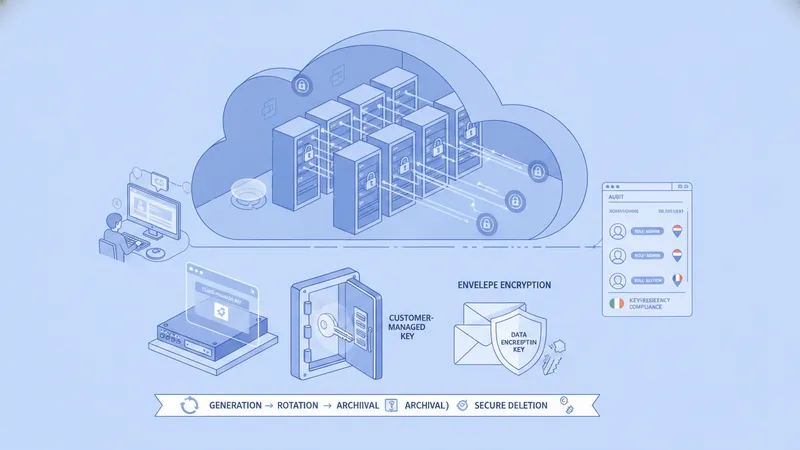
Key lifecycle management includes generation, rotation, archival, and secure deletion. Rotation policies often balance security needs against operational constraints, and some standards suggest routine rotation intervals while accounting for affected services. Access to key material usually requires strict role separation and logging to capture who accessed keys and when. When using envelope encryption, data encryption keys are themselves encrypted using master keys, which may help limit the scope of compromise and simplify key rotation strategies for large datasets.
Data masking, tokenization, and pseudonymization are techniques used to reduce exposure of sensitive elements while preserving utility for testing or analytics. Masking may replace values in non-production environments; tokenization replaces sensitive values with surrogate tokens bound in a token vault. Pseudonymization reduces identifiability by substituting identifiers; however, its effectiveness depends on context and the possibility of linkage attacks. These techniques may be combined with strict access controls and logging to meet privacy-oriented requirements without impeding legitimate processing.
Cryptographic controls should be complemented by operational safeguards such as secure backups, integrity checks, and well-defined key recovery procedures. Backup encryption and retention policies must align with deletion and legal hold requirements to prevent unintended exposure during restoration. Documentation of cryptographic choices and rationale can aid compliance demonstrations and support risk assessments. Teams often consider cryptographic agility—planning for algorithm or key changes—to reduce future migration burdens if standards evolve.
Monitoring and detection systems help surface anomalies, suspicious activity, and potential exfiltration attempts in cloud environments. Common telemetry sources include API access logs, object storage access records, authentication logs, and network flow data. Aggregating these sources into a centralized analysis platform enables correlation and context for alerts. Alerting strategies typically prioritize actionable events to reduce noise, and investigative playbooks outline the steps for triage, containment, and evidence preservation. Maintaining chain-of-custody details for logs and artifacts can be important for regulatory or legal processes.

Incident response in cloud contexts often requires coordination between cloud providers and customers, reflecting the shared responsibility model. Playbooks usually document who is responsible for specific containment actions, how to collect forensic evidence without altering state, and the communication paths for internal and external stakeholders. Post-incident reviews contribute to learning and controls improvement; these reviews may update detection rules, harden IAM policies, or refine data classification practices. Regular tabletop exercises can surface gaps in coordination and telemetry availability before a real event occurs.
Audit controls and compliance evidence rely on consistent logging, policy enforcement, and documented change management. Automated evidence collection—such as configuration snapshots, policy evaluation reports, and access logs—can speed assessments and reduce manual effort. Mapping technical controls to specific regulatory requirements or contractual clauses helps clarify what evidence is required. Where external attestations are applicable, organizations often maintain copies of provider compliance reports and ensure their own policies align with those documented controls to demonstrate an end-to-end posture.
Insider considerations include validating the retention, integrity, and availability of logs; ensuring alerts include sufficient context for triage; and planning for log volume and cost. Teams may design retention tiers for different types of telemetry to balance forensic needs against storage expense. Integrating detection with workflow platforms can support timely investigations, and periodic reviews of alert effectiveness help refine thresholds. These operational details support sustained compliance and improve responsiveness to privacy-related incidents.
Risk assessment processes help organizations prioritize controls based on the sensitivity of data and the potential impact of compromise. Typical assessments identify assets, threats, and likelihoods, and then evaluate existing controls to derive residual risk. Frameworks such as ISO/IEC 27001, NIST Cybersecurity Framework, or sector-specific guidance are often used to structure governance programs and map controls to obligations. Choosing a framework may be informed by regulatory expectations, contractual commitments, or internal risk appetite, and teams may adopt elements from multiple frameworks to meet diverse requirements.

Governance activities include policies for data classification, retention, third-party risk management, and privacy impact assessments. Data inventories and processing records support transparency and help determine where personal data resides and how it is used. Third-party assessments and contractual terms with cloud service providers and sub-processors commonly document roles, responsibilities, and security measures. Ongoing vendor oversight may involve periodic reviews of provider controls, changes to service offerings, and alignment with organizational compliance needs.
Compliance reporting typically combines technical evidence—configurations, logs, and control attestations—with policy records and audit trails. Reporting schedules and formats may vary by regulator or contractual requirement; for example, some regimes expect timely breach notifications, while others focus on periodic compliance filings. Effective reporting often depends on predefined templates, clear mappings from controls to requirements, and automated extraction of relevant evidence to reduce manual compilation time. Transparency about control limitations and mitigation plans can also be part of reporting to stakeholders.
Operational considerations for governance include maintaining an up-to-date data inventory, scheduling periodic reassessments, and documenting decision rationales for chosen controls. Risk treatment plans may sequence remediation by impact and feasibility, and continuous monitoring measures can validate control effectiveness over time. These practices support informed compliance reporting and help organizations adapt to regulatory changes or shifts in their cloud usage patterns while maintaining traceable governance records.