
A digital twin platform creates a virtual representation of manufacturing assets, processes, or whole production lines and connects those representations to live or historical operational data. In manufacturing settings this typically means combining physics-based or data-driven models with sensor feeds, control-system logs, and maintenance records to mirror behavior, visualize states, and enable scenario analysis. The platform layer coordinates model lifecycle, data ingestion, time-series storage, and integration with supervisory control and enterprise systems.
Core capabilities often include device connectivity, standardized data schemas, synchronization of real-time telemetry with model state, and a user layer for visualization and analytics. Within United States manufacturing contexts, these platforms may interface with PLCs, OPC UA servers, MES deployments, and cloud services hosted by U.S.-based providers. Implementations can vary from on-premises frameworks to hybrid cloud arrangements that balance latency, data governance, and compute needs.
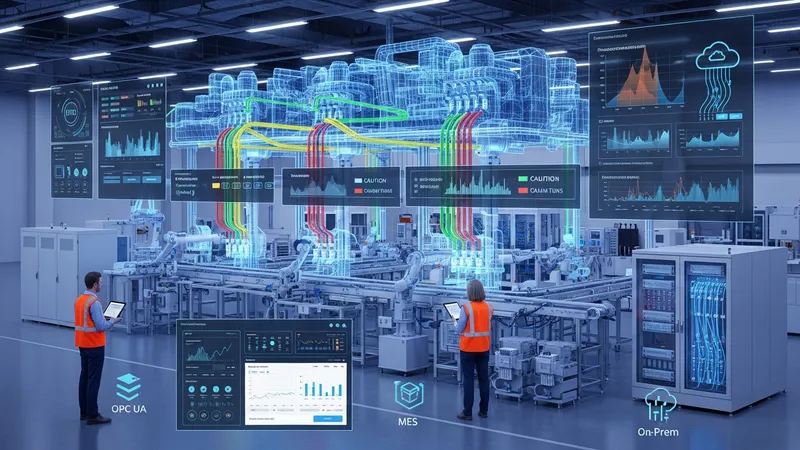
Architecture choices for digital twin platforms in U.S. factories typically balance edge computing and cloud resources. Edge nodes may handle fast control loops and preprocessing of telemetry, while cloud components support long-term data retention, complex simulations, and multi-site aggregations. Manufacturers often consider latency tolerance, data sovereignty, and existing IT/OT separation when selecting an architecture. Integrations with enterprise systems such as ERP and MES commonly use API-based connectors or message-brokering patterns.
Data ingestion and normalization are central operational concerns. Telemetry from PLCs, CNC controllers, and industrial sensors commonly arrive in different formats and sampling rates; platforms often apply time-series alignment, unit normalization, and schema mapping to create coherent inputs for models. Standards like ISA-95 for enterprise-control integration and OPC UA for device-level interoperability are commonly referenced in U.S. deployments to reduce custom integration work and improve maintainability.
Modeling approaches vary: physics-based models, data-driven statistical or machine learning models, and hybrid forms can coexist within a platform. Physics-based models may capture thermodynamics, kinematics, or electrical behavior for a specific asset, while data-driven models often address anomaly detection or cycle time prediction using historical production data. Model management features typically include versioning, validation against live data, and retraining or recalibration workflows.
Common manufacturing applications of digital twin platforms in the United States include predictive maintenance, production throughput analysis, and virtual commissioning. Predictive maintenance models may analyze vibration, temperature, and operating cycles to estimate degradation patterns. Virtual commissioning uses a twin to test control logic or layout changes before affecting the physical line, which can reduce downtime risks. These applications frequently rely on combining domain knowledge with observed operational patterns.
In summary, a digital twin platform for manufacturing is a layered software environment that synchronizes virtual models with machine and process data to support monitoring, analysis, and scenario testing. Platform selection and architecture in U.S. factories often reflect trade-offs among latency, data governance, standards compliance, and the need to integrate with existing control and enterprise systems. The next sections examine practical components and considerations in more detail.
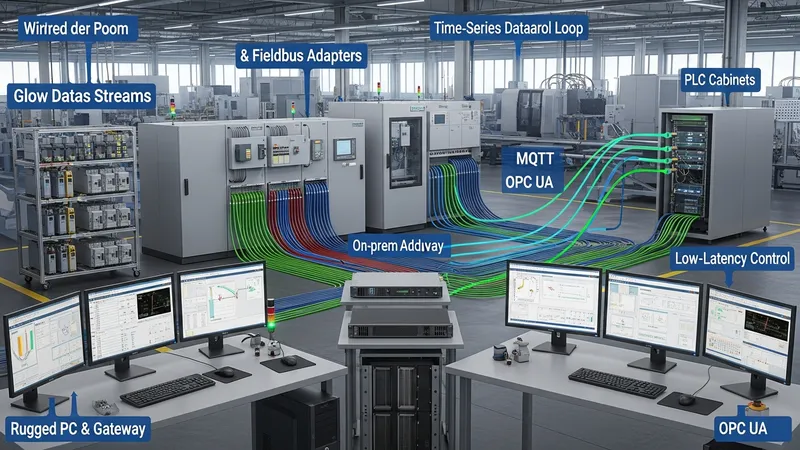
Architectural patterns for manufacturing-focused digital twin platforms commonly separate edge, cloud, and application layers. Edge components run on-premises gateways or industrial PCs to collect high-frequency telemetry and execute low-latency control loops, while cloud services host scalable storage, simulation engines, and cross-site analytics. Data integration commonly uses time-series databases, message brokers (for example MQTT), and API gateways to move information between layers. U.S. manufacturers often evaluate architectures for compliance with corporate IT policies and sector regulations, and may use hybrid patterns to limit sensitive data leaving plant networks.
Interoperability is a frequent practical challenge. Device-level protocols such as OPC UA and legacy fieldbus adapters are often required to connect diverse machine assets. Mapping and harmonizing semantic models can reduce downstream engineering effort; some teams apply standard information models or employ middleware that translates vendor-specific telemetry into normalized schemas. In the U.S. context, adherence to automation standards and the ability to interface with ERP and MES systems are common procurement considerations.
Latency and bandwidth considerations shape whether analytics run locally or in a centralized cloud. Time-critical anomaly detection and control-loop support often run at the edge, while historical trend analysis and fleet-level comparisons typically occur in cloud environments. This division can affect platform selection and the design of data retention policies. Manufacturers designing pilots typically measure network performance and instrument sampling needs before scaling.
Data governance and lifecycle practices are important architecture inputs. Defining which data remain on-premises, which are aggregated in the cloud, and how long telemetry is retained influences storage cost and compliance posture. Technical teams in the United States may coordinate with legal or security groups to address intellectual property concerns and meet sector-specific reporting requirements. Such governance decisions also affect which integration patterns and third-party services are acceptable.
Model selection depends on the use case and available data. Physics-based models can capture mechanical and thermodynamic behavior for equipment-level simulation, while data-driven models, including time-series forecasting and supervised learning, may detect operational anomalies or predict failures. Hybrid approaches combine first-principles constraints with statistical learning to improve generalization when data are limited. In U.S. manufacturing environments, teams often pilot simpler models for baseline monitoring and progressively introduce more sophisticated simulations as data quality improves.
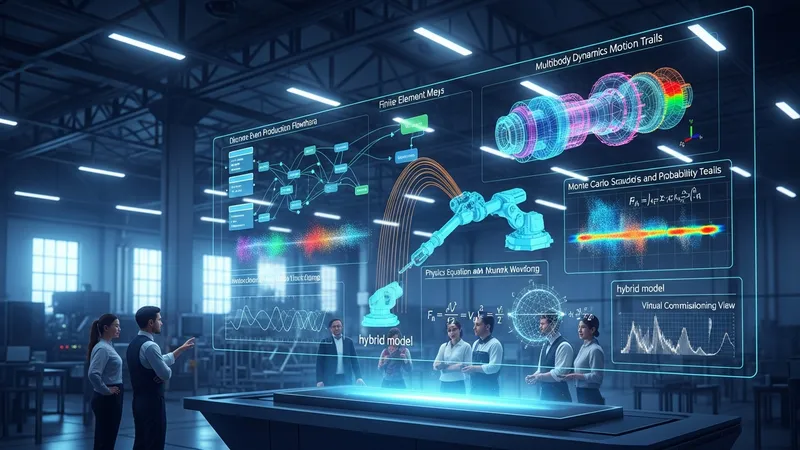
Simulation capabilities within platforms may include discrete-event models for production flows, finite-element or multibody dynamics for equipment behavior, and Monte Carlo approaches for variability analysis. Virtual commissioning uses these simulations to validate control logic and layout changes prior to physical deployment, which can reduce unplanned downtime during changeovers. Simulation fidelity is typically balanced against computational cost and the time required to run experiments, especially when cloud compute is billed per use.
Analytical workflows often combine descriptive dashboards with automated alerts and root-cause analysis pipelines. Time-series anomaly detection can flag deviations from expected operating envelopes, and causal analysis tools may help link anomalies to upstream events. For U.S. manufacturers, integration of analytics outputs with maintenance management systems can streamline work order generation and provide operational context for technicians, while preserving audit trails required by internal controls.
Model governance and validation practices help maintain trust in twin outputs. Validation often compares model predictions to historical events and has scheduled recalibration routines as processes or equipment age. Documentation of model assumptions, input data ranges, and retraining triggers is commonly used to support cross-functional reviews. Engineering and operations teams typically agree on acceptance criteria before models influence automated actions on the plant floor.
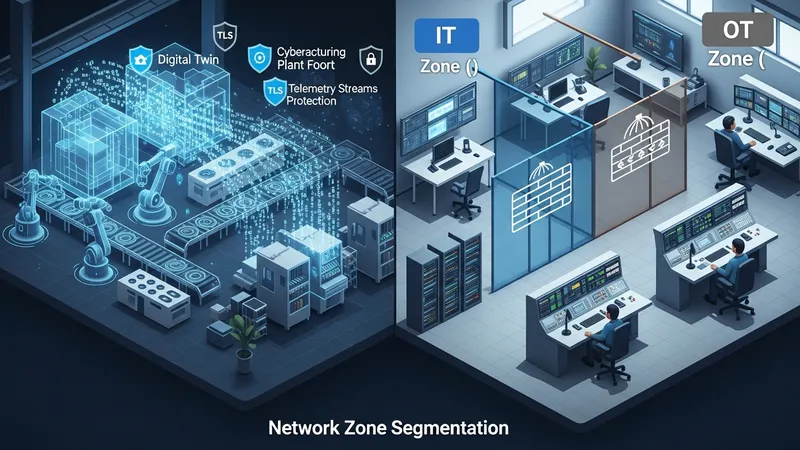
Security is a core operational consideration when connecting plant equipment to a digital twin platform. Typical mitigations include network segmentation between IT and OT, use of secure protocols (for example, TLS for telemetry), role-based access controls, and credential management for devices. U.S. manufacturers often reference guidance from the National Institute of Standards and Technology (NIST) and industry bodies to align practices with broadly accepted frameworks addressing industrial control system security.
Data privacy and IP protection influence decisions about cloud tenancy and data residency. Companies that handle sensitive process data frequently choose private or dedicated cloud options, or implement strict anonymization and aggregation before offsite transfer. Contract terms and vendor security controls are examined as part of procurement, and internal policy teams commonly require evidence of third-party audits or compliance certifications for cloud-hosted services used in manufacturing contexts.
Operational readiness includes staff training, change-management practices, and playbooks for failure modes. Introducing a twin that influences workflows requires documented operating procedures and clarity on who can approve changes to models or automated actions. U.S. plants often run staged rollouts and use shadow-mode deployments—where model recommendations are monitored but not acted upon automatically—before enabling bidirectional control to reduce unintended disruptions.
Resilience planning addresses both cyber incidents and equipment failures. Backup data flows, redundant sensors, and fail-safe control logic help maintain production when a twin or associated services become unavailable. Regular incident response exercises that include IT and OT stakeholders are commonly used to test assumptions in recovery plans and ensure coordination during cross-domain events.
Cost components for digital twin initiatives typically include initial integration engineering, ongoing data storage and compute, licenses for platform software, and personnel costs for model development and maintenance. In the United States, manufacturers often pilot a limited scope to establish baseline metrics before wider rollout; pilots can reveal realistic operating expenses such as edge hardware, cloud compute hours, and specialist staffing needs. Budget planning commonly uses conservative estimates and sensitivity analysis for scale-up scenarios.
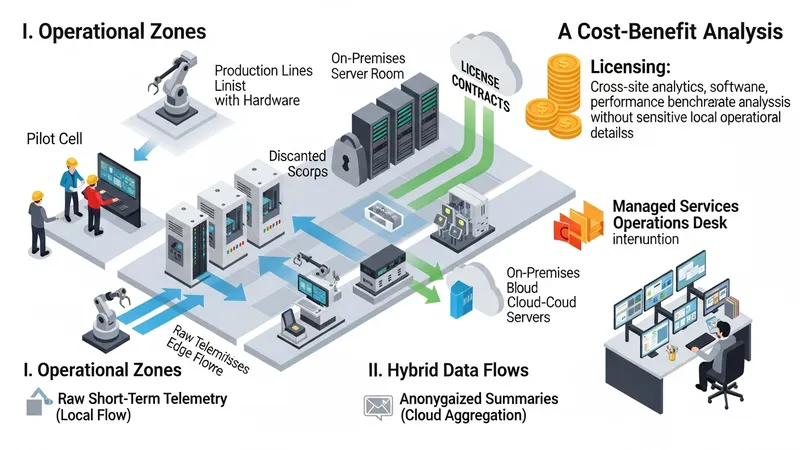
Deployment patterns vary from vendor-hosted cloud services to fully on-premises solutions. Small to mid-size U.S. manufacturers sometimes adopt managed services to reduce internal maintenance burden, while larger enterprises may prefer private deployments to centralize control over assets and data. Hybrid models that keep short-term telemetry on-premises while aggregating anonymized summaries for cross-site analytics are also common to manage cost and governance trade-offs.
Standards alignment helps reduce integration expense and improve long-term interoperability. In U.S. manufacturing, references to ISA-95 for integration with enterprise systems and OPC UA for machine-level data exchange are frequent. Participation in industry consortia and use of published information models can simplify vendor integrations and reduce custom mapping efforts when adding new assets or expanding to additional sites.
Decision-makers commonly track measurable performance indicators such as reductions in unplanned downtime, improvements in cycle time variability, or the accuracy of remaining useful life estimates as part of post-deployment evaluation. These metrics can support ongoing investment decisions while avoiding claims of guaranteed outcomes; manufacturers typically use observed improvements from pilots to inform phased rollouts and resource allocation for broader adoption.