
Companies that produce resistive heating components create devices that convert electrical energy into heat for industrial, commercial, and consumer applications. This work covers selection of conductive and sheath materials, geometric and electrical design, methods to assemble resistive elements into housings, and the documentation and testing needed to demonstrate performance. Production ranges from single-piece cartridge heaters to continuous coils and complex infrared emitters, and manufacturing practices vary according to required temperatures, environmental exposure, and intended service life.
Manufacturing these components typically involves iterative design and engineering to balance resistance, watt density, thermal expansion, and mechanical robustness. Firms consider manufacturability alongside application constraints: ease of assembly, required tolerances, and end-user safety expectations. Process controls, material sourcing, and adherence to safety and environmental standards often shape production workflows and the inspection criteria applied during and after fabrication.
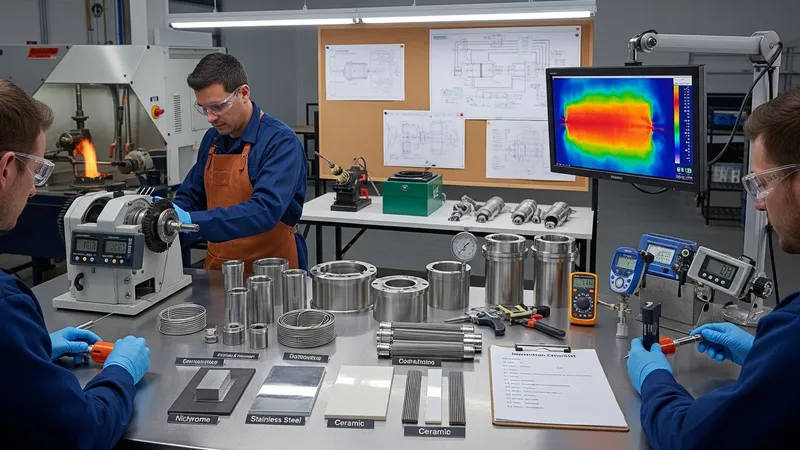
Material selection is central to performance and longevity. Resistance alloys such as nickel-chromium and iron-chromium-aluminium are often chosen for their stable resistivity at elevated temperatures and reasonable oxidation resistance. Sheath materials including stainless steels and copper alloys are selected based on corrosion exposure, required thermal conductivity, and mechanical strength. Designers may trade off higher conductivity for lower surface temperature or select thicker sheaths where mechanical wear is a concern. Supply-chain consistency for these alloys can also affect batch-to-batch variation and must be managed.
Fabrication methods commonly include wire forming, coil winding, insertion into ceramic cores, compacting MgO powder for tubular elements, and laser or arc welding for end fittings and terminals. Automated winding and insertion stations can increase repeatability, while manual finishing may remain necessary for specialized shapes. Sealing techniques — brazing, welding, or epoxy seals — are selected for compatibility with operating temperatures and environmental exposure. Production yield often depends on controlling particulate contamination and achieving consistent compaction or densification where insulation powders are used.
Quality control processes typically combine electrical, thermal, and mechanical tests. Resistance measurements and insulation resistance checks may be performed on every unit, while accelerated life tests, thermal cycling, and corrosion exposure tests are often conducted on sample batches. Thermal imaging and surface temperature mapping can verify even heat distribution and identify hot spots. Traceability via serial numbers or batch codes helps correlate in-field failures with production records and material lots. Documentation of test results and control limits may be needed for procurement and regulatory review.
Safety and industry standards guide design margins, labeling, grounding, and temperature-limiting provisions. Compliance often involves reference to general electrical safety frameworks and, where applicable, product-type standards that specify construction and test methods. Environmental regulations may require restrictions on certain alloys or coatings and call for material declarations. Manufacturers commonly maintain certifications or third-party test reports to demonstrate conformance; however, specific requirements depend on application, market, and end-use safety obligations.
Manufacturers often align production, test planning, and documentation to customer application cases so that elements meet projected duty cycles and environmental conditions. Typical considerations include specifying allowable watt density, anticipated duty cycle, and the presence of corrosive media, which may influence both design and inspection routines. This overview has outlined core components of production and standards; the next sections examine practical components and considerations in more detail.
Choosing conductive and sheath materials is a foundational decision affecting performance, cost, and durability. Resistance alloys such as nickel-chromium (nichrome) and iron-chromium-aluminium (FeCrAl) may be used where stable resistivity over temperature is required, while copper-based conductors can be chosen for lower-temperature, high-conductivity needs. Sheath choices—stainless steel, Incoloy, or copper—are influenced by corrosion potential, required heat transfer, and mechanical protection. Designers may apply conservative watt densities when operating environments include oxidation, scale formation, or abrasive contact, and they often model thermal expansion to prevent internal stress and degradation over repeated cycles.
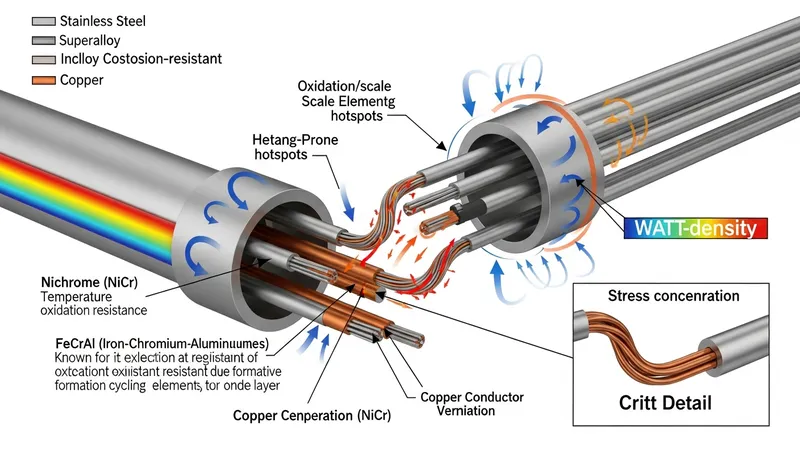
Geometric design factors include element diameter, length-to-diameter ratio, and the presence of bends or terminations that can concentrate stress. Watt density, defined as power per unit surface area, typically guides allowable loading; higher watt densities may reduce element life unless compensated by improved cooling or materials with higher oxidation resistance. Electrical considerations such as lead routing, contact resistance at terminals, and grounding provisions are weighed alongside mechanical fixtures. Tolerances for resistance and physical dimensions are often specified based on application sensitivity and measurement capability during production.
Environmental and regulatory contexts further affect material choices and designs. Exposure to moisture, corrosive chemicals, or salt spray may prompt selection of higher-grade alloys or protective coatings. In food-contact or medical-adjacent applications, material declarations and compliance with hygienic design principles can shape surface finish and sealing methods. Manufacturers often document material certificates and construction drawings so that changes in raw-material suppliers do not unintentionally alter element properties during production runs.
An operational consideration that manufacturers frequently report internally is the trade-off between manufacturability and performance margins. Simpler geometries and standard sizes can reduce lead times and variability, while custom shapes may require prototyping and additional process controls. When specifying elements, engineers may request small pilot runs to validate thermal behavior and assembly compatibility. These practices may help align design intent with reproducible manufacturing outcomes without assuming a single universal solution for all applications.
Common fabrication methods include winding resistance wire on mandrels, inserting wire into ceramic tubes, compacting magnesium oxide into metal sheaths, and applying coatings to form infrared emitters. Each method has process-critical steps: control of winding tension and pitch for coils, particulate control and compaction pressure for MgO-filled tubular elements, and atmosphere control during high-temperature sintering where ceramic components are used. These variables can influence both short-term functionality and long-term stability. Production equipment may be configured for batch or continuous processing depending on volume and geometric consistency requirements.
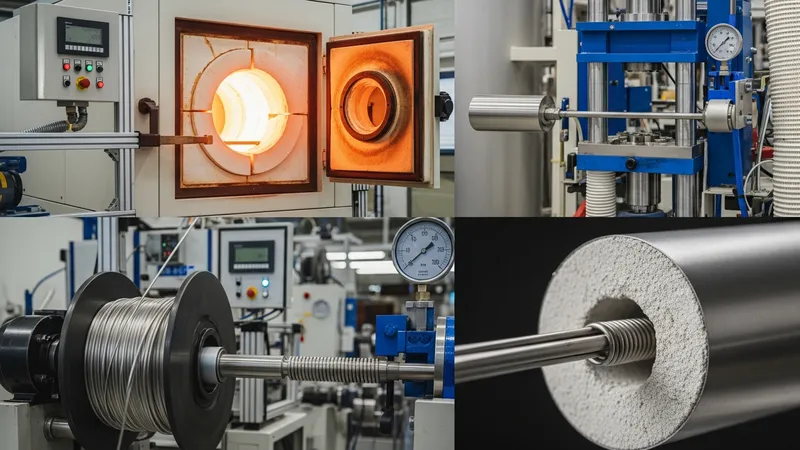
Joining and termination processes connect resistive paths to external leads and mounting hardware. Techniques such as laser welding, TIG welding, brazing, and mechanical crimping are used according to materials and temperature limits. Sealing and insulation around terminals may use high-temperature ceramics, mica, or specialized epoxies rated for the operating environment. Fixture design for consistent weld penetration or braze flow is often a key quality driver; manufacturers typically document parameters like heat input and filler materials to maintain reproducibility across shifts and machines.
Automation is increasingly applied to improve repeatability for high-volume product lines. Automated winding stations with tension control, robotic insertion for ceramic cores, and inline testing reduce manual variation. For low-volume or highly customized parts, skilled manual assembly remains common, particularly for complex terminations or when visual inspection is essential. Process control charts and first-article inspection methods are often used to bridge automated and manual operations, helping to detect drift and enabling corrective actions before full production continues.
Manufacturers commonly track yield influencers such as contamination during MgO packing, incomplete seals at terminations, or variations in wire resistance from different suppliers. Mitigation strategies may include tighter incoming material inspection, environmental controls for humidity and particulate, and statistical process control for critical dimensions. Engineers may recommend production trials that simulate expected duty cycles to validate assembly choices before scaling to larger batches, recognizing that accelerated tests may only approximate long-term in-service conditions.
Quality control typically integrates electrical, mechanical, and thermal verification steps. Electrical checks often consist of DC resistance to confirm target ohms and insulation resistance testing to detect leakage paths. Mechanical inspection ensures dimensional conformity, secure terminations, and proper sheath finishes. Thermal verification can include controlled power-up to measure surface temperatures and detect hot spots, as well as thermal cycling to observe changes in resistance or insulation over repeated heating and cooling. Sampling plans may vary with product criticality; safety-critical applications often require more extensive batch testing and documentation.
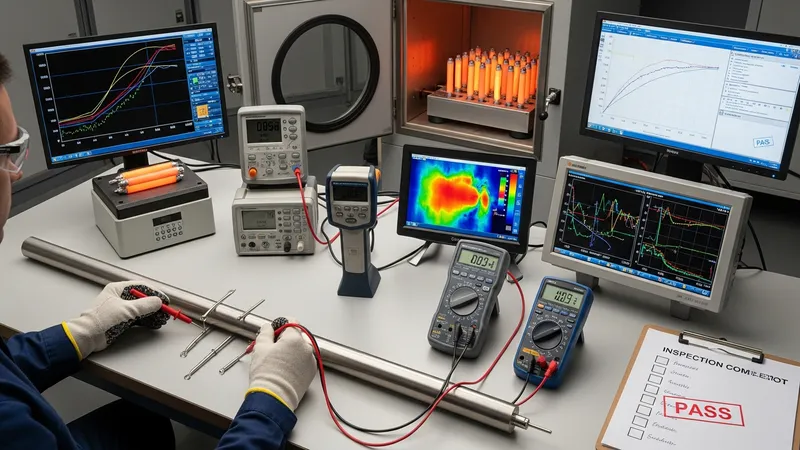
Performance testing often uses accelerated life or endurance tests to estimate wear modes such as oxidation, embrittlement, or insulation breakdown. Thermal-shock and vibration tests can reveal mechanical weaknesses in terminations or support structures. For radiant and infrared elements, spectral output and emissivity measurements may be performed to validate application suitability. Test protocols typically report conditions and criteria so purchasers and regulatory bodies can interpret results; they do not guarantee longevity but provide comparative data for design decisions.
Safety practices are implemented at both product and process levels. Grounding provisions, double-insulated designs, and temperature-limiting devices may be incorporated to reduce risk in service. Manufacturers often maintain work instructions and training for personnel handling high-temperature assemblies and welding operations to prevent defects and ensure worker safety. Documented traceability for raw materials and heat-treatment records may be retained to support investigations if failures occur in the field.
Documentation and certification practices differ by market and application. Many producers retain internal test records and conform to customer-specific quality plans, and some pursue third-party testing or certification when market access requires independent validation. For non-certified products, detailed datasheets and test reports can still inform buyers about expected performance characteristics and recommended installation conditions. These materials help end-users match element properties to duty cycles and environmental constraints without implying absolute performance guarantees.
Industry frameworks that influence heating-element design include general electrical safety standards, environmental regulations, and product-type specifications relevant to the intended market. Standards organizations such as international electrotechnical and national testing bodies publish test methods and safety guidelines that manufacturers may reference. Environmental compliance may require limits on specific substances or material declarations for supply-chain transparency. Manufacturers commonly align their documentation and testing to address applicable standards for regions where the products will be installed.
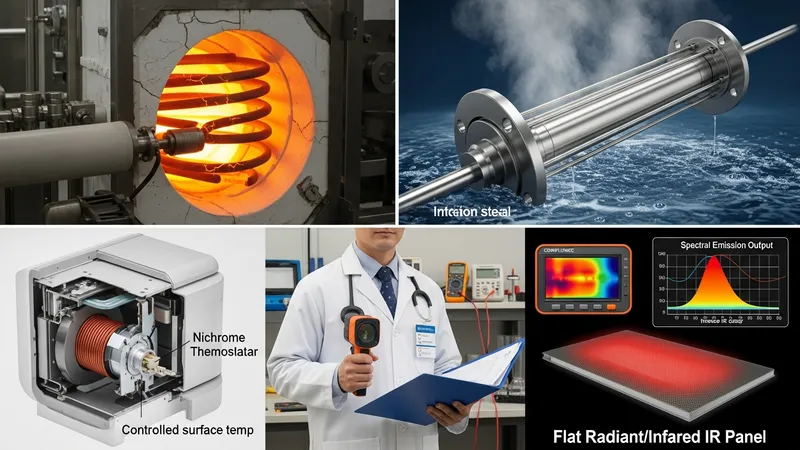
Common applications illustrate how manufacturing choices map to use cases. Industrial furnaces and process heaters typically demand elements that tolerate high temperatures and cyclical loads, prompting use of high-temperature alloys and robust sheathing. Immersion heaters for liquids emphasize corrosion resistance and reliable sealing. Consumer appliances often prioritize cost-effective materials, controlled surface temperatures, and consistent serial production. Radiant and infrared units are designed for spectral output and emitter durability, which may influence coating and substrate selection.
Compliance and market-entry considerations often shape production documentation and test depth. For example, elements destined for regulated equipment may need clearly defined test matrices and traceability to material certificates, while those for laboratory or industrial use may emphasize performance under specified duty cycles. Manufacturers may also maintain recommended installation guidance that addresses mounting, electrical supply, and environmental exposure to reduce the likelihood of misuse-related degradation, stated as considerations rather than guarantees of outcome.
In selecting or designing heating elements, stakeholders typically weigh application-specific factors—expected on/off cycles, maximum temperatures, exposure to corrosives, and space constraints—against available construction approaches. Close communication between design engineers and manufacturing teams can reduce rework and lead to elements whose materials, fabrication methods, and test regimes align with end-use expectations. Further technical detail on these components appears earlier in this article’s sections on materials, fabrication, testing, and safety practices.