
KiwiSaver and similar retirement plans in New Zealand are structured long-term savings arrangements designed to accumulate retirement resources through regular contributions and investment. These schemes typically combine member contributions, employer contributions where required, and sometimes government support, with rules governing eligibility, contribution rates, and permitted withdrawals. Providers manage participant accounts and offer a range of investment funds that differ by asset mix, risk profile, and fee structures. Participants normally choose a fund that matches their time horizon and risk tolerance, or they may remain in a default fund selected by their provider.
Administration and regulation are central to how these plans operate in New Zealand. Registered providers must meet disclosure and governance requirements, and funds are usually subject to oversight by financial regulators and independent rules on reporting. Contribution mechanics can include fixed percentages of gross pay or voluntary lump sums, while fee models may combine fixed charges and percentage-based management fees. Access rules commonly limit withdrawals before retirement except for defined circumstances such as transfers overseas or significant financial hardship, as set out in official guidance and provider terms.

Contribution arrangements across these plan types often follow standard patterns in New Zealand. For KiwiSaver specifically, employee contribution options commonly include percentages of gross pay such as 3%, 4%, 6%, 8% or 10%, and many employers contribute a minimum percentage where employment rules require it. Employer-sponsored schemes may set different contribution formulas or matching levels. Participants can typically make additional voluntary contributions or set up lump-sum transfers from other accounts. Tax treatment of contributions and investment returns can vary by plan type and should be reviewed through official guidance.
Fee structures are a key differentiator among providers and fund options. Common components include administration fees charged per member account, fixed member fees, and percentage-based management fees that apply to fund balances. Some funds may also levy performance or performance-related fees, though these are less common. Fee disclosure obligations in New Zealand require providers to publish fee schedules and performance information, enabling members to compare ongoing charges and the potential impact of fees on long-term accumulation.
Investment options in retirement plans generally fall into categories that reflect different risk and return profiles. Conservative or capital-protected funds typically hold higher allocations to cash and short-term fixed income, while balanced and growth funds include increasing shares of listed equities and alternative assets. Lifecycle or age-based approaches may automatically shift asset mixes to more conservative settings as a member approaches typical retirement ages. Provider reporting often includes historical returns and risk metrics, but past performance may not indicate future outcomes.
Withdrawal and eligibility rules help define how and when accumulated balances can be accessed. KiwiSaver accounts usually restrict withdrawals until qualifying retirement age, with exceptions for specific circumstances such as serious financial hardship, significant medical costs, or permanent emigration. Employer and retail schemes may have their own access provisions. Regulatory oversight and member protections are intended to preserve retirement savings for their intended purpose while allowing limited flexibility in defined situations. The next sections examine practical components and considerations in more detail.

Contribution models in New Zealand retirement arrangements can vary by plan type and employment status. For KiwiSaver, employees commonly choose contribution rates that are a percentage of gross salary—options often include 3%, 4%, 6%, 8% or 10%—with employers typically required to contribute a minimum amount, commonly around 3% where applicable. Self-employed people and voluntary members may set up periodic transfers or lump sums. Employer-sponsored funds may offer matching contributions or discrete employer-only contribution schedules. Participants often face thresholds or minimum payment rules defined by providers and employment agreements.
Frequency and methods of contribution also differ. Payroll deduction is a standard method for employed members, enabling automatic transfers each pay period to a KiwiSaver or workplace fund. Voluntary contributions can be made via direct debit or one-off payments to many providers, and transfers between schemes are normally permitted subject to provider processing. For planning purposes, members may review contribution frequency, percentage levels, and the potential effect of employer matching on long-term balances, bearing in mind that these elements may change under employment terms or policy adjustments.
Government interactions may influence contribution incentives. Historically, New Zealand schemes have included forms of government contribution or tax treatment designed to encourage participation; these supports can affect effective member accumulation rates. Regulatory frameworks require providers to disclose contribution rules clearly in product disclosure statements and member communications. Participants are commonly advised to review official information sources like the national KiwiSaver site and independent financial guidance to understand the precise mechanics that apply to their accounts.
Practical considerations include understanding how salary changes, job transitions, and periods of leave can affect contributions. Changing employers can prompt account transfers or continuation with an existing provider, and periods of low income may reduce nominal contribution amounts even if percentage rates remain constant. Members should typically monitor contributions lodged by employers to ensure alignment with agreed rates, and verify that voluntary transfers are received and allocated correctly by providers to maintain intended accumulation paths.
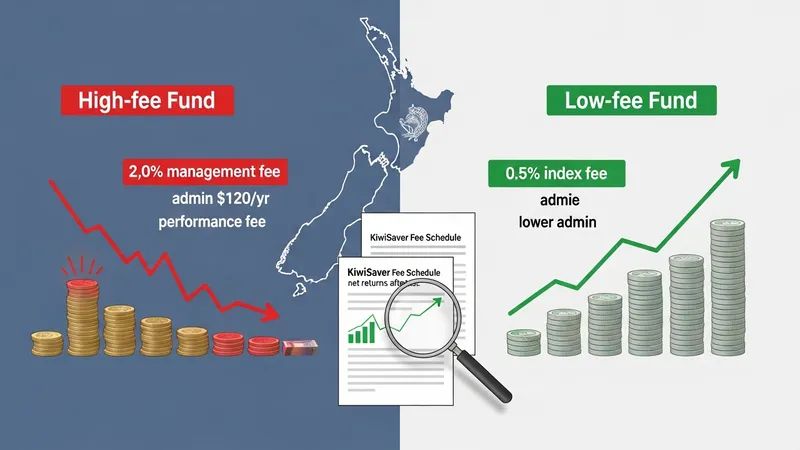
Fees for retirement plans in New Zealand generally include a mix of fixed and variable charges that can materially affect long-term balances. Common components are an administration fee charged either as a fixed amount per member each year or as a monthly fee, a member fee that may be fixed or tiered, and an asset-based management fee expressed as a percentage of the fund balance. Some funds may apply performance-linked charges or additional transaction fees. Fee disclosure requirements in the New Zealand market seek to improve comparability by requiring providers to publish clear fee schedules and annual fund performance net of fees.
Comparing fee impacts often involves looking at the total annual charge and its cumulative effect over decades. For example, two funds with similar returns before fees can exhibit materially different accumulation outcomes if one charges higher asset-based fees or additional fixed fees. Many KiwiSaver providers publish annual fund updates and key information documents that show net returns and fee breakdowns. Fee structures can vary by fund type too: funds investing in more complex assets or with active management may charge higher management fees than passive or index-tracking funds.
Administration efficiency and scale can influence fee levels. Larger providers or funds with substantial aggregated balances may be able to spread fixed costs across more members, often resulting in lower per-member fixed charges. Conversely, niche or boutique funds that offer specialised investment strategies may have higher relative fees. Members often consider the trade-off between expected net returns after fees and the particular investment approach, bearing in mind that higher fees do not necessarily correlate with better future performance.
Regulatory safeguards in New Zealand require transparent disclosure of fees and related-party transactions. Independent resources such as the Financial Markets Authority and consumer-facing sites like Sorted provide comparison tools and explanatory material to help members understand fee components. Reviewing fee schedules, member statements, and publicly available fund performance reporting may help members form a clearer picture of likely ongoing charges and their potential long-term effect.

Investment options within KiwiSaver and comparable plans are commonly grouped into categories that reflect asset allocation and risk exposure. Typical categories include conservative funds (higher cash and fixed-income holdings, lower short-term volatility), balanced funds (a mix of fixed income and equities), and growth or aggressive funds (higher equity exposure, greater expected volatility). Lifecycle or age-based funds automatically adjust asset mixes over time, shifting toward more conservative allocations as a member approaches typical retirement age. These categories help members match investment exposure to time horizons and risk preferences.
Risk profiling and asset allocation choices in New Zealand plans frequently consider local market exposure alongside global diversification. Many KiwiSaver funds hold a mix of domestic and international equities and bonds, and fund disclosure documents often list major asset classes and regional exposures. Over the past decade, providers commonly emphasise diversification to manage idiosyncratic risk. Members may review fund fact sheets that present historical volatility measures and asset allocation breakdowns to compare how different fund categories allocate across equities, fixed income, property, and alternative assets.
Performance reporting for each fund type commonly shows returns over multiple timeframes, such as one-, three-, and five-year periods, with the caveat that past performance is not a reliable predictor of future results. In New Zealand the availability of passive or index-tracking options has increased, offering members lower-cost exposures to broad market indices; active management remains available for those seeking different risk-return trade-offs. Fund selection considerations often include liquidity, turnover, and whether the fund uses derivatives or invests in illiquid assets, as these factors can affect both risk and fee levels.
Operational aspects such as rebalancing policies, currency hedging, and the use of external investment managers may also vary by fund and provider. Prospectuses and periodic reporting from providers typically describe these operational rules and how the fund intends to achieve its strategic asset allocation. Members may consider these technical features as part of understanding the risk profile and how the fund would respond to market stress or shifts in economic conditions.

Access rules determine when and how accumulated balances can be withdrawn. In New Zealand, KiwiSaver generally restricts withdrawals until a member reaches a qualifying retirement age or in specified situations such as significant financial hardship, serious illness, or permanent emigration. Employer and retail schemes may have different vesting or access rules tied to employment terms or product conditions. Understanding these provisions is important because limited early access is a common feature intended to preserve retirement resources while allowing constrained exceptions when necessary.
Tax treatment of contributions and investment returns can differ by plan. Some retirement products enjoy favourable tax treatment on investment returns or contributions, while others are taxed according to general income or investment tax rules. In New Zealand, providers typically apply a portfolio investment entity (PIE) tax framework to investment returns for many funds, which can affect net returns depending on a member’s income. Members may find it useful to consult official guidance or independent sources to understand how tax applies to their specific plan type and personal circumstances.
Regulatory oversight for retirement plans in New Zealand involves multiple agencies that set disclosure, governance, and conduct standards. The Financial Markets Authority (FMA) regulates financial markets and enforces disclosure and conduct rules, while independent education bodies such as Sorted provide guidance for consumers. Providers are required to publish product disclosure statements, annual reports, and other materials that outline fees, investment strategy, and risks. These regulatory requirements aim to increase transparency and protect members through governance and reporting obligations.
When comparing plan features, it is often helpful to consult official informational resources and provider disclosure documents to verify eligibility, access rules, and tax treatment. Members commonly review periodic statements and statutory disclosures to track changes in fees, asset allocation, and performance. The regulatory framework in New Zealand is structured to promote clarity, and sourcing information from official channels may assist in understanding the legal and operational rules that govern how retirement savings are accumulated and accessed.

This overview described how KiwiSaver and other retirement plans in New Zealand typically combine contribution mechanisms, fee models, and a range of investment options to support long-term accumulation. Contribution structures often involve payroll deductions and employer contributions, fee models mix fixed and percentage-based charges, and investment options span conservative to growth-oriented funds. Regulatory and disclosure frameworks aim to provide transparency through published fee schedules, fund reporting, and governance requirements. Members commonly balance contribution levels, fee impact, and fund risk when considering which options suit their circumstances.
Key considerations include understanding the frequency and percentage of contributions, the composition and costs of chosen funds, and the access rules that limit early withdrawals except in defined circumstances. Historical or typical government supports have sometimes been part of the framework for KiwiSaver-style schemes, and regulatory oversight requires providers to publish clear information. Comparing the structural features and operational terms across plan types can help clarify how each component may affect long-term outcomes.
Practical steps for participants often include reviewing provider disclosures, monitoring contribution records, and checking periodic fund updates for changes in fees or investment strategy. Official New Zealand resources and independent educational sites commonly provide tools and explanations to interpret disclosure documents and to view typical fund characteristics. These resources may assist members in forming an informed view of plan components without implying specific recommendations.
The material that follows in this series provides deeper detail on contribution mechanics, fee comparisons, investment categories, and the regulatory context to support an informational understanding of KiwiSaver and related retirement arrangements. Readers may consult official New Zealand sources for the most current procedural or regulatory information.