
Formal educational offerings that cover the fundamentals and applied aspects of machine learning typically present a mix of theoretical concepts and practical exercises. These programs often explain how algorithms infer patterns from data, the distinction between prediction and description, and the roles of data preparation, feature representation, and evaluation metrics. Learners may encounter mathematical foundations such as linear algebra, probability, and optimization, alongside conceptual topics like overfitting, generalization, and model interpretability. Course sequences commonly aim to move students from concept comprehension to hands-on implementation using sample datasets and reproducible workflows.
Course structures frequently vary by depth and format: brief introductory modules focus on conceptual literacy, while longer sequences include programming labs, project work, and assessments. Prerequisites may range from basic programming and statistics to more advanced calculus and linear algebra for in-depth tracks. Assessment methods often combine quizzes, coding assignments, peer review, and capstone projects. Instructors may emphasize reproducible code, dataset documentation, and evaluation using cross-validation or other resampling techniques to build reliable interpretation of model performance.

Comparing topic coverage across courses often reveals common building blocks: data collection and cleaning, exploratory data analysis, model selection, and performance evaluation. Some syllabi place greater weight on mathematical derivations, while others prioritize project-based learning and applied pipelines. For learners, it may be useful to check whether a course includes hands-on components that mirror typical data workflows, such as splitting datasets, handling missing values, and tracking model versions. Course outlines may indicate the expected balance between theory and practice, which can influence the types of learning outcomes students achieve.
Feature engineering and representation learning are frequently covered because they directly affect model capability and interpretability. Practical lessons often illustrate how transforming variables, encoding categorical data, and constructing features from time or text inputs may change model behavior. Some modules introduce automated approaches such as feature selection or embedding techniques, while others teach manual strategies and domain-informed transformations. In applied settings, teams typically document feature definitions and validate feature impact using ablation studies or controlled experiments to support reproducible results.
Algorithmic breadth in curricula can span from simple linear models to ensemble methods and neural networks, with attention to algorithmic assumptions and computational considerations. Instructors often discuss trade-offs such as bias–variance, scalability to large datasets, and suitability for noisy or imbalanced data. Computational cost and resource needs are commonly assessed when covering model classes; for example, some algorithms may require substantial memory or GPU time for training. Courses may therefore include guidance on choosing models that match dataset size, label quality, and available compute.
Assessment and evaluation topics frequently teach commonly used metrics and validation strategies. For classification tasks this often includes precision, recall, ROC curves, and confusion matrices; for regression, metrics such as mean absolute error or mean squared error may be covered. Cross-validation and holdout validation are typically described as ways to estimate generalization performance, with caveats about data leakage and hyperparameter tuning. Instruction often shows how to report results transparently and interpret metric trade-offs relative to application requirements.
In summary, structured educational programs that cover machine learning combine core theory, practical tool use, and project-based evaluation so learners can develop analytic thinking and technical skills. Content often progresses from foundational mathematics and basic algorithms to more advanced methods and applied workflows, and assessments commonly require demonstration of reproducible results. The next sections examine practical components and considerations in more detail.
Typical curriculum components address foundational mathematics, probability and statistics, algorithmic principles, and data-centric skills. Foundational modules may cover linear algebra concepts such as matrix operations, eigenvectors, and singular value decomposition because these appear in dimensionality reduction and model parameterizations. Probability and statistics sections often introduce distributions, hypothesis testing, and estimation techniques that underpin probabilistic models. Coursework may present optimization concepts—gradient descent variants and regularization methods—since many learning algorithms are trained by optimizing objective functions.
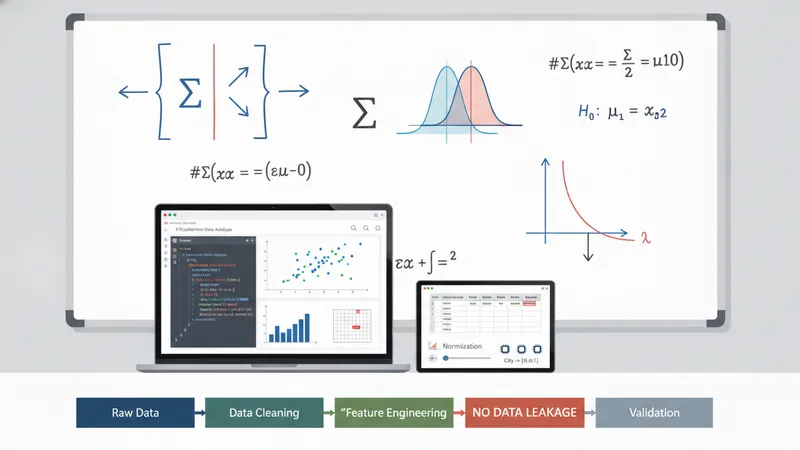
Data preparation segments usually teach practical workflows for cleaning, transforming, and documenting datasets. Topics can include handling missing or inconsistent values, normalizing or scaling features, and encoding categorical variables. Instruction frequently emphasizes exploratory data analysis using visualizations and summary statistics to identify patterns or anomalies that affect modeling choices. Students may learn to use pipelines that capture preprocessing steps for reproducibility and to avoid leakage between training and validation sets when estimating performance.
Modeling modules commonly compare families of algorithms and their typical use cases. Linear and logistic regression often introduce baseline approaches, while tree-based models and ensembles are presented for flexible nonparametric modeling. Neural network sections may describe architectures for structured data, sequences, or images and explain concepts such as activation functions and backpropagation at a conceptual level. Courses may also address model selection techniques, hyperparameter search strategies, and considerations for interpretability versus predictive capacity.
Ethical and practical considerations sometimes appear as dedicated topics or integrated discussions, covering dataset bias, fairness measures, and the importance of transparent reporting. Training may note that models can perpetuate existing biases in data and that evaluation across subgroups may be necessary to surface disparities. Documentation practices—data provenance, versioning, and experiment tracking—are often introduced as ways to maintain accountability and support reproducible workflows. These considerations help frame technical skills within broader responsible practice.
Programming instruction typically centers on a main language and associated libraries for data manipulation and modeling. Many programs use a scripting language for examples, showing how to load data, perform transformations, and prototype models. Tool-focused lessons may introduce data-processing libraries, plotting utilities for exploratory analysis, and serialization formats for saving results. Practical labs often demonstrate how to structure code into notebooks or modules and how to manage environments to ensure reproducible execution across systems.

Frameworks for model development and experimentation are commonly covered so learners can implement and test algorithms efficiently. Examples may include widely used libraries for traditional machine learning and specialized frameworks for gradient-based training of deep models. Instruction may explain differences between high-level APIs for rapid prototyping and lower-level constructs used when customizing architectures. Courses often include examples that highlight the trade-offs between development speed, transparency, and performance.
Computational and deployment tools may be introduced to show how models move from experimentation to production-like settings. Topics can include serialization formats for saving trained models, basic considerations for serving models as part of an application, and monitoring of model outputs over time. Performance profiling and resource estimation are sometimes taught so learners can anticipate memory and compute requirements for different model classes and dataset sizes. These sections tend to be conceptual rather than exhaustive operational guides.
Practical tips in tool-related modules often focus on reproducibility and documentation: freezing dependencies, using random seeds judiciously, and tracking experiments with simple logging. Instructors may demonstrate lightweight experiment-tracking options and emphasize that systematic recording of hyperparameters, data versions, and metric results supports later analysis. These practices often improve collaboration and diagnostic ability, which are common learning outcomes of applied coursework.
Project-based assessments commonly require learners to apply a pipeline from raw data to evaluated model outputs, demonstrating understanding across multiple topics. Typical projects ask for problem definition, dataset description, preprocessing steps, model selection rationale, and evaluation results. Grading criteria often examine reproducibility, clarity of assumptions, and appropriate use of metrics rather than only final performance numbers. Projects may be structured to mirror typical workflow stages and to highlight trade-offs made during development.

Evaluation practices taught in coursework may stress the importance of proper validation techniques to avoid optimistic estimates. Instructors often present cross-validation, stratified sampling for imbalanced labels, and temporal validation for time-series data as domain-relevant methods. The lessons commonly warn about data leakage—where information from validation sets influences training—and show how to design experiments to obtain more reliable estimates of out-of-sample behavior. Such evaluation topics are central to interpreting what a reported metric may actually imply.
Diagnostic tools and interpretability methods are frequently included to help learners understand model behavior beyond aggregate metrics. Techniques may include feature importance measures, partial dependence plots, confusion matrix analysis, and local explanation methods for individual predictions. Students typically practice using these tools to identify failure modes, bias patterns, or opportunities for incremental improvement. Coursework may frame these methods as investigative steps that supplement, rather than replace, quantitative evaluation.
Peer review and presentation elements are sometimes used to assess communication skills and reasoning. Students often prepare concise reports or poster-style summaries that describe dataset choices, modeling steps, and evaluation findings. Instructors may evaluate clarity of argumentation, transparency of methods, and the ability to contextualize results in relation to limitations. These communication-focused outcomes are intended to reflect how technical work is commonly shared and critiqued in applied settings.
Typical learning outcomes include the ability to select and justify modeling approaches, apply common preprocessing techniques, and evaluate models with appropriate metrics. Courses may aim for learners to demonstrate competency in implementing end-to-end workflows, documenting experiments, and interpreting results with attention to uncertainty and limitations. Outcomes often emphasize analytical reasoning—how to form hypotheses, test them empirically, and revise approaches based on diagnostic evidence rather than asserting definitive conclusions.

Skill development often encompasses both technical and soft skills: code hygiene, version control basics, and reproducible reporting alongside critical thinking about data quality and ethical implications. Many programs value the capacity to articulate assumptions, communicate limitations, and present findings to varied audiences. These communicative and organizational skills may be assessed via written documentation, code submissions, and oral presentations in project deliverables.
Continued learning pathways are commonly described as part of curricula, showing how foundational knowledge supports specialization in areas such as natural language processing, computer vision, or reinforcement learning. Courses may encourage iterative skill building through progressively complex projects and exposure to research literature. Learners are sometimes guided to evaluate their readiness for further study or applied roles by reflecting on competencies demonstrated through assessments.
Overall, structured machine learning education typically aims to produce learners who can reason about data and models, implement reproducible experiments, and communicate findings responsibly. Course outcomes often combine technical proficiency with consideration of broader impacts, and they may prepare students for varied applications or further study. This final page complements earlier sections by summarizing the learning-oriented perspectives and considerations covered throughout the article.