
Workflow orchestration that combines automation flows with machine intelligence involves coordinating nodes, triggers, and external models to perform multi-step tasks. In this approach, event signals initiate sequences where data moves through parsing, enrichment, decision logic, and external API calls. The coordination layer typically schedules or routes work, handles branching based on data or model outputs, and records state for visibility and retry. Describing these mechanisms helps clarify how an automation platform can connect event sources, transform payloads, and consult AI components without implying specific outcomes or endorsements.
Key elements in such automation patterns include trigger types, integration nodes, conditional branching, and error handling. Triggers may be time-based, webhook-driven, or event-stream consumers; integration nodes handle REST or webhook exchanges with models or services; branching evaluates conditions that may include model confidence scores. Error handling often uses retries, fallback paths, or alerting steps. Understanding these pieces supports design choices that balance latency, cost, and resilience while keeping system behavior observable and auditable.
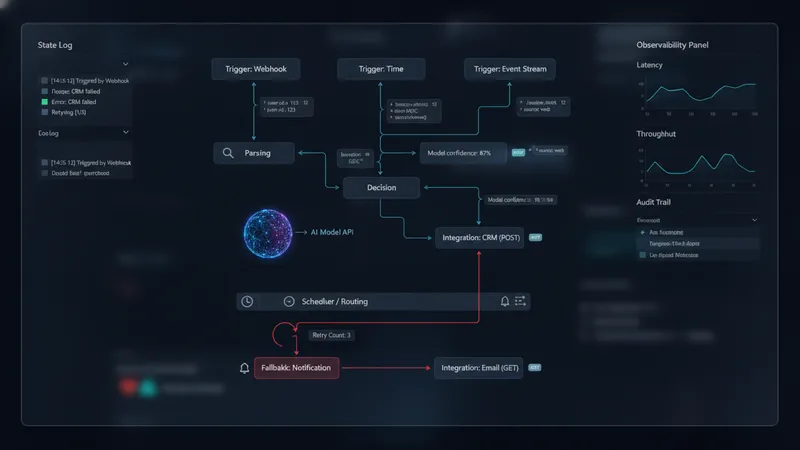
Event-driven trigger pipelines often form the entry point for automation. In practical setups, a webhook or queue event may provide an initial JSON payload that is parsed and validated by early nodes. Subsequent nodes enrich that payload with lookups or context before invoking a model or downstream API. Designers commonly add lightweight validation to detect malformed inputs and may include rate limiting to modulate throughput. These pipelines can typically be tuned to trade off immediacy against batching for cost or resource management.
The AI agent pattern with webhook and model integration usually separates concerns between orchestration and model inference. A workflow may send a curated prompt or structured data to an external model, receive structured or textual output, and then apply conditional logic based on that output. In many configurations, a model's response may be treated as advisory, with thresholds or confidence heuristics controlling whether automated actions proceed or human review is required. This separation helps maintain traceability and reduces the risk of undesired automated actions.
Data transformation and conditional branching with nodes supports complex decisioning without embedding logic in a single component. Mapping nodes typically convert incoming schemas to required target formats; validation nodes flag invalid records; branching nodes route data along paths defined by rules or model-derived attributes. Common practices include schema checking, type coercion, and using intermediate storage for large payloads. These techniques may help workflows remain modular and easier to maintain, and they often enable selective retries on transient failures.
Error handling and observability are core operational concerns in automation orchestration. Typical approaches include retry policies with backoff, dead-letter paths for persistent failures, and structured logging of step inputs and outputs for later inspection. Monitoring tools or dashboarding often track success rates and latency percentiles so operators can prioritize remediation. Designers frequently aim to balance automatic retries against rapid escalation to human review, depending on the potential impact of a failed action.
When these elements are combined, a practical automation architecture often emerges: triggers feed data into transformation layers, an AI step provides enrichment or decision signals, and branching plus error handling determine final actions. This architecture may support use cases such as content enrichment, automated routing, or augmenting human review, while preserving audit trails. The next sections examine practical components and considerations in more detail.
Trigger mechanisms determine how workflows start and often shape latency and throughput characteristics. Common trigger categories include webhooks for immediate event ingestion, scheduled polls for periodic batching, and message queue consumers for high-volume streams. Each trigger type typically influences how often a workflow runs and how state is managed: webhooks favor near-real-time processing with single-event contexts, while queue consumers may favor batch processing to reduce external API calls. Choosing a trigger pattern often involves trade-offs between responsiveness, cost, and the complexity of idempotency controls.
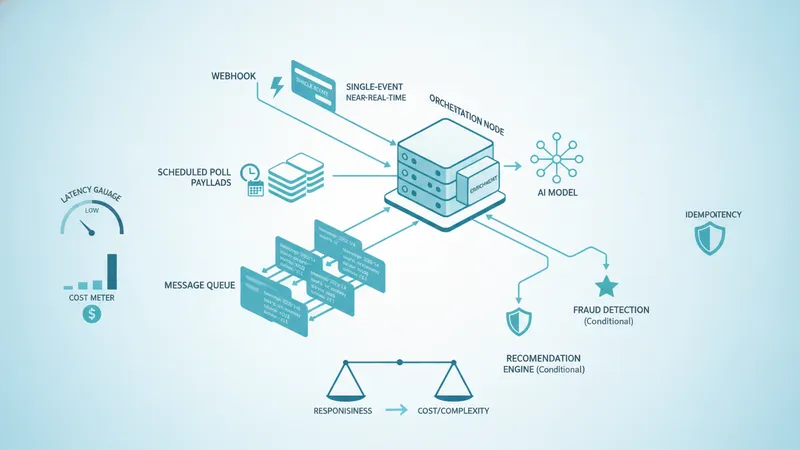
Event metadata and payload design are important for downstream AI steps. Triggers commonly include contextual fields such as timestamps, source identifiers, or schema version markers to help parsing nodes validate incoming data. Including minimal validation at the trigger stage can reduce unnecessary model invocations. In many implementations, lightweight enrichment before calling an AI model—for example, appending relevant contextual tags—may improve model utility and help ensure that subsequent conditional branches have sufficient data to make decisions.
Throughput control and rate limiting are frequently applied at the trigger layer to protect downstream systems and manage costs. Systems often employ token buckets or leaky-bucket algorithms in preceding layers, or they batch events in timed windows to reduce per-call overhead. When AI model calls are billed per request, batching or performing inexpensive prefilters that discard irrelevant events are common cost-control techniques. These measures typically reduce spikes and improve predictability of the automation platform.
Idempotency and deduplication are practical considerations for event-based workflows. Duplicate events can appear due to network retries or upstream retries, so workflows often assign and check unique event IDs before processing. Idempotent design—where reprocessing an event leads to the same observable outcome—may simplify error recovery. Logging event identifiers and processing outcomes aids investigations and supports replay strategies for missed or recovered events.
Integrating external models into orchestration flows typically separates orchestration logic from model interaction. Workflows usually prepare structured inputs, invoke model endpoints or API nodes, and parse model outputs into structured fields or flags. This separation may make it easier to change model providers or update prompts without altering the higher-level routing. In many systems, input sanitization and prompt engineering are treated as configurable steps so that model requests remain consistent and traceable.
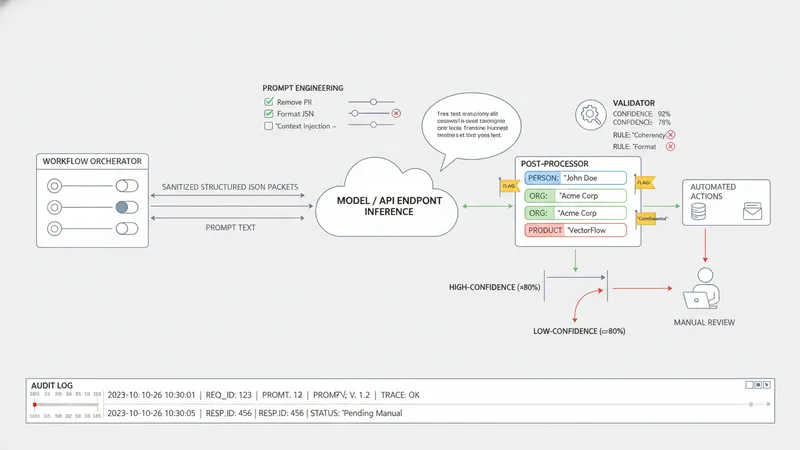
Handling model outputs often involves translating free-text responses into structured signals. Common strategies include post-processing heuristics, using small validators, or invoking a secondary model to extract entities or confidence estimates. Where model responses drive automated actions, designers often apply thresholding or soft-fail rules so that low-confidence outputs lead to manual review or alternate paths. Logging the model inputs and outputs in a structured audit trail supports debugging and downstream analysis.
Authentication, request patterns, and retry behavior are protocol-level concerns when calling model APIs. Typical setups use secure credential storage and short-lived tokens for API calls, along with retries implementing exponential backoff for transient errors. To limit exposure to unexpected charges, some workflows may implement quotas or circuit breakers that temporarily halt model calls when error rates or latency exceed predefined levels. These controls are often viewed as protective layers rather than guarantees of service continuity.
Latency expectations shape how orchestration invokes models. Synchronous calls are common when immediate decisions are required, but asynchronous patterns—queueing a request and acting on the eventual result—can improve scalability for longer-running inferences. Designers often balance synchronous simplicity with asynchronous resilience, considering user experience, resource constraints, and the criticality of timely responses.
Data processing nodes typically perform schema validation, mapping, enrichment, and normalization before decision points. These steps may include converting date formats, normalizing identifiers, or enriching records with lookups from external services. Such processing can reduce the complexity of conditional logic by ensuring that downstream nodes receive data in predictable formats. Where data volumes are large, partitioning, streaming transformations, or intermediate storage are often used to keep workflow steps efficient.
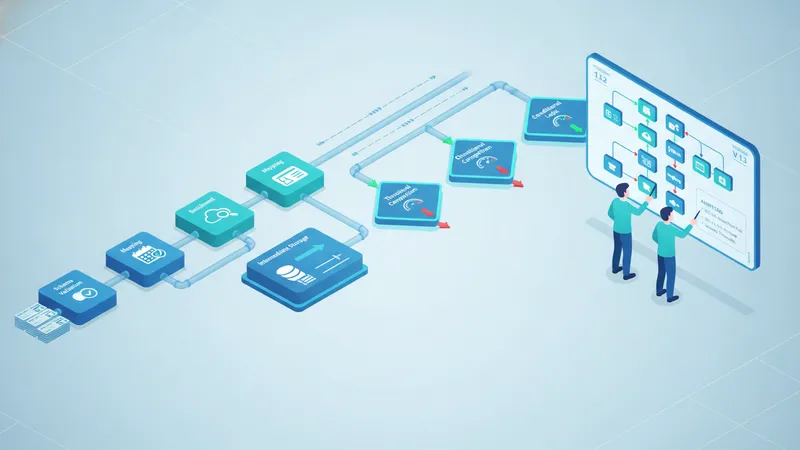
Conditional logic commonly uses rule-based checks, threshold comparisons, or model-derived flags to determine routing. Simple rules might check numeric thresholds or presence of fields, while more complex decisions combine multiple attributes using logical operators. Designers frequently document decision matrices and maintain them centrally so that branching behavior is auditable and can be updated without changing core workflow structures. This modular approach may help teams respond to evolving business or operational requirements.
Testing branches and validating end-to-end flows are standard maintenance practices. Unit testing individual nodes and integration testing entire workflows with representative inputs help surface edge cases. Many practitioners create test harnesses that replay historical events to observe branch coverage and measure how often particular paths execute. These tests often inform adjustments to branching thresholds or enrichment steps to improve overall reliability.
Retries, fallbacks, and dead-letter handling are typical components of robust branching strategies. For recoverable failures, workflows often implement limited retries with backoff; for persistent errors, a dead-letter path may capture failed payloads for manual review. Fallbacks can route items to degraded but safe processing paths, such as flagging content for human review rather than attempting further automated actions. Such approaches aim to limit unintended automated effects while preserving throughput for healthy inputs.
Observability typically includes structured logs, metrics, and traces that capture the journey of each event through the orchestration system. Common metrics include processing latency, success rates per node, and model call counts. Tracing can reveal bottlenecks and support root-cause analysis for failed runs. Many teams define service-level indicators that reflect end-to-end workflow health and use dashboards to monitor trends, while preserving records for compliance and post-incident analysis.
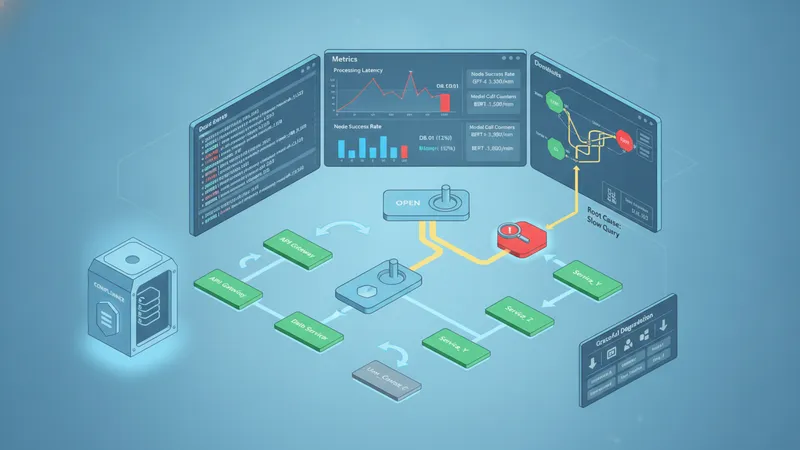
Resilience strategies often combine retries, circuit breakers, and graceful degradation. Circuit breakers may open when external dependencies exceed error thresholds, redirecting traffic to fallback paths. Graceful degradation can reduce feature complexity under load—for example, skipping optional enrichment steps to prioritize core processing. Such patterns are intended to maintain a baseline of service rather than to guarantee uninterrupted operation.
Change management for orchestration flows commonly uses versioned workflows and staged rollouts. Versioning allows rollback if a new workflow revision produces unexpected behavior, while staged rollouts let teams observe effects on a subset of traffic. Automation platforms may provide simulation or dry-run modes for validating logic changes before they affect live events. These practices help reduce operational risk and improve the predictability of updates.
Security and governance concerns center on credential management, data minimization, and access controls. Credentials for external APIs and models are typically stored securely and accessed by nodes at runtime. Minimizing the amount of personal or sensitive data sent to models, and retaining only necessary logs, are common governance practices. Role-based access to orchestration definitions and audit logs supports accountability and helps maintain compliance with organizational requirements.