
Online universities in the United Kingdom refer to higher education institutions that deliver degree programmes, diplomas, and short courses primarily through digital platforms. These institutions may operate fully online or as part of blended learning models, with students accessing lectures, resources, and interactive activities remotely. Many online universities are formally accredited and conform to United Kingdom academic regulations, offering recognised qualifications that are comparable to those delivered on traditional campuses. The structure, curriculum, and academic requirements typically follow UK standards, though learners may benefit from increased scheduling flexibility and access from any location with an internet connection.
The growth of online universities in the UK can often be attributed to evolving learner demands, such as the need for more adaptable learning environments and the ability to combine study with employment or family duties. The use of advanced educational technology allows for interactive teaching methods, including live webinars, video lectures, and forums for group discussion. Online universities may also provide digital support services, such as access to e-libraries, academic advising, and technical assistance, to enable student engagement and success without a physical campus presence.

Institutions like The Open University are frequently referenced as examples of how the digital delivery model can enable people in the UK to access education regardless of geographic limitations. Their approach involves a combination of online materials and assessment, professional support, and community engagement, which collectively have been designed to adapt to a wide spectrum of student needs.
Arden University represents another notable example, offering career-focused degrees that emphasise flexible study modes. Their online courses are developed to meet modern industry standards, with regular content updates and tools to help students track academic progress and manage their workload efficiently.
Several traditional universities in the UK, including University College London, have expanded their digital learning portfolios. UCL’s online programmes are supported by respected academic faculties and are delivered using digital platforms with interactive features. These offerings can enable working professionals to study while continuing with employment.
UK online universities often apply the same rigorous admissions standards and quality assurance processes as their in-person counterparts. Degrees obtained through these routes are generally subject to the same regulatory scrutiny and recognition, both domestically and internationally. Many students choose online study for the potential to balance professional development with personal obligations, as the formats are adaptable and may support a range of learning preferences.
In summary, online universities in the United Kingdom have made higher education more accessible, especially for those who require adaptable forms of study. The next sections examine practical components and considerations in more detail.
The methods used to deliver courses at UK online universities are typically designed to support flexible study and sustained engagement in a virtual environment. Core materials, such as recorded lectures, reading assignments, and digital textbooks, are made available through password-protected platforms known as virtual learning environments (VLEs). This allows students to access content according to their own schedules, which may provide an advantage for those balancing study with employment or caring responsibilities.
Many online universities in the UK incorporate synchronous elements, such as live webinars or video conferencing sessions, which enable interaction between students and academic staff in real time. These sessions may be scheduled weekly or at key points during the course and can support collaborative work and prompt feedback. Asynchronous elements, including discussion forums and pre-recorded content, typically allow participation at any time and are common features of the online learning model.
Assessment in UK online universities is frequently conducted through a mixture of coursework submissions, projects, and timed online examinations. Plagiarism detection and academic integrity policies similar to those in traditional settings apply, with technological tools in place to monitor standards. In some cases, practical components may require attendance at in-person workshops or local assessment centres, though many programmes are structured to remain fully online.
Support services, such as academic advising, careers guidance, and IT helpdesks, are generally delivered through online communication tools. Institutions may also provide mental health resources and peer support communities adapted for digital engagement. These services aim to replicate the assistance provided on campus, contributing to a comprehensive student experience in a remote learning context.
UK online universities are subject to accreditation and oversight by national quality assurance bodies such as the Quality Assurance Agency for Higher Education (QAA). Programmes must demonstrate that they meet academic standards and learning outcomes equivalent to those offered in traditional campus environments. Accreditation may determine whether a degree is recognised for employment or further study within the UK and internationally.
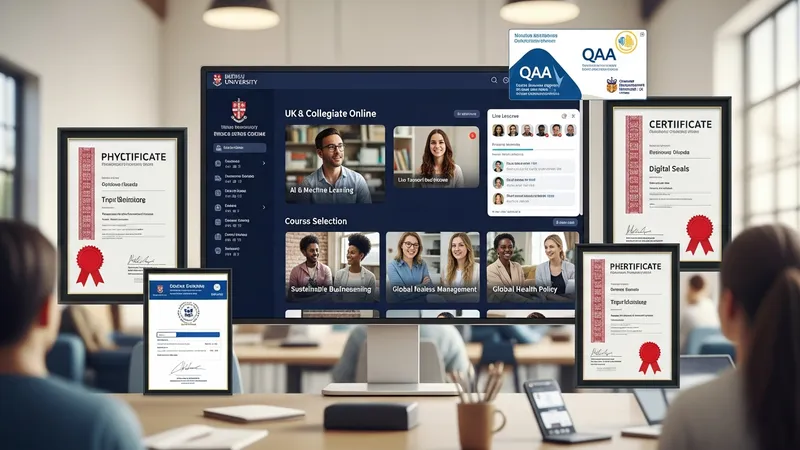
Degrees awarded through online universities in the UK typically carry the same legal status as those gained through face-to-face study. Institutions are often regulated by the Office for Students (OfS), ensuring compliance with standards around student outcomes, equality, and value for money. Students may also be eligible for government-backed tuition fee loans and support schemes, subject to meeting eligibility criteria and course requirements.
Quality assurance policies in UK online universities include regular reviews of curriculum content, assessment procedures, and student support mechanisms. External examiners, drawn from other UK institutions, may review marking and course materials to ensure consistency and fairness. Findings from these reviews are typically published on university websites for transparency.
The recognition of online degrees by employers and professional bodies in the UK can depend on the course content, accreditation status, and sector. Many employers consider online degrees from accredited UK universities as valid qualifications, though entry into regulated professions (such as law or medicine) may require further training or in-person components.
The demographic profile of students enrolling in UK online universities is notably varied. Enrolment figures from public sources suggest that mature students—those aged 21 and above—make up a significant portion of the online student population. Many students in these programmes are in employment or caring for dependents, seeking to enhance their qualifications without having to relocate or defer current responsibilities.

International participation is another distinct trend among UK online universities. Institutions such as The Open University report enrolments from students across several continents, reflecting the global interest in UK-accredited qualifications. However, most students remain UK residents, with domestic accessibility being a main factor driving growth in online enrolments over the past decade.
Fields of study with high online participation rates in the UK typically include business and management, computing, education, and health-related subjects. These courses may align more closely with workplace requirements or offer direct relevance to evolving career roles, appealing to professionals seeking formal recognition of their expertise.
Retention and degree completion rates for online students in the UK can differ from those in campus-based settings. UK universities have implemented targeted initiatives, such as enhanced digital support and proactive academic outreach, to help online learners progress through their programmes. These approaches are designed to address common barriers like isolation or challenges with time management in remote study environments.
Online universities in the UK encounter a range of operational challenges, including the requirement to maintain academic integrity, ensure accessibility for students with varying technological resources, and align digital pedagogy with evolving sector standards. Developing robust security measures for online assessments and safeguarding data privacy continues to be a priority for institutions.
Adapting teaching methods to suit diverse learner preferences is another ongoing area of development. Research within the UK context indicates that students exhibit varying degrees of digital literacy and self-direction, necessitating the inclusion of orientation modules and support for digital skills at the outset of their studies. These measures aim to reduce barriers to participation and support equitable outcomes.
The UK government and sector bodies have introduced strategies to reinforce the resilience and innovation of online higher education. This includes investing in digital infrastructure, supporting collaborative research on technology-enhanced learning, and promoting inclusive practices. As regulatory frameworks evolve, there may be new standards for quality assurance and an increased focus on the recognition of microcredentials or modular learning pathways.
Looking ahead, UK online universities are likely to continue refining their models to enhance flexibility, engagement, and academic quality. As digital platforms become more sophisticated, there are ongoing discussions around virtual reality, adaptive learning technologies, and widening access for underrepresented communities. These developments suggest that the landscape of UK higher education will remain dynamic, with online universities playing an increasingly visible role.