
Secure network architecture describes the systematic design and organisation of networks to provide protection for data, resources, and communications. This concept involves constructing network environments that can defend against unauthorised access, misuse, or disruption, primarily through carefully planned physical and logical controls. Engineers typically employ multiple strategies to create interconnected layers that can help address emerging security risks and mitigate vulnerabilities.
In practice, secure network architecture utilises techniques such as network division, authenticated user access, encrypted connections, and persistent activity monitoring. These components are structured to support business continuity, data confidentiality, and regulatory compliance. When designing for resilience, organisations often rely on established frameworks and guidelines to guide their implementations, taking into account factors such as operational scale, compliance requirements, and evolving threat landscapes.

One of the defining characteristics of secure network architecture is its layered approach. Each layer serves as a control point, often combining physical barriers with logical checkpoints. This technique can stem the movement of threats inside the network and reduce the risk of wide-scale compromise if a single point is breached.
In the United Kingdom, the regulatory landscape influences secure network architecture through requirements such as the Network and Information Systems (NIS) Regulations and guidance from agencies like the National Cyber Security Centre (NCSC). These standards often steer organisations towards best practice in isolating sensitive assets and continuously monitoring for unusual activity.
Segmentation and zero trust strategies are increasingly adopted as a response to the evolving nature of cyber threats. By isolating workloads, departments, or user groups, entities can more effectively manage permissions and rapidly respond to incidents. Encryption technology also remains fundamental as organisations handle personal and sensitive data across cloud, remote, and hybrid environments.
Despite robust planning, no architecture can fully eliminate risk; however, secure design principles may substantially reduce the probability and impact of unauthorised access or service disruptions. Integration of automated monitoring, regular testing, and proactive review supports adaptive resilience as technologies and threats develop.
In summary, secure network architecture is an evolving discipline shaped by technical, regulatory, and operational factors in the UK. The following sections break down its main components, implementation strategies, and common challenges in greater detail.
Layered security, sometimes referred to as “defence in depth,” is a foundational strategy within secure network architecture. This approach relies on the sequential arrangement of controls, each designed to address different attack vectors or failure points. In many United Kingdom deployments, this begins with strong perimeter protections and progresses inward to more granular, role-based restrictions.

The application of multiple layers can range from physical controls, such as secured hardware environments, to logical safeguards, like network access controls and internal firewalls. Each layer is structured to delay, detect, or contain potential compromise. Organisations often base these design decisions on risk assessments and regulatory guidelines specific to their industry.
The use of zero trust principles further refines the layered approach by treating every access attempt as untrusted by default. In the UK, public sector organisations are increasingly implementing zero trust pilots, particularly for services hosting sensitive citizen data. This can involve combining user authentication, endpoint verification, and encrypted session management.
Regular review and update of security layers are necessary to address shifting attack surfaces as environments change. Effective layered architectures typically incorporate feedback from security assessments and lessons learned during incident response, promoting ongoing adaptation to new threats affecting networks in the United Kingdom.
Segmentation is a core technique frequently used in secure network architecture designs to control the flow of traffic and compartmentalise network resources. In the UK, enterprises deploy segmentation to separate different departments, data tiers, or application environments, thereby containing potential breaches.
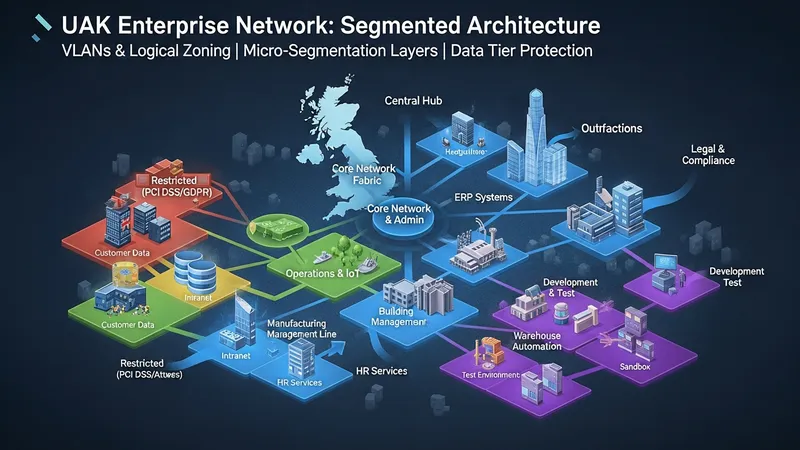
VLANs (Virtual Local Area Networks), network zones, and micro-segmentation are commonly referenced methods for achieving logical separation. These practices allow for more granular security policies—for example, permitting or denying network access based on user group memberships or specific application needs. The ability to isolate sensitive information is a priority for sectors handling regulated data in the United Kingdom.
Next-generation firewall systems with advanced rule sets play a critical role in enforcing segmentation. They can examine traffic at the application level and automatically block or flag suspicious behaviour. Implementation of such systems in the UK typically aligns with compliance mandates, such as those set by the NCSC or Information Commissioner’s Office (ICO).
Effective segmentation may present operational challenges, including increased complexity and management overhead. Regular audits and monitoring help ensure that segment boundaries align with current risk assessments and business priorities, supporting adaptive security postures in the UK’s organisational networks.
Encryption, both for data at rest and in transit, is an essential element of secure network architecture. Within the United Kingdom, organisations often implement encryption protocols such as TLS (Transport Layer Security) for secure communications, and AES (Advanced Encryption Standard) for protected storage.

End-to-end encryption frameworks help maintain the confidentiality and integrity of sensitive data as it moves between endpoints or across shared infrastructure. The deployment of encryption requires careful key management, typically guided by standards set within UK government frameworks or industry-specific bodies.
Organisations can face challenges integrating encryption with legacy systems or third-party services. Interoperability concerns and the need to balance security with performance are often cited considerations in UK infrastructure projects, where user experience must remain consistent while enhancing protection levels.
Continuous review of cryptographic standards is encouraged to guard against evolving vulnerabilities and advances in computing technology. UK authorities, such as the NCSC, regularly update guidance on recommended protocols, ensuring alignment with current threat landscapes and legal obligations.
Continuous monitoring forms a critical part of secure network architecture by providing ongoing oversight of network traffic, system activity, and potential threat indicators. United Kingdom organisations typically use a blend of automated tools, such as Intrusion Detection Systems (IDS) and Security Information and Event Management (SIEM) platforms, to facilitate timely awareness of deviations or incidents.

Alignment with regulatory requirements is a significant driver for continuous monitoring in the UK. Frameworks such as the National Cyber Security Centre’s guidance and the requirements of the General Data Protection Regulation (GDPR) influence how entities monitor and report on network activities, particularly when processing personal information.
Monitoring systems may include real-time alerts, audit trail generation, and periodic vulnerability assessments. These processes enable teams to detect anomalies, investigate root causes, and enact corrective measures in response to emerging risks, helping to minimise potential impacts on organisational operations.
Effective continuous monitoring must adapt to innovation in attack techniques and changing operational contexts. Regular updates and collaboration between technical and compliance teams support a proactive security stance, bolstering the resilience of secure network architectures throughout the United Kingdom.