
Artificial intelligence applied in everyday settings refers to systems that process data to perform tasks that support decisions, automate routine work, or extract patterns from information. In practical terms, this includes algorithms that learn from historical inputs to predict outcomes, language models that interpret or generate text, and vision systems that analyze images or video. These implementations typically combine data ingestion, model training, validation, and integration with existing software so that automated outputs can be used by people or other systems in operational contexts.
Implementations often vary by sector and objective. A typical real-world deployment may focus on reducing manual effort, identifying anomalies, or improving situational awareness rather than replacing human judgment. Key components include data collection and labeling, model selection and tuning, and deployment pipelines that connect models to user interfaces or automation logic. Practical constraints such as data quality, latency requirements, and interpretability needs frequently shape which AI techniques are chosen and how they are integrated.

Comparing these approaches shows different data and model requirements. Predictive analytics often relies on structured datasets and numerical features, where classical regression or tree-based learners may suffice and interpretability can be emphasized. NLP typically requires large corpora of text and tokenization or embedding strategies; modern systems may use transformer-based models for richer context but can demand more compute. Computer vision workflows need annotated images and augmentation strategies to handle variations in lighting or perspective. Each class of application may require different validation strategies and operational monitoring.
Implementation frameworks for real-world AI usually include stages that move from proof-of-concept to production. Initial exploration can use smaller samples and offline evaluation, while production deployment needs reproducible pipelines for preprocessing, model training, and versioned artifacts. Continuous integration and delivery patterns adapted for models — often called MLOps — help manage retraining schedules, performance drift, and rollback plans. Teams commonly balance automation with human oversight so that automated outputs are reviewed or constrained where necessary.
Evaluation and measurement are critical for applicability. Common metrics vary by task: forecasting uses error measures like mean absolute error, classification uses precision and recall, and vision tasks may use intersection-over-union or mean average precision. Beyond raw accuracy, practical evaluation often examines latency, robustness to input shifts, and failure modes that could affect downstream processes. Stress-testing with realistic edge cases and tracking performance over time may help reveal degradation and guide maintenance.
Industry examples illustrate differing priorities: manufacturing may emphasize vision-based defect detection with tight latency and high throughput; financial services may use predictive models for risk scoring where explainability and audit trails matter; public sector deployments may focus on information extraction from documents with strict privacy constraints. These contextual differences influence architecture choices, data governance, and stakeholder engagement in typical projects.
In summary, practical AI integrates data, models, and operational processes to address specific tasks such as forecasting, text understanding, or visual analysis. Real-world implementations emphasize measurable performance, maintainability, and alignment with user workflows. The next sections examine practical components and considerations in more detail.
Machine learning applied to prediction typically begins with framing the problem as a supervised or unsupervised task. Supervised approaches map inputs to known labels or targets and are common for demand forecasting, churn estimation, or predictive maintenance. Unsupervised methods can surface clusters or anomalies when labeled outcomes are unavailable. Feature preparation often consumes much of the project effort: handling missing values, encoding categorical data, and selecting temporal features can materially affect model stability. Teams may choose tree-based ensembles for tabular data or use neural networks when complex nonlinear interactions are prominent.

Model selection and validation strategies may vary depending on data volume and risk tolerance. Cross-validation, holdout periods aligned to temporal order, and backtesting for time-series tasks are frequently used to estimate performance under realistic conditions. Attention to class imbalance and sampling strategies can reduce misleading metrics in skewed datasets. Explainability techniques such as feature importance, partial dependence plots, or local surrogate models can be employed where transparency is needed for decision support or audits.
Operational considerations for predictive systems often include retraining cadence and monitoring for distributional shifts. Models may be retrained on a schedule or triggered by observed performance drops; monitoring pipelines track prediction accuracy, input feature distributions, and resource usage. Practical pipelines tend to containerize model artifacts and rely on orchestration tools to automate retraining and deployment. Integration with existing reporting and alerting systems helps stakeholders interpret predictions and take appropriate actions.
Risk management and testing are important in productionized predictive analytics. Scenario testing, sensitivity analysis, and stress tests may reveal how models behave under outlier conditions. Documentation of data sources, preprocessing steps, and decision thresholds supports reproducibility and governance. These practices may often reduce operational surprises and support iterative improvement while keeping projects aligned with organizational constraints and stakeholder needs.
NLP applications in operational contexts commonly address tasks such as document classification, information extraction, summarization, and conversational interfaces. Preprocessing steps like tokenization, normalization, and stop-word handling prepare raw text for modeling. Embedding techniques convert text into numerical representations; recent transformer-based models provide contextualized embeddings that often improve downstream task performance but require greater computational resources. Selection of model complexity should consider dataset size, latency requirements, and the need for interpretability in user-facing or regulated contexts.
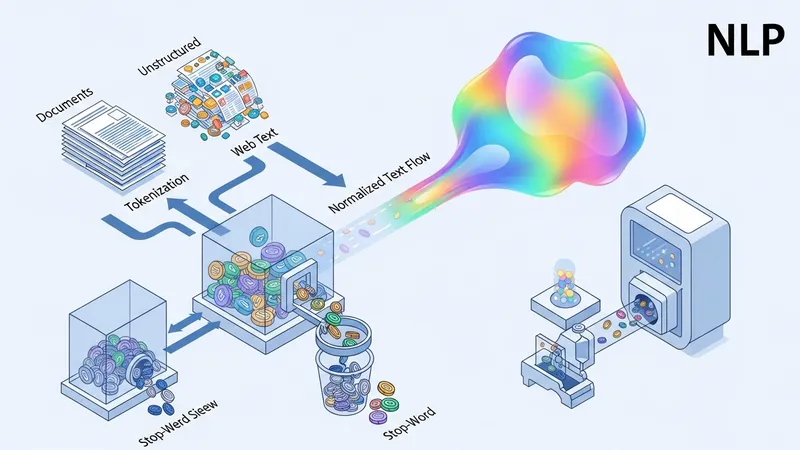
Pipeline design for text-based systems may include annotation strategies, quality control for labeled data, and iterative model updates. Labeling guidelines intended for human annotators can improve consistency in training sets. Evaluation typically uses metrics such as F1 score for classification, ROUGE for summarization, or task-specific measures for extraction accuracy. Human-in-the-loop approaches are often used to validate outputs, correct model errors, and provide ongoing feedback that supports incremental improvement.
Deployment choices can affect user experience and cost. On-device or edge inference may be appropriate where latency and offline operation are critical, while cloud-hosted models can provide rapid scalability and access to larger models. Hybrid approaches sometimes combine lightweight local models for immediate responses with backend systems for deeper analysis. Practical NLP implementations also consider multilingual support, handling of sensitive content, and mechanisms to flag low-confidence outputs for human review.
Ethical and privacy considerations often influence NLP use. Text may contain personally identifiable information or sensitive subject matter, so data minimization, anonymization, and access controls are commonly applied. Bias in training data can affect model outputs; therefore, auditing for disparate performance across groups and documenting limitations may be used to inform stakeholders. These governance practices typically form part of responsible deployment strategies.
Computer vision applications typically focus on tasks such as object detection, classification, segmentation, and pose estimation. Convolutional neural networks and detection architectures are commonly used for visual pattern recognition, while segmentation models delineate object boundaries when pixel-level decisions matter. Preparing annotated datasets with appropriate diversity in lighting, orientation, and background conditions is often a substantial portion of project effort. Data augmentation techniques can help improve robustness to natural variability in visual inputs.

Design decisions for vision systems often balance model accuracy against latency and hardware constraints. Real-time inspection or robotic guidance may require inference at the edge with optimized models, whereas batch review of images may tolerate heavier models running in cloud environments. Considerations include image capture standards, resolution, and pre-processing pipelines that normalize input for consistent inference. Calibration and alignment procedures may be needed when vision systems interface with physical processes or sensors.
Quality assurance for vision-based automation typically includes validation on holdout datasets, confusion analysis for common error modes, and targeted testing for adversarial or unexpected conditions. Where safety or regulatory compliance matters, redundant sensing or fail-safe logic may be implemented so that automated decisions do not operate without human oversight in critical scenarios. Logging of predictions and capture of example failures supports iterative improvements and root-cause analysis.
Maintenance and lifecycle concerns include dataset drift, evolving visual contexts, and labeling updates when new defect types or object classes emerge. Retraining and version control for models, combined with procedures for rolling back deployments, help manage operational risk. Cross-disciplinary collaboration among domain experts, labelers, and engineers typically improves dataset relevance and downstream performance in applied vision projects.
Practical AI implementations depend heavily on data quality and governance. Establishing clear data lineage, ownership, and access controls can reduce ambiguities during model development and audits. Data preprocessing standards and agreed-upon labeling schemas help maintain consistency across annotation efforts. Monitoring pipelines may track feature distributions and missing-data rates so that teams can detect data drift or collection issues early. These practices typically support more reliable model behavior over time.
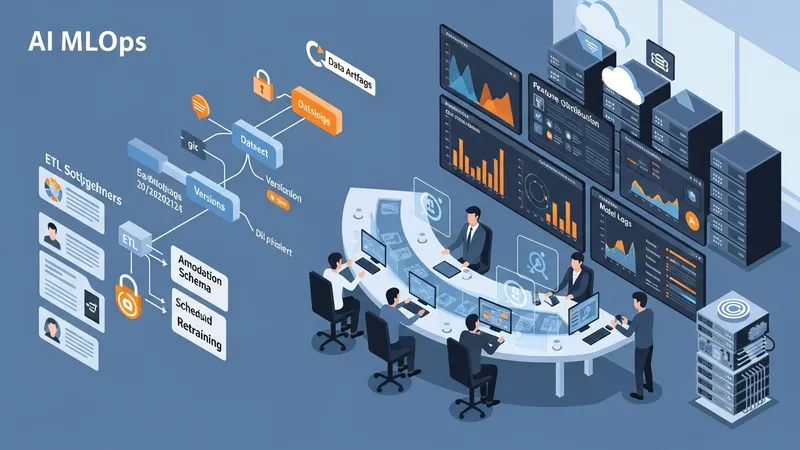
MLOps and deployment patterns address reproducibility and scalability. Versioning of datasets, model artifacts, and deployment configurations supports traceability and rollback when necessary. Automated testing of model performance, integration tests with downstream systems, and scheduled retraining pipelines are commonly used to maintain production readiness. Observability tools that log inputs, predictions, and model health metrics can inform maintenance schedules and incident response.
Risk, fairness, and privacy considerations often shape model design and operational constraints. Privacy-preserving techniques such as differential privacy, data minimization, or secure enclaves may be applied when handling sensitive information. Fairness assessments and bias mitigation steps can help identify disparate impacts, and documenting these analyses supports accountability. Regulatory compliance and sector-specific rules may further inform how models are permitted to operate and what documentation is required.
Long-term sustainability of AI solutions typically requires cross-functional governance, clear performance targets, and iterative evaluation. Stakeholder engagement to define acceptable error rates, interpretability requirements, and escalation paths for anomalous outputs supports alignment with organizational goals. Regular reviews of value delivered, operational costs, and ethical implications may guide decisions on continued investment or modification of deployed systems.